
Research Agenda
Correspondence Theory is developed here as a conceptual theory, but its architecture is designed to support a cumulative research program. The preceding section presented propositions derived from the representation-network ontology, Organizational Correspondence, Cognitive Integrity, and the Correspondence Loop. This section outlines how future research can investigate those propositions without redefining the theory.
Figure 7
Research Program Architecture
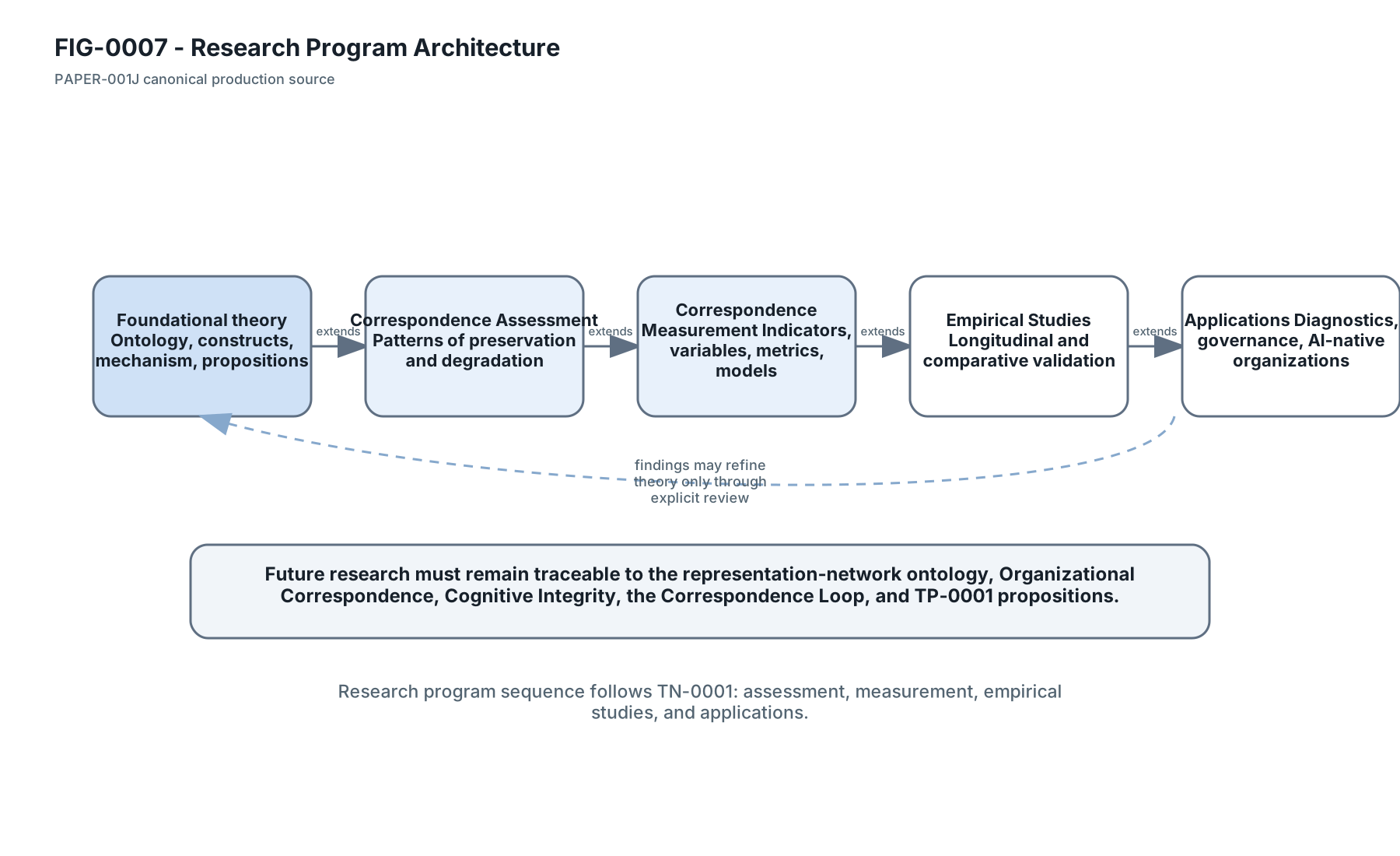
The research program should begin from the distinction between theory and empirical evidence. Theoretical constructs and mechanisms are not directly observed. Researchers observe traces and infer theoretical phenomena. For Correspondence Theory, relevant traces may include representation changes, relationship changes, evaluation records, revision events, contradiction signals, decision traces, governance records, organizational memory updates, and AI reasoning traces. These traces may support inferences about representation-network maintenance, Organizational Correspondence, Cognitive Integrity, and Correspondence Loop activity.
Future diagnostic work should focus on identifying patterns of correspondence preservation and degradation. Such work may examine semantic continuity, causal traceability, representation fragmentation, ambiguity, contradiction, or missing relationships. However, diagnostic frameworks should remain downstream of the theory. They should interpret patterns in the representation network without redefining Organizational Correspondence, Cognitive Integrity, or the Correspondence Loop.
Future measurement work should proceed separately from diagnostics. The research methodology for this program distinguishes observable traces, indicators, variables, metrics, measurement models, validation studies, and empirical evidence. This sequence matters because indicators are not variables, variables are not metrics, and metrics are not theory. Measurement frameworks should define how empirical observations represent theoretical concepts, but they should not alter the canonical definitions.
Table 5 - Future Research Agenda
Table 5
Future Research Agenda
| Research domain | Illustrative research question | Potential unit or level of analysis | Possible empirical setting | Relevant evidence or observable traces | Intended theoretical contribution |
|---|---|---|---|---|---|
| Diagnostic work | What patterns indicate correspondence preservation or degradation in an evolving representation network? | Representation, relationship, network region, organization | Organizations with decision records, policies, plans, memory artifacts, AI-generated outputs, or governance records | Representation changes, relationship changes, contradiction signals, ambiguity signals, missing relationships, fragmentation patterns | Identify patterns of correspondence preservation and degradation without redefining Organizational Correspondence, Cognitive Integrity, or the Correspondence Loop |
| Measurement work | How can observable traces become indicators, variables, metrics, measurement models, and validation studies without becoming theory? | Indicator, variable, metric, construct-measure relationship | Research settings with structured traces and sufficient evidence quality for measurement development | Observable traces, indicators, variables, metrics, measurement-model evidence, validation records | Build measurement frameworks that represent theoretical concepts without altering canonical definitions |
| Empirical validation | Which hypotheses derived from structural, dynamic, organizational, and AI-native propositions receive empirical support? | Hypothesis, proposition category, organization, representation network | Comparative or field studies of organizations with observable representation-network activity | Representation-network maintenance evidence, Correspondence Loop activation traces, revision events, AI-generated representation changes | Test hypotheses derived from the proposition architecture while preserving the distinction between propositions and empirical findings |
| Longitudinal research | How do correspondence conditions persist, degrade, revise, or recover over time? | Representation network over time, network region, organization | Longitudinal organizational records, decision histories, learning histories, AI-mediated work histories | Time-stamped representation changes, relationship revisions, degradation accumulation, recovery events, learning updates | Explain temporal preservation, degradation, revision, and recovery dynamics |
| Comparative organizational research | Why might organizations with similar resources, strategies, or governance exhibit different levels of Cognitive Integrity? | Organization, comparable organizational unit, governance context | Human-only, hybrid, and AI-native organizations with comparable strategies or operating conditions | Differences in representation-network maintenance, governance records, decision traces, memory updates, execution outcomes | Explain variation in Cognitive Integrity through differences in representation-network maintenance |
| AI-native organizational research | Does increased AI-generated representation volume increase maintenance demands and correspondence degradation risk when maintenance capacity does not scale? | AI-native organization, AI-generated representation stream, human-AI representation network | Organizations using AI to generate, summarize, classify, recommend, revise, or act upon representations | AI-generated artifacts, prompts or reasoning traces where available, recommendation records, policy links, outcome links, memory links | Clarify how AI-generated representation change affects Correspondence Loop activation and correspondence degradation risk |
| Intervention-oriented research | Which practices help organizations detect contradiction, preserve causal traceability, revise obsolete representations, or connect learning back to prior decisions? | Intervention, practice, representation-network region, organization | Organizations testing practices for traceability, revision, contradiction detection, or learning integration | Intervention records, revised representations, repaired relationships, evidence notes, authority or governance review records | Study applications of the theory without adding practices to the theory itself |
| Evidence-quality research | How does evidence quality affect the strength of inferences about Organizational Correspondence, Cognitive Integrity, and Correspondence Loop activity? | Evidence source, trace, inference, study design | Settings with explicit, partial, informal, or retrospective records | Time-stamped evidence, traceability quality, completeness of records, retrospective accounts, missing evidence | Separate theoretical inference from the quality of evidence supporting that inference |
Empirical validation should derive hypotheses from the proposition architecture. Structural propositions invite studies of whether representation-network maintenance is associated with Organizational Correspondence and whether degradation accumulates when semantic and causal relationships are not preserved. Dynamic propositions invite studies of Correspondence Loop activation, recovery from degradation, and revision effectiveness. Organizational propositions invite studies of the relationship between Organizational Correspondence and Cognitive Integrity. AI-native propositions invite studies of whether AI-generated representation change increases maintenance demands.
Longitudinal research is especially important. Correspondence Theory concerns preservation, degradation, revision, and recovery over time. Cross-sectional studies may provide useful snapshots, but they are limited for studying whether correspondence conditions are sustained or degraded. Longitudinal designs can examine how representations change, how relationships are revised, whether degradation accumulates, and whether local revision restores coherence in affected regions of the representation network.
Comparative organizational research is also promising. Organizations with similar strategies, resources, or governance structures may differ in Cognitive Integrity because they differ in representation-network maintenance. Comparative studies could examine human-only, hybrid, and AI-native organizations to understand how rates of representation change affect the frequency and burden of Correspondence Loop activity. Such studies should preserve implementation independence by treating tools and systems as possible sources of traces, not as definitions of the theory.
AI-native organizational research is a particularly important domain. AI systems can generate, summarize, classify, recommend, and revise representations at high speed. Future research should investigate whether increased AI-generated representation volume increases correspondence degradation risk when maintenance capacity does not scale. It should also examine whether AI improves organizational cognition only when its outputs remain connected to intent, decisions, policies, outcomes, and organizational memory.
Intervention-oriented research may eventually examine how organizations improve representation-network maintenance. Such work should remain downstream of the conceptual theory. It may investigate practices that help organizations detect contradiction, preserve causal traceability, revise obsolete representations, or connect learning back to prior decisions. However, these practices should be treated as possible applications of the theory rather than additions to the theory itself.
Evidence quality should be reported separately from theoretical findings. Some organizations may provide explicit, time-stamped, traceable evidence linked to relevant representations and relationships. Others may provide partial records, informal documentation, or retrospective accounts. Weak evidence does not invalidate the theory, but it limits the strength of research inference. Future studies should therefore distinguish between the theoretical condition being inferred and the quality of evidence supporting that inference.
This research agenda positions Paper 001 as the conceptual foundation rather than the empirical endpoint. Future work should develop diagnostic frameworks, measurement frameworks, hypothesis sets, empirical study designs, validation studies, longitudinal datasets, and AI-native organizational case studies. Each should remain traceable to the canonical theory and proposition catalog. The objective is cumulative research: extending, testing, refining, and, where necessary, revising Correspondence Theory through disciplined empirical work.
The discussion now turns from research program design to the broader implications of the theory. If the future work described here is to remain cumulative, the manuscript must be clear about what Correspondence Theory contributes, what it does not claim, and how it should be interpreted by organizational scholars and practitioners.