AI-Native Transformation
Adding AI is easy.
Changing how the organization operates is harder.
AI can already analyze information, generate content, prepare recommendations, automate workflows and execute increasingly complex work.
But adding more capable AI does not automatically make the organization itself more intelligent.
AI-Native Transformation redesigns how people, AI, knowledge, authority, decisions, execution, evidence and learning work together.Find your starting point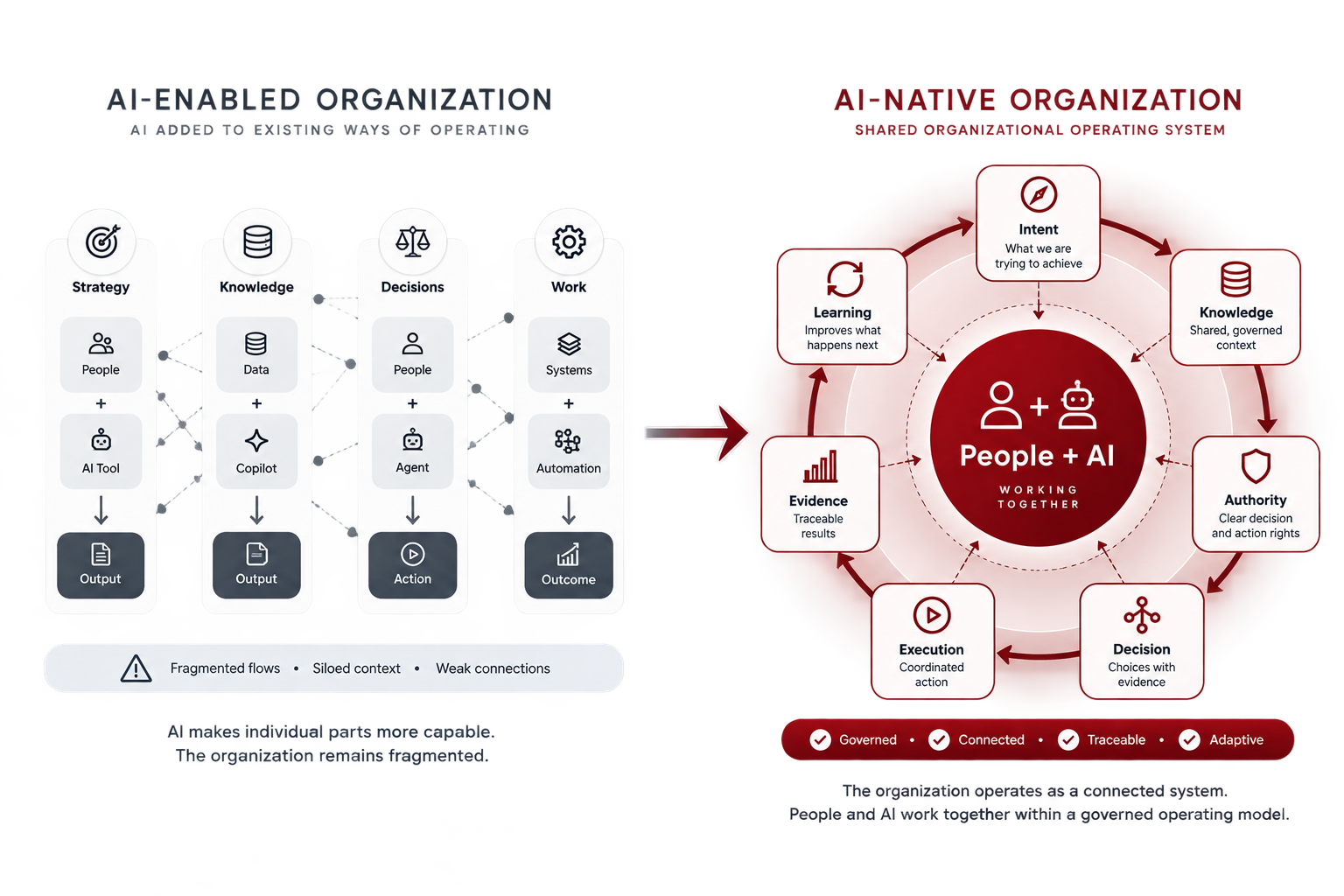
Why AI adoption isn't enough
AI can accelerate the organization.
It can also accelerate fragmentation.
More AI capability creates more of everything—without a changed operating model, coherence breaks down.
More AI capability creates:
More information
More recommendations
More decisions
More automated actions
More evidence
More outcomes
Without a changed operating model:
Context gets lost
Authority becomes unclear
Actions disconnect from intent
Evidence accumulates without learning
Outcomes are hard to connect
Learning does not compound
The organization becomes more capable without becoming more coherent.
What AI-native actually means
Not AI-controlled.
Designed for people and AI to operate together.
- Intent
People and AI understand what the organization is trying to achieve.
- Knowledge
Both operate from governed, connected context.
- Authority
Decision and action rights remain explicit and governable.
- Decisions
Choices remain connected to intent and evidence.
- Execution
Actions remain traceable to what authorized them.
- Evidence
Outcomes return as evidence.
- Learning
Evidence changes what happens next.
The goal is not maximum automation.
It is to increase what people and AI can accomplish together while preserving the organization's ability to understand and govern its own operation.
What actually changes
You don't replace the organization.
You progressively rewire how it operates.
From
Fragmented intent
Siloed knowledge
Implicit authority
Disconnected decisions
Tool-centric automation
Scattered evidence
Temporary learning
Toward
Explicit intent
Connected knowledge
Governed authority
Traceable decisions
Coordinated human + AI execution
Connected evidence
Continuous learning
How to begin
Different organizations need
different starting points.
- 01
Understand
AI Readiness AssessmentAssess readiness, operating constraints, governance, risks and priorities.
Explore the assessment - 02
Align
Executive Strategy WorkshopClarify the operating ambition, decision context and transformation path.
Explore the workshop - 03
Build
AI-Native Operating System SprintEstablish a working foundation for AI-native organizational operation in 30 days.
Explore the sprint - 04
Improve
Continuous OptimizationStrengthen correspondence, AI performance, workflows and outcomes.
Explore optimization - 05
Scale
Enterprise TransformationExtend the operating model across functions, business units and portfolios.
Explore enterprise transformation
The destination
The destination is an
AI-native operating system.
Explore the Organizational Operating System - Intent
- Knowledge
- Authority
- Decisions
- Execution
- Evidence
- Learning
People • AI • Systems • Data • Integrations