Introduction
Organizations increasingly think, decide, remember, and adapt through representations (March and Simon, 1958; Hutchins, 1995; Walsh and Ungson, 1991; Alavi and Leidner, 2001). Strategies, policies, decisions, plans, execution records, outcome measures, digital twins, governance logs, knowledge repositories, and AI-generated artifacts are not merely documentation. They are the media through which organizational cognition becomes persistent, shareable, actionable, and revisable.
This representational condition becomes more consequential in AI-native organizations (Bharadwaj et al., 2013; Faraj et al., 2018; Kellogg et al., 2020; Raisch and Krakowski, 2021). In this paper, an AI-native organization is an organization in which AI agents participate materially in organizational cognition by generating, modifying, interpreting, relating, recommending, or acting upon organizational representations. This definition does not require full autonomy or the absence of human actors. It means that AI is no longer only an analytical tool used after organizational cognition has occurred; AI becomes a participant in the production and maintenance of represented organizational cognition.
The theoretical problem is therefore not only that organizations must process more information or coordinate more interdependent work. The deeper problem is that relationships among representations must be preserved as both human and AI actors create and revise them. Strategic intent may be clearly represented, but AI-generated execution plans may reinterpret that intent. Decision logs may exist, but their connection to evidence, authority, and outcomes may weaken. Organizational memory may expand, but lessons may remain disconnected from future decisions. Digital twins may model operational conditions, but fail to connect to strategic intent, decision rationale, and learning.
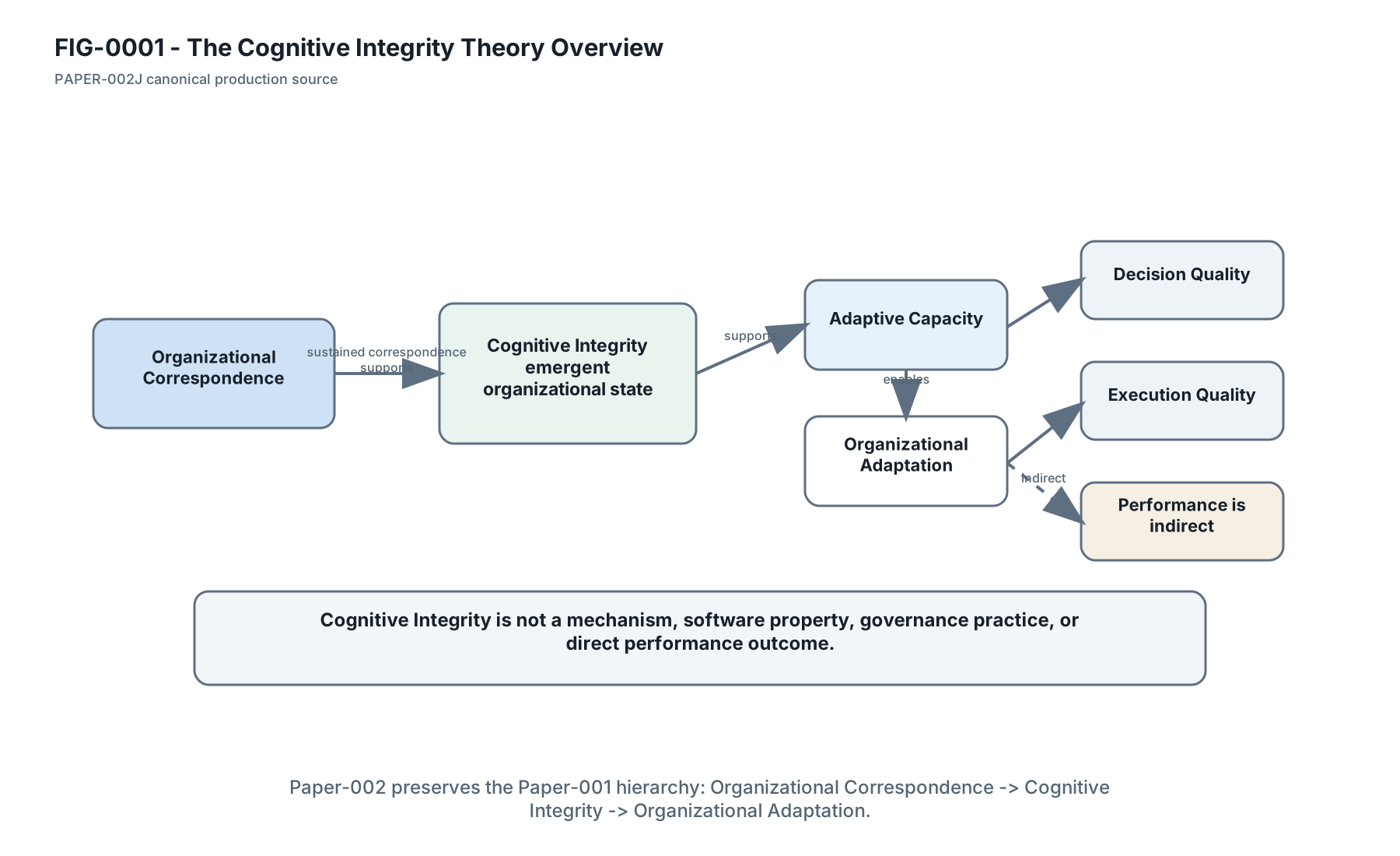
This paper introduces Cognitive Integrity as a construct for explaining this problem. Cognitive Integrity is the emergent organizational state associated with sustained Organizational Correspondence. Organizational Correspondence preserves meaningful semantic and causal relationships among organizational representations. Cognitive Integrity names the state of coherent, consistent, and traceable organizational cognition that becomes possible when correspondence is sustained across human and AI actors over time.
The paper preserves the theoretical hierarchy:
Organizational Correspondence -> Cognitive Integrity -> Organizational Adaptation.
This hierarchy is not a workflow. Organizational Correspondence is the underlying correspondence condition. Cognitive Integrity is the emergent organizational state associated with sustained correspondence. Organizational Adaptation is a downstream capability supported when organizations can respond to change without losing coherence among intent, decisions, execution, outcomes, and learning.
The paper makes four contributions. First, it defines Cognitive Integrity as a distinct construct for studying AI-mediated organizational cognition. Second, it differentiates Cognitive Integrity from alignment, coordination, knowledge integration, organizational memory, learning, dynamic capabilities, and resilience. Third, it develops a conceptual model linking Organizational Correspondence, Cognitive Integrity, preservation mechanisms, failure modes, and adaptation. Fourth, it advances propositions, a nomological network, and a preliminary measurement agenda for future empirical research.
Figure 1
The Cognitive Integrity Theory Overview