
Constitutional Organizational Architecture
Constitutional Organizational Architecture is the focal construct of this paper. It is defined as a higher-order, formative and configurational architectural construct explaining how constitutional clarity, authority architecture, actor and role architecture, representation architecture, governance observability, adaptation architecture, constitutional evolution architecture, and resilience and repair architecture operate as a complementary system.
The construct is higher-order because it is composed of interdependent dimensions. It is formative because the dimensions jointly constitute the architecture rather than reflecting a single latent trait. It is configurational because no single element is expected to substitute fully for the others. Authority clarity without representation quality may create formal legitimacy without observability. Autonomy without accountable delegation may create speed without answerability. Governance observability without amendment pathways may reveal drift without enabling repair.
Table 2 clarifies the construct hierarchy used in the remainder of the paper.
| Theoretical role | Elements in this paper |
|---|---|
| Focal construct | Constitutional Organizational Architecture |
| Core dimensions | Constitutional foundation; actor and authority architecture; organizational configuration; runtime and representation; learning and adaptation; constitutional evolution and resilience |
| Mechanisms | Authority-legitimacy; delegation-accountability; constraint-enabled autonomy; correspondence-observability; topology-adaptation; continuity-adaptation; representation-learning; meaningful-human-governance safeguard; resilience-repair |
| Proximal outcomes | Legitimacy, accountability, governance observability, bounded autonomy, constitutional compliance, learning |
| Distal outcomes | Organizational coherence, adaptive capacity, constitutional resilience |
| Boundary conditions | Agent autonomy, agent density, decision impact, reversibility, representation quality, governance competence, regulation, volatility |
| Failure modes | Rigidity, drift, capture, paralysis, false assurance, accountability diffusion, uncontrolled agent cascades |
Figure 2
Constitutional Organizational Architecture
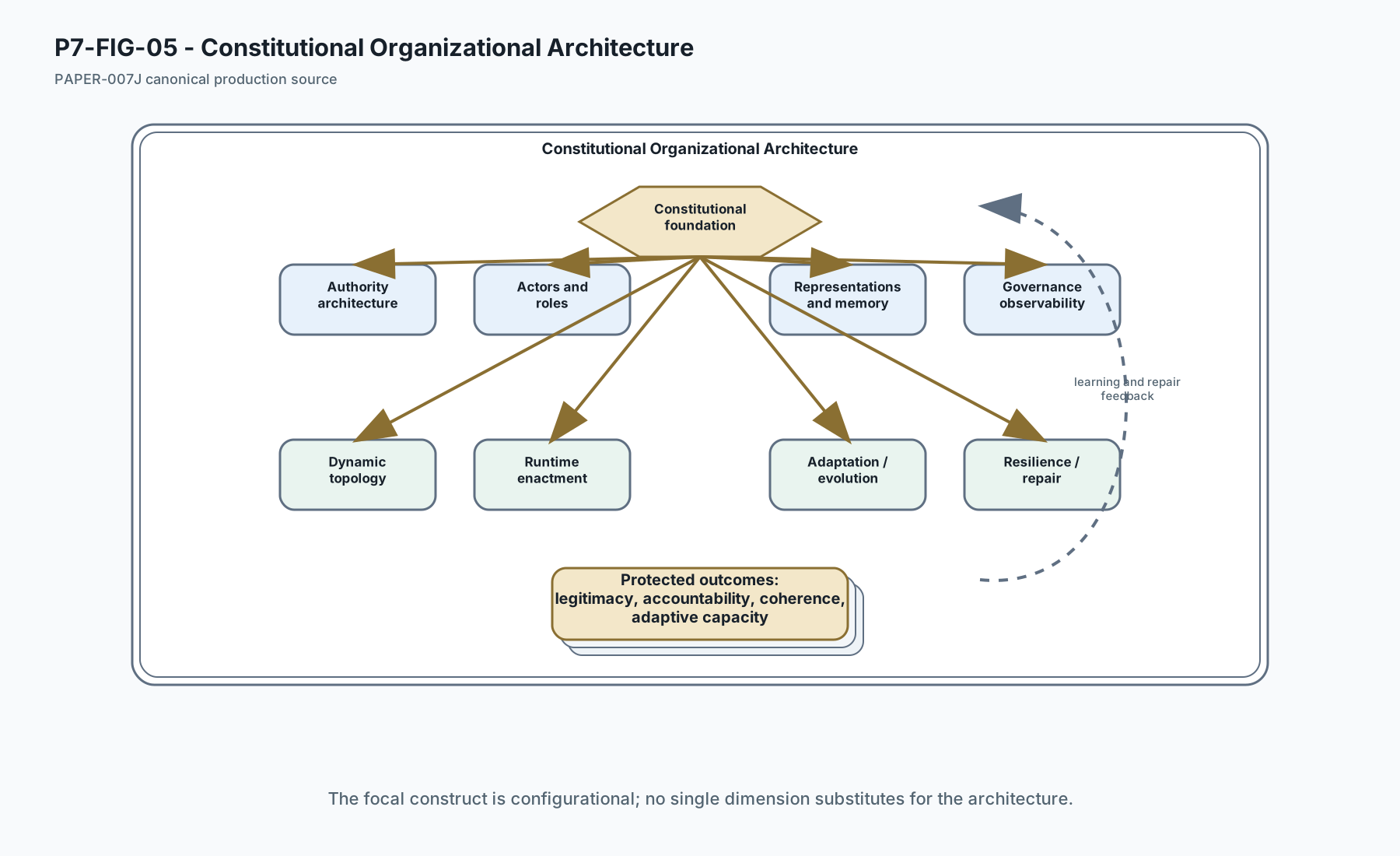
The constitutional foundation specifies organizational purpose, identity, principles, provisions, authority limits, amendment conditions, and continuity commitments. It defines what should remain stable enough for actors to trust the organization as the organization changes.
The actor and authority architecture defines membership, actor types, roles, jurisdictions, decision rights, delegation paths, accountability anchors, revocation mechanisms, escalation paths, and contestability. This domain is central because AI-native organizing increases the gap between what systems can technically do and what they are organizationally authorized to do.
The organizational configuration domain defines structures, capabilities, interfaces, modular relationships, topology, and operating-model relationships (Barney, 1991; Wernerfelt, 1984; Grant, 1996; Cohen and Levinthal, 1990; Nonaka, 1994). It explains how work can be recomposed without losing authority boundaries or accountability relationships.
The runtime and representation domain captures decisions, actions, workflows, evidence, organizational memory, and the representational relationships that make action traceable. Runtime action is where the constitution is enacted, tested, and sometimes strained.
The learning and adaptation domain includes sensing, evaluation, learning, reconfiguration, experimentation, rollback, and institutionalization. It allows organizations to change while keeping change classified and governed.
The constitutional evolution and resilience domain defines amendment, transition, assurance, failure detection, containment, remedy, historical preservation, learning, and repair. It recognizes that constitutional architecture cannot prevent all failure. Instead, it should make failures detectable, containable, contestable, and repairable.
Recursive and federated application allows enterprise constitutions, local charters, delegated jurisdictions, inherited constraints, local autonomy, federal precedence, and dispute resolution to operate across teams, units, platforms, partnerships, and ecosystems. This does not imply that every ecosystem has a single sovereign authority. It means constitutional architecture can specify how local autonomy and enterprise coherence are related.
5.1 Authority Architecture in Mixed Human-AI Action
Authority is the most important distinction in the theory because AI-native organizations can easily confuse capacity, permission, and legitimacy. A model may be capable of producing a recommendation. A system may have permission to update a workflow. An AI agent may be delegated a narrow action scope. None of these facts establishes that the agent is an authority source.
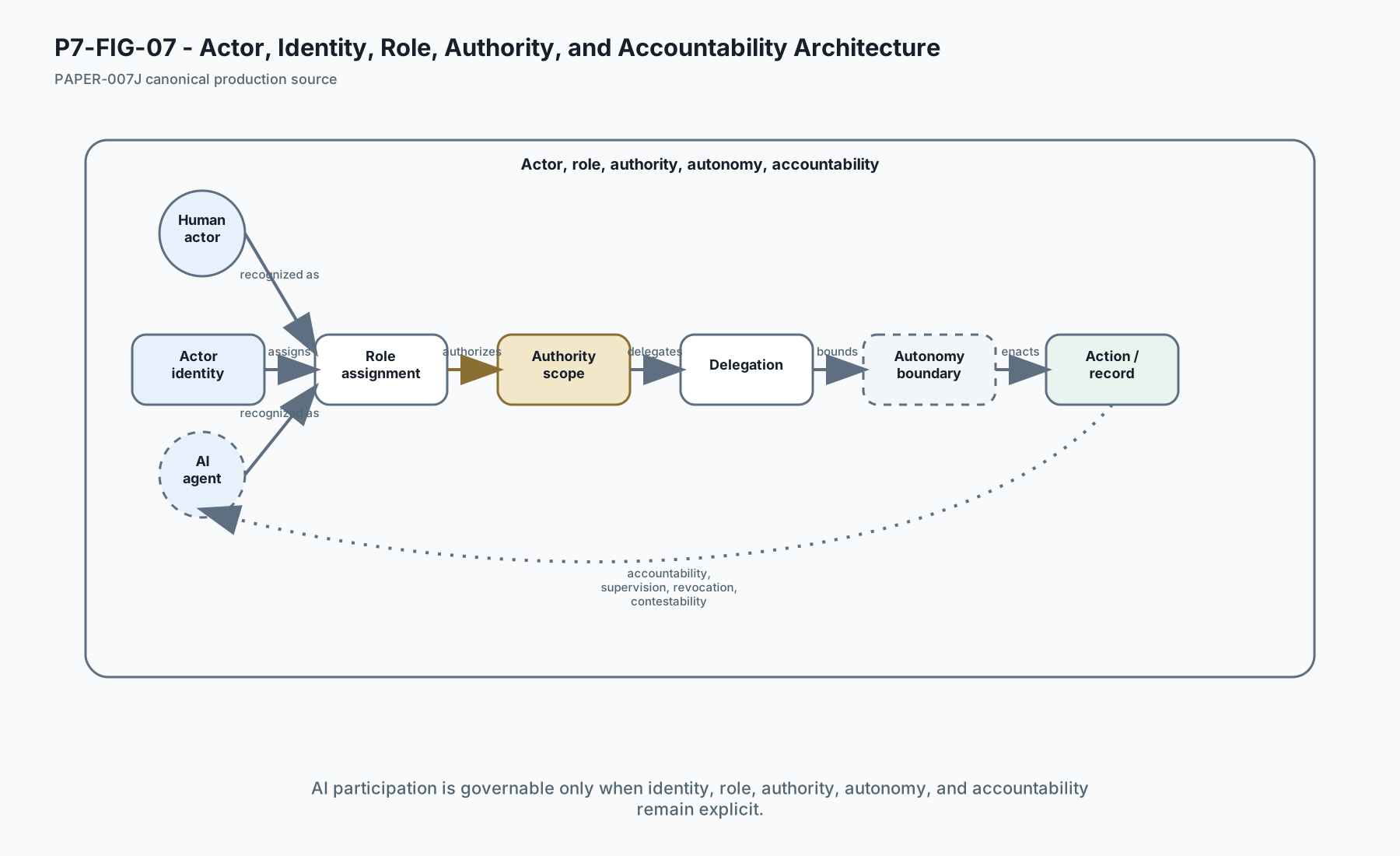
Authority provenance refers to the traceability of decisions and actions to constitutional sources, jurisdictions, roles, delegations, and accountability anchors. In mixed human-AI organizing, authority provenance should indicate who or what acted, under which role, within which jurisdiction, by which delegation, under which constraints, and with which retained accountability. Delegated AI action remains attributable through organizational authority chains. This is why revocation, escalation, and contestability are not optional control details; they are conditions for legitimate bounded autonomy.
Figure 3
Actor, Identity, Role, Authority, and Accountability Architecture
5.2 Human-AI Organizational Participation
AI-native organizations can involve several participation forms: human-only roles, AI-assisted roles, delegated AI execution, supervised AI roles, hybrid roles, and agent collectives. These forms should not be treated as a maturity ladder toward maximum autonomy. The appropriate form depends on task risk, decision impact, reversibility, representation quality, technical reliability, organizational maturity, and governance competence.
Human-AI role differentiation requires specifying which tasks require human judgment, which tasks may be AI-assisted, which may be delegated to AI agents, which require supervision, and which require escalation. Meaningful human governance becomes especially important when action is high impact, ambiguous, contested, or difficult to reverse. It requires not only a human in the loop, but also evidence access, interpretive capacity, authority to intervene, and a practicable path for contesting or amending action.
5.3 Representation, Correspondence, and Observability
Constitutional governance requires organizational action to be representable and traceable. Authority, decisions, delegations, evidence, outcomes, and learning must be represented well enough for governance to observe whether action corresponds with constitutional commitments. Representational correspondence does not mean that representations are complete or perfectly true. Representations are always partial and interpretive. The issue is whether meaningful relationships among purpose, authority, decisions, execution, outcomes, and learning are preserved well enough for actors to understand and govern organizational action.
Governance observability differs from data volume, transparency, explainability, and auditability. Transparency may reveal that a system acted. Explainability may describe why a model produced an output. Auditability may preserve a record. Governance observability asks a different organizational question: whether actors can interpret whether action was authorized, attributable, accountable, and consistent with constitutional commitments. An organization may collect extensive logs without understanding whether delegated action was authorized, whether evidence supports a decision, whether outcomes correspond to intent, or whether learning has changed the conditions for future action. Observability therefore depends on the quality, provenance, temporal validity, and interpretability of organizational representations.
5.4 Adaptation and Constitutional Evolution
AI-native organizations need adaptation, but not every change is the same. Operational adjustment, workflow reconfiguration, policy change, role change, structural change, topology change, architecture change, constitutional amendment, and constitutional evolution differ in authority requirements and continuity implications.
Figure 4
Adaptation versus Constitutional Evolution
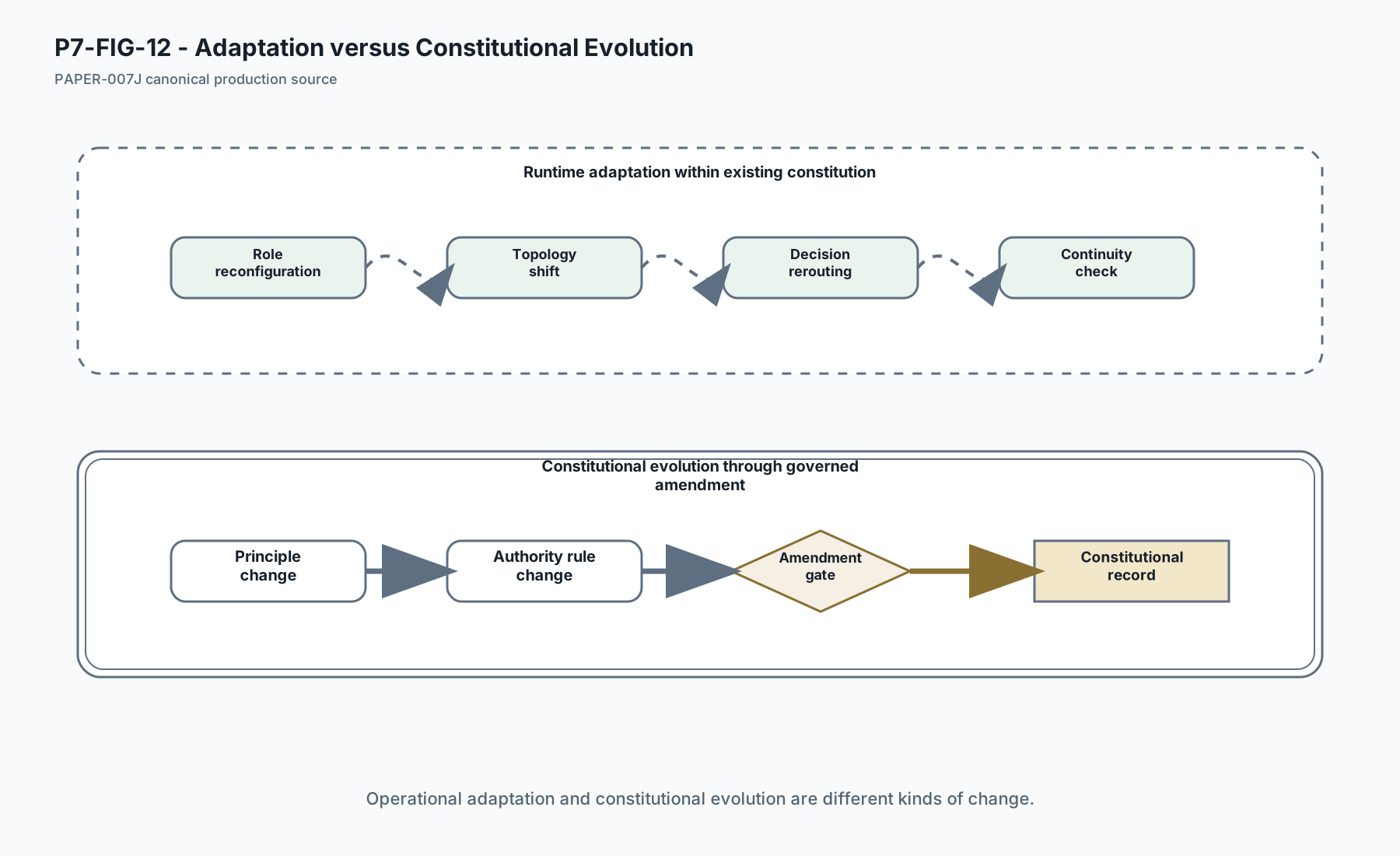
Runtime adaptation may occur through delegated authority when changes remain within existing constitutional limits. Constitutional evolution is required when change alters the organization's principles, authority basis, jurisdictions, rights, accountability structure, or amendment rules. Learning may reveal the need for constitutional evolution, but learning should not silently rewrite constitutional commitments. This distinction allows organizations to adapt quickly without erasing the commitments that make adaptation legitimate.
The same distinction applies to repair. A runtime failure may require containment or rollback within existing authority. A constitutional failure may require interpretation, contestation, amendment, and historical preservation. Repair is therefore a feedback process rather than a single corrective act: detection identifies possible drift; interpretation determines whether the issue is operational or constitutional; containment limits harm; remedy restores accountable action; learning updates future practice; and constitutional review determines whether deeper provisions require amendment.