Limits of Existing Organizational Models
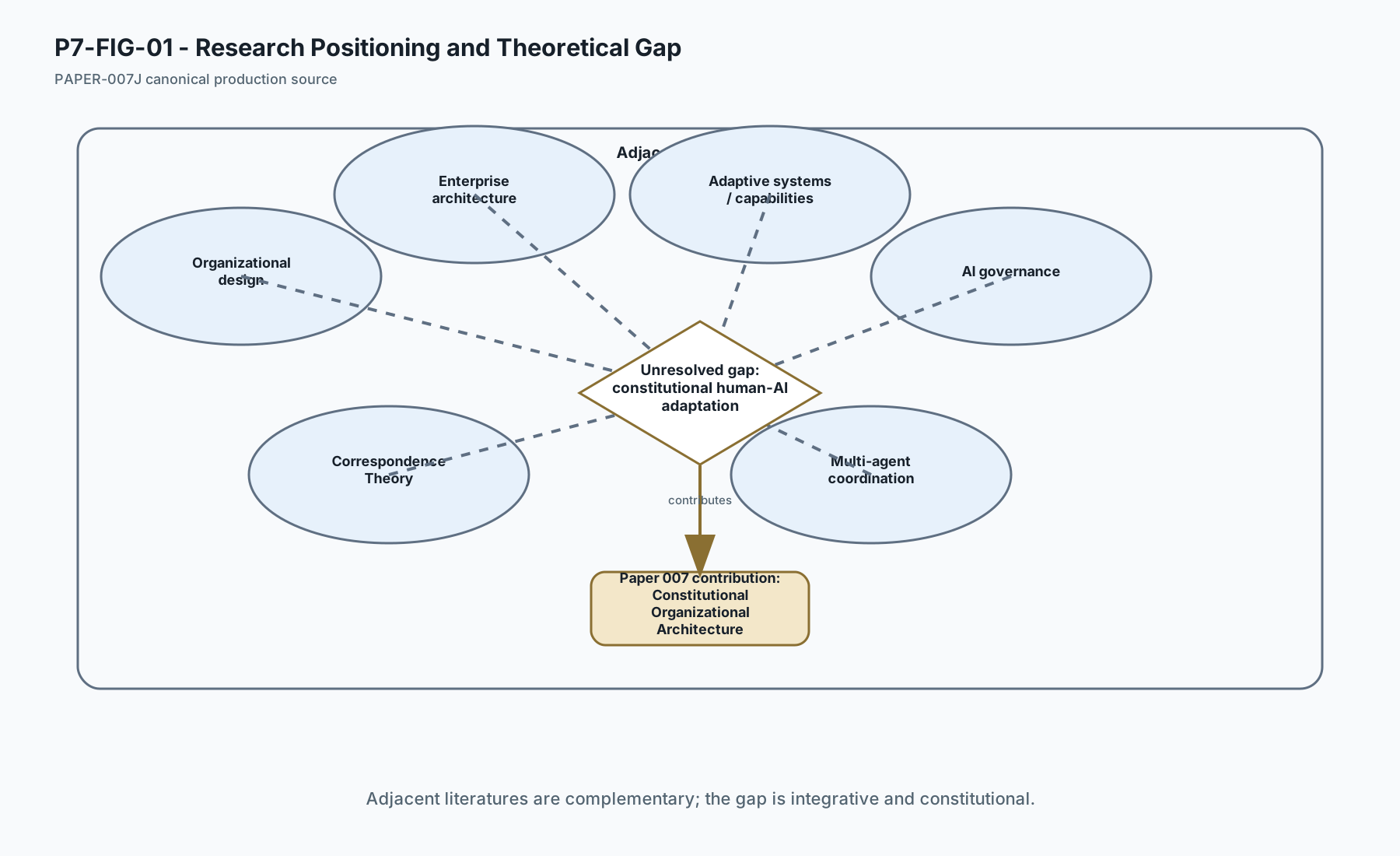
The argument does not require rejecting existing organizing paradigms. Each contributes something important. The gap is that none provides a complete account of constitutionally governed human-AI organizational adaptation.
Hierarchy contributes clear authority lines, accountability paths, and escalation. It is especially useful when decisions are high impact, irreversible, or institutionally sensitive. Its limitation is that it can assume authority is attached to human office holders and that coordination flows through stable reporting lines. AI-native work often involves distributed action across roles, agents, platforms, and temporary configurations that cannot be governed by reporting lines alone.
Matrix and network forms address cross-functional interdependence and distributed expertise. They help explain how organizations coordinate across multiple dimensions. Yet they can obscure authority provenance and accountability when many actors participate. Adding AI agents to already ambiguous matrix or network arrangements can deepen attribution problems unless delegation, jurisdiction, and revocation are explicitly constituted.
Platform organizations support modular participation and ecosystem coordination (Gawer, 2014; Parker et al., 2016). They are valuable for understanding interfaces, participation rules, and scalable interaction. Their limitation is that platform rules do not necessarily define enterprise authority, legitimacy, or constitutional evolution. A platform may orchestrate action without explaining which organizational commitments authorize that action.
Agile and self-management models emphasize local autonomy, experimentation, and adaptive work (Laloux, 2014; Robertson, 2015). These models contribute practical insights about decentralized decision-making. However, they may depend on cultural, leadership, or human judgment assumptions that do not transfer directly to AI agents. Local autonomy becomes risky when computational actors can execute quickly across organizational boundaries without explicit authority limits.
Viable-system, cybernetic, and complex adaptive models explain feedback, recursion, variety, and self-organization. They contribute a strong language for adaptive systems. Yet they can under-specify the institutional legitimacy of delegated action and the distinction between ordinary adaptation and changes to the constitutive rules of adaptation.
Enterprise architecture and operating models explain how business, information, process, application, and technology domains fit together. They are necessary for implementation and alignment, but they do not alone define the legitimacy of mixed human-AI organizational action. Treating Constitutional Organizational Architecture as a software architecture or enterprise architecture layer would miss the theoretical problem. The focal issue is not only how systems are connected, but how organizational agency, authority, accountability, and adaptation are constituted.
AI governance frameworks identify important principles and controls. They support risk management, accountability, transparency, and human oversight. However, they often begin after the organization has already defined its roles, authority structures, and operating model. In AI-native organizations, those organizational foundations themselves become the governance problem.
Multi-agent systems and electronic institutions offer formal ways to specify agents, protocols, roles, norms, and sanctions. They are highly relevant, but their formalisms require organizational embedding. An agent protocol is not the same as organizational legitimacy, and technical permissions are not the same as decision rights.
The unresolved gap is therefore integrative and constitutional. Existing models explain coordination, adaptation, technology, governance, or agency in part. What remains underdeveloped is an organizational theory explaining how mixed human-AI actors exercise distributed agency under legitimate, accountable, observable, adaptable, and evolvable constitutional arrangements.
Figure 1
Research Positioning and Theoretical Gap