
Executive Work and the Evolution of Enterprise Interaction
The history of executive support technologies is best understood as a layered lineage rather than a simple replacement sequence. Early management information systems and decision-support systems established that managerial and executive work requires information and modeling support suited to decision structure, organizational level, and task uncertainty. Executive information systems and executive support systems then focused attention on critical success factors, exception reporting, and online access for senior leaders. Business intelligence and dashboard systems further stabilized the organizational language of measures, trends, visualization, performance monitoring, and periodic review. Each tradition remains relevant to executive operation.
This lineage changed what executives could see, but it did not remove the interpretive nature of executive work. Information availability does not guarantee organizational understanding. Status visibility does not equal situation awareness. A dashboard may display that an indicator changed without explaining whether the change matters for current intent, whether the underlying representation remains fresh, whether there is conflicting evidence, who has authority to act, what prior commitments are implicated, or what follow-up should become organizational memory. These are not deficiencies of dashboards as such. They mark the boundary between information access and organizational operation.
Figure 1 summarizes this evolution. It places executive information access, decision support, business intelligence, dashboards, assistants, and EOE in a lineage in which later forms inherit earlier functions while adding new integration demands.
<a id="fig-1"></a>
Figure 1
From Executive Information Access to Executive Operating Experience
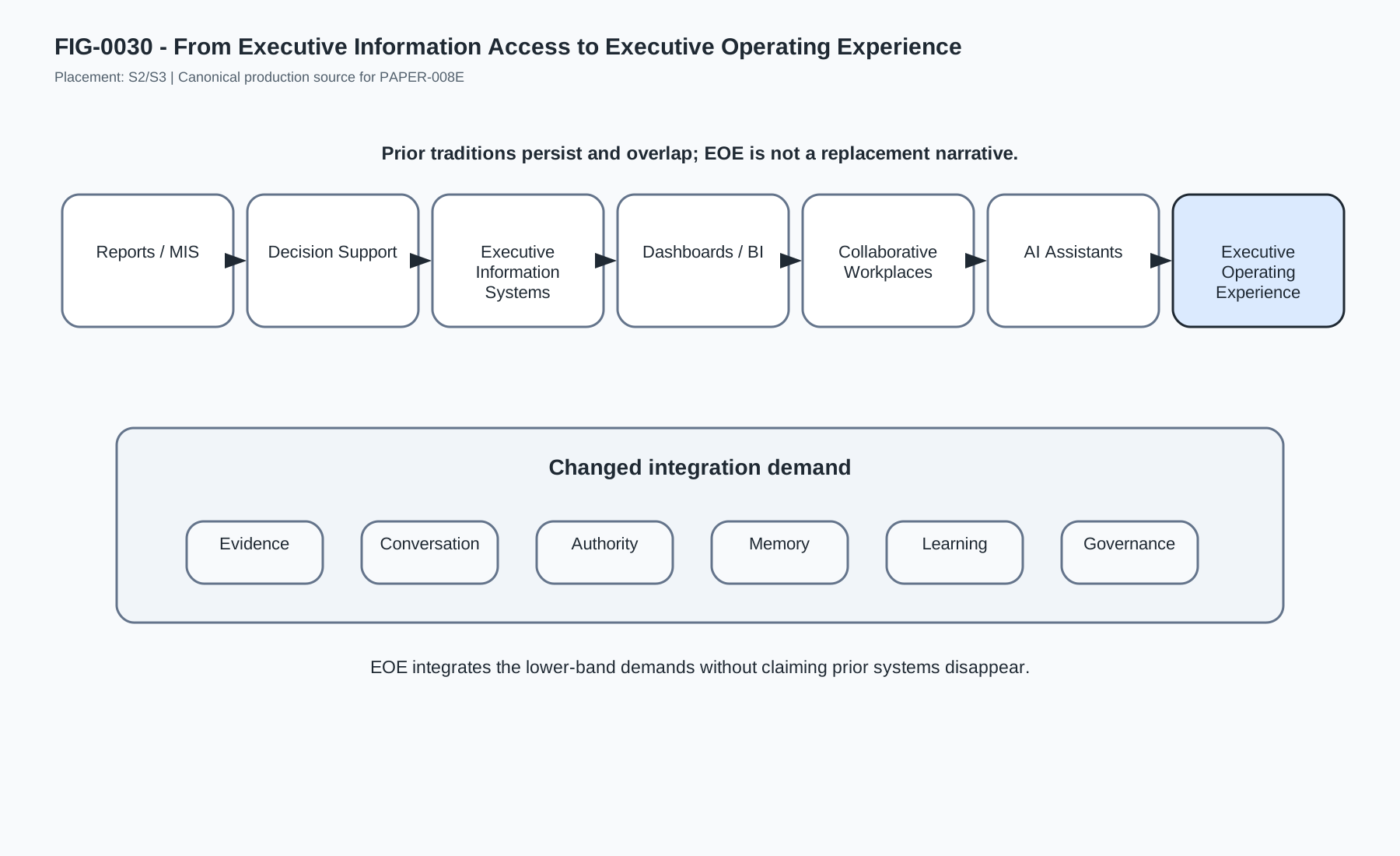
Long description: see `figures/FIG-0030/accessibility.md`.
Table 1, Adjacent System Comparison, should be read with the same logic. Its purpose is not to diminish existing systems, but to clarify what each explains and what remains outside its ordinary unit of analysis.
<a id="table-1"></a>
Table 1. Adjacent System Comparison
| Adjacent system | Primary contribution inherited | What it does not fully explain | EOE distinction | Source families |
|---|---|---|---|---|
| Executive information systems | Executive access to critical information. | Guided conversation, authority, memory, and governed AI participation. | EOE treats the briefing as an operating episode rather than a reporting surface. | Rockart et al.; Rockart and Treacy. |
| Decision support systems | Structured support for choices and alternatives. | Organizational continuity, authority provenance, and cross-episode learning. | EOE embeds decision support inside governed organizational operation. | Gorry and Scott Morton; Simon. |
| BI dashboards | Aggregated metrics and monitoring. | Evidence disclosure, uncertainty, dissent, and authorization boundaries. | EOE prioritizes correspondence and governed interpretation over metric display. | EIS/DSS lineage; correspondence theory. |
| Human-AI interaction systems | Explanation, reliance calibration, and interaction guidelines. | Organizational decision rights and operating memory. | EOE locates HAI inside organizational governance. | Amershi et al.; Lee and See; Miller; NIST. |
| CSCW and grounding systems | Shared objects, articulation, repair, and common ground. | Executive authority and organizational learning across episodes. | EOE combines grounded conversation with authority and memory. | Clark and Brennan; Schmidt and Bannon; Suchman. |
| Organizational memory systems | Retention of knowledge, routines, and transactive memory. | Real-time executive attention and decision authorization. | EOE makes memory an operating condition for future briefings. | Walsh and Ungson; Wegner. |
| Governance and accountability systems | Rights, accountability, audit, and oversight. | How those boundaries are experienced conversationally. | EOE makes governance visible during briefing transitions. | Fama and Jensen; Bovens; Kroll et al.; Raji et al. |
Note. EOE = Executive Operating Experience; BI = business intelligence; CSCW = computer-supported cooperative work; HAI = human-AI interaction.
The key shift is from exposing organizational information to supporting a governed operating episode. Executive work involves allocating scarce attention, forming and revising agendas, interpreting ambiguous organizational signals, coordinating across roles, authorizing action, delegating responsibility, monitoring change, and learning from outcomes. A system that supports executive operation must therefore account not only for what is shown, but for how represented organizational reality becomes judgment, decision, authorized action, and memory. This is the point at which enterprise interaction becomes a research problem of organizational cognition and governance.
This distinction also explains why the paper uses the term experience with care. Experience does not refer here to aesthetic preference or interface polish. It refers to the structured condition through which an executive can orient to organizational reality and act within it. An executive operating experience includes representational form, conversational acts, evidence availability, authority visibility, temporal continuity, and the consequences of action. It is therefore broader than usability and narrower than total organizational life. This middle level is analytically useful because many failures of executive technology occur precisely between information display and organizational action: the executive sees something, interprets it, asks questions, accepts or rejects a recommendation, authorizes work, and expects the organization to remember what happened.