
Organizational Wisdom
"Knowledge tells an organization what it knows. Wisdom shapes what it becomes."
Beyond Learning
Few ideas have influenced modern management as profoundly as organizational learning. Organizations conduct retrospectives, capture lessons learned, measure performance, analyze customer feedback, benchmark competitors, train employees, build knowledge repositories, and deploy artificial intelligence to discover patterns hidden within vast amounts of information. Learning has become one of the defining ambitions of modern organizations. Yet learning alone cannot explain why some organizations seem to become better with age while others simply become older. Some accumulate extraordinary amounts of knowledge while repeating remarkably similar mistakes. Others learn rapidly but struggle to transform that learning into lasting capability. Information grows. Experience accumulates. Reports multiply. Artificial intelligence continuously generates new insights. The organization appears increasingly knowledgeable, yet its judgment changes remarkably little. Something essential is still missing: wisdom.
Knowledge Is Not Wisdom
Knowledge answers questions. Wisdom changes how questions are asked. An organization may know everything about its customers while misunderstanding its purpose. It may understand every operational metric while overlooking a profound strategic shift. It may possess extraordinary analytical capability while repeatedly making short-term decisions that weaken its long-term future. Knowledge explains; wisdom interprets. Knowledge accumulates; wisdom integrates. Knowledge can be stored; wisdom must emerge. Knowledge remembers the past; wisdom guides the future. To understand this distinction, it helps to view wisdom not as another organizational capability, but as the long-term consequence of sustained correspondence.
Organizational Wisdom is the emergent capability that develops when sustained stewardship preserves Correspondence and Cognitive Integrity across time. Wisdom enables organizations not merely to know more, but to exercise increasingly sound judgment while continuously adapting.
Wisdom Is an Emergent Capability
Organizations cannot declare themselves wise, purchase wisdom, automate it, install it through software, or introduce it through restructuring. Wisdom emerges. It emerges when meaningful relationships remain coherent across years of organizational experience. Every preserved lesson strengthens judgment. Every successful adaptation deepens understanding. Every strategic decision interpreted within its broader context enriches future capability. Wisdom is therefore not another organizational process. It is an emergent property of sustained correspondence. Organizations become wiser because their understanding becomes increasingly coherent over time.
The Difference Between Experience and Learning
Experience alone teaches remarkably little. Every organization accumulates experience. Not every organization learns from it. Imagine two organizations facing the same unexpected market disruption. Both investigate what happened. Both document their findings. Both redesign their processes. A year later, one organization responds confidently to similar challenges. The other repeats remarkably similar mistakes under slightly different circumstances. The difference is not experience. Both organizations experienced the same events. The difference lies in whether those experiences became meaningfully connected to future organizational judgment. Learning changes understanding. Wisdom changes future decisions.
Wisdom Compounds Across Generations
One of the most remarkable characteristics of enduring organizations is their ability to preserve judgment across generations. Founders leave, executives retire, technologies become obsolete, markets evolve, and strategies change. Yet certain organizations continue making decisions that remain recognizably aligned with their enduring purpose. Their wisdom does not reside inside individual people. It resides within the continuity of the Representation Network. Each generation inherits more than documents. It inherits relationships, context, judgment, and meaning. The organization remembers not merely what happened. It remembers how to think. That is the beginning of organizational wisdom.
AI and Organizational Wisdom
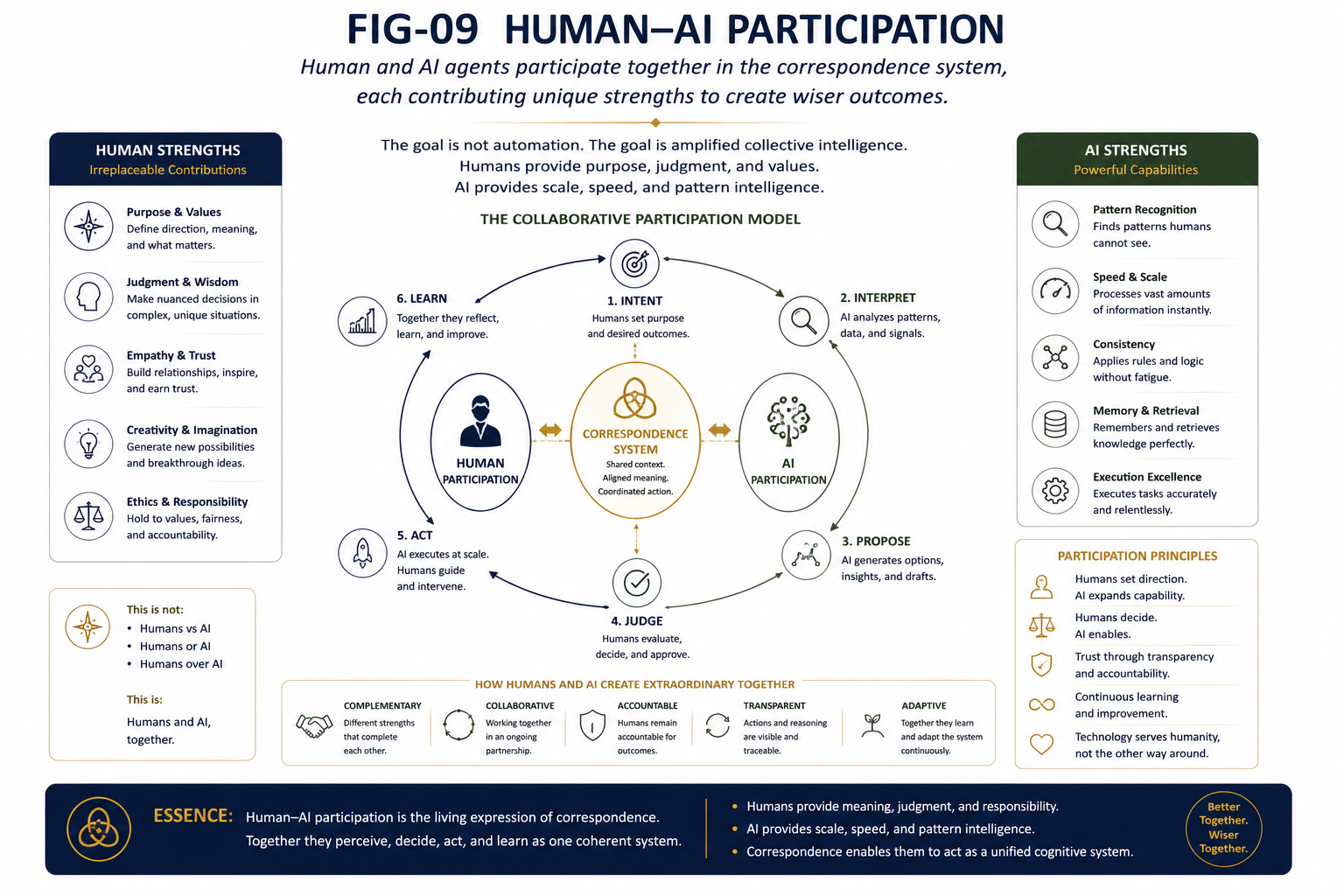
Artificial intelligence dramatically expands organizational learning. It discovers patterns, recognizes anomalies, summarizes history, generates scenarios, and supports complex reasoning. These capabilities strengthen organizational knowledge. They do not automatically create wisdom. Artificial intelligence excels at discovering relationships. Organizations must still determine which relationships deserve preservation. AI proposes; organizations judge. AI accelerates learning; organizations cultivate wisdom. The future belongs not to organizations possessing the most powerful artificial intelligence. It belongs to organizations capable of integrating artificial intelligence into an enduring system of organizational judgment.
Wisdom Creates Resilience
Organizations possessing deep wisdom respond differently to uncertainty. They rarely panic. Nor do they become rigid. Instead, they recognize enduring principles beneath changing circumstances. Purpose provides direction. Correspondence preserves meaning. Cognitive Integrity maintains coherence. Stewardship protects continuity. Wisdom allows adaptation without losing identity. These organizations change continuously, yet remain recognizably themselves. That is resilience in its deepest sense: not resistance to change, but the capacity to evolve without fragmentation.
Wisdom Is Never Finished
Organizational Wisdom is not a destination. Every acquisition reshapes it. Every strategic decision influences it. Every technological breakthrough challenges it. Every AI-generated representation contributes to it. Wisdom therefore remains unfinished. Organizations continually deepen—or weaken—their collective judgment. Every preserved relationship strengthens future capability. Every disconnected relationship diminishes it. Wisdom is not accumulated once. It is cultivated continuously. Like correspondence itself, it is renewed through every meaningful organizational choice.
Seeing the Whole
Throughout this book we have gradually assembled a different understanding of organizations. Organizations create representations. Representations form networks. Correspondence preserves meaningful relationships. Sustained correspondence gives rise to Cognitive Integrity. Stewardship protects that integrity. Organizational Wisdom emerges over time. None of these ideas stands alone. Each exists because of the others. Together they describe an organization capable of preserving meaning while continuously changing. The next chapter brings these ideas together for the first time, not as separate concepts but as a single integrated model: the Correspondence Organization.