
The Leadership Bottleneck
When execution was slow, leadership could hide inside supervision. Managers reviewed progress, cleared obstacles, assigned responsibility, and kept work moving. Those activities mattered because human execution was scarce. As AI increases execution capacity, a different scarcity appears. The organization can do more than leaders can wisely direct. The bottleneck moves upward, from the speed of work to the quality of intent. That is the leadership problem in its new form. Oversight still matters, but the larger responsibility moves toward intent, judgment, ethics, and direction. For generations, organizations were designed around a simple assumption.
The primary challenge was execution: leaders made decisions, managers coordinated work, teams performed tasks, information moved upward, and instructions moved downward. The operating system reflected this reality.
Leadership became closely associated with directing execution: approving work, resolving exceptions, monitoring progress, and making operational decisions. The more complex the organization became, the more leadership attention focused on coordination. For decades, this made perfect sense. Human execution was the limiting factor. Artificial intelligence changes that assumption. Execution increasingly becomes continuous. Information flows automatically. Analysis happens instantly. Coordination increasingly occurs across intelligent systems rather than through layers of management. Execution becomes less scarce. Leadership attention becomes more scarce. This creates a new organizational bottleneck. The same pattern appears in emerging work on human-agent teams.
Surveys and workplace signals suggest that leaders are often ahead of employees in familiarity with agents, expectations for agent management, and belief that AI will reshape workflows. That gap is itself a leadership problem. The question is not only whether agents can perform work. It is whether leaders can define enough intent, oversight, training, and trust for people and agents to work coherently together. The constraint is not technology or execution alone. It is leadership itself. The challenge is no longer whether work can be completed. The challenge is whether the organization has sufficient clarity about what work should be completed. This represents one of the largest shifts in the history of management.
For more than a century, leadership created value by directing execution. Increasingly, leadership creates value by defining intent. Intent establishes purpose, direction, priorities, constraints, trade-offs, and desired outcomes. Intelligent systems increasingly participate in execution. Purpose remains fundamentally human. The role of leadership changes with it.
Leaders spend less time approving individual decisions and more time defining strategic direction. They spend less time coordinating daily activity and more time creating organizational clarity. They spend less time asking what is happening and more time deciding what should happen next. Leadership moves upward, not in hierarchy, but in abstraction. Figure 7.1 therefore is not a celebration of executive detachment. It is a warning: the more execution scales, the more expensive unclear intent becomes.
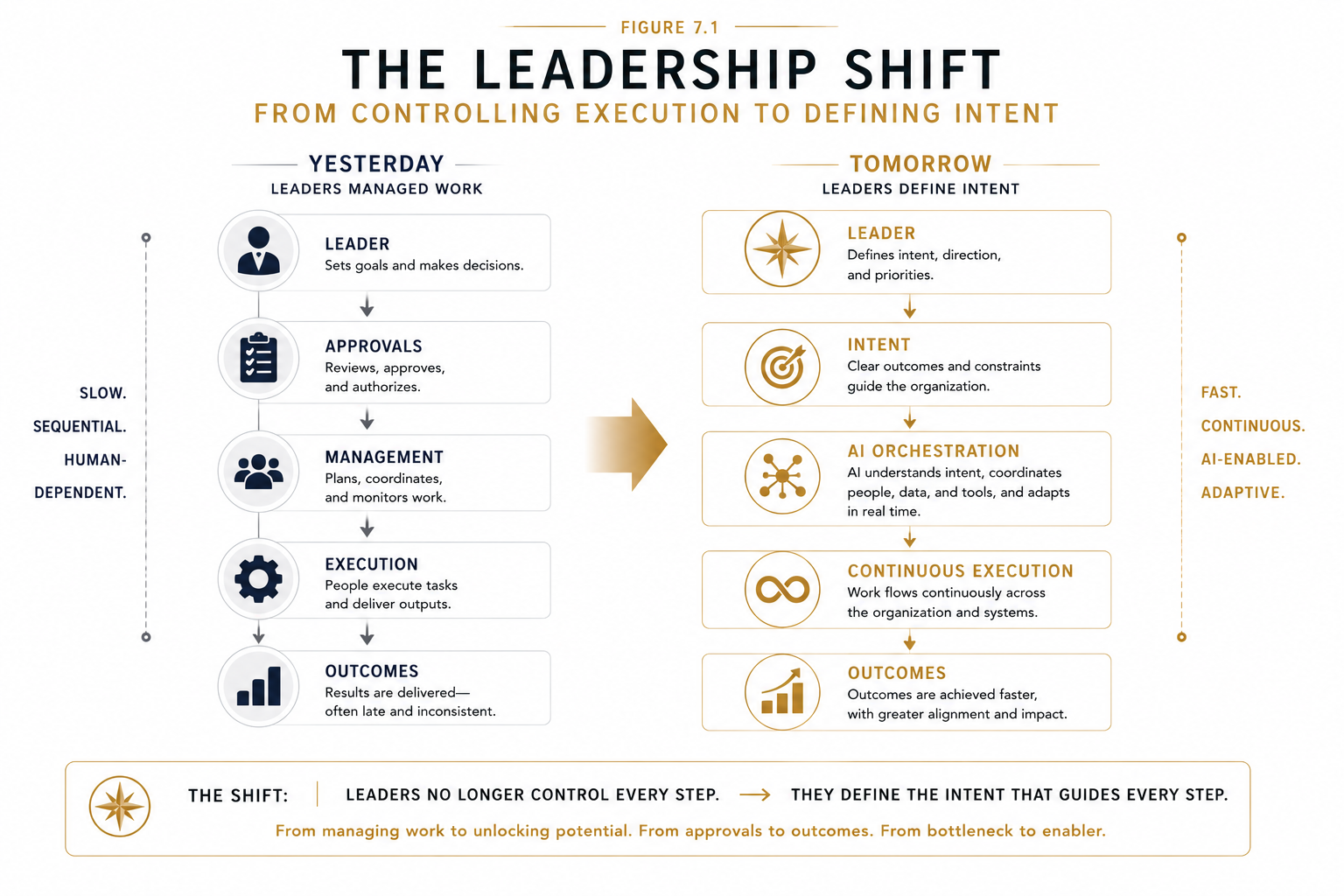
Artificial intelligence increasingly orchestrates execution, allowing leaders to focus on purpose, priorities, and long-term direction.
This figure identifies the migration of leadership work from operational supervision toward intent definition. It does not claim management disappears; it shows why the quality of purpose, judgment, and direction becomes more decisive as execution becomes more available.
This also changes the relationship between leadership and management. Management asks: Are we executing correctly? Leadership asks: Are we pursuing the right outcome? For generations, organizations required large amounts of management because execution demanded continuous coordination. Artificial intelligence increasingly absorbs much of that coordination. Management does not disappear. Its focus changes. Routine operational oversight gradually gives way to designing systems, improving capabilities, and enabling continuous adaptation. Leadership becomes less operational and more intentional. This creates another important shift: information is no longer scarce, execution is no longer scarce, and attention becomes scarce.
Every interruption competes for executive judgment. Every operational decision consumes cognitive capacity that could otherwise be invested in strategic thinking. Artificial intelligence cannot eliminate this constraint. It can reduce unnecessary demands on it.
The highest-performing organizations of the future will not be those whose leaders make the greatest number of decisions. They will be those whose leaders make the most important decisions. This is a profound difference. Leadership quality will increasingly be measured not by activity, but by clarity. The clearer the organizational intent, the less operational intervention becomes necessary. Artificial intelligence amplifies that clarity throughout the organization. Poor intent produces confusion at machine speed. Clear intent produces alignment at machine speed. The technology amplifies leadership itself.
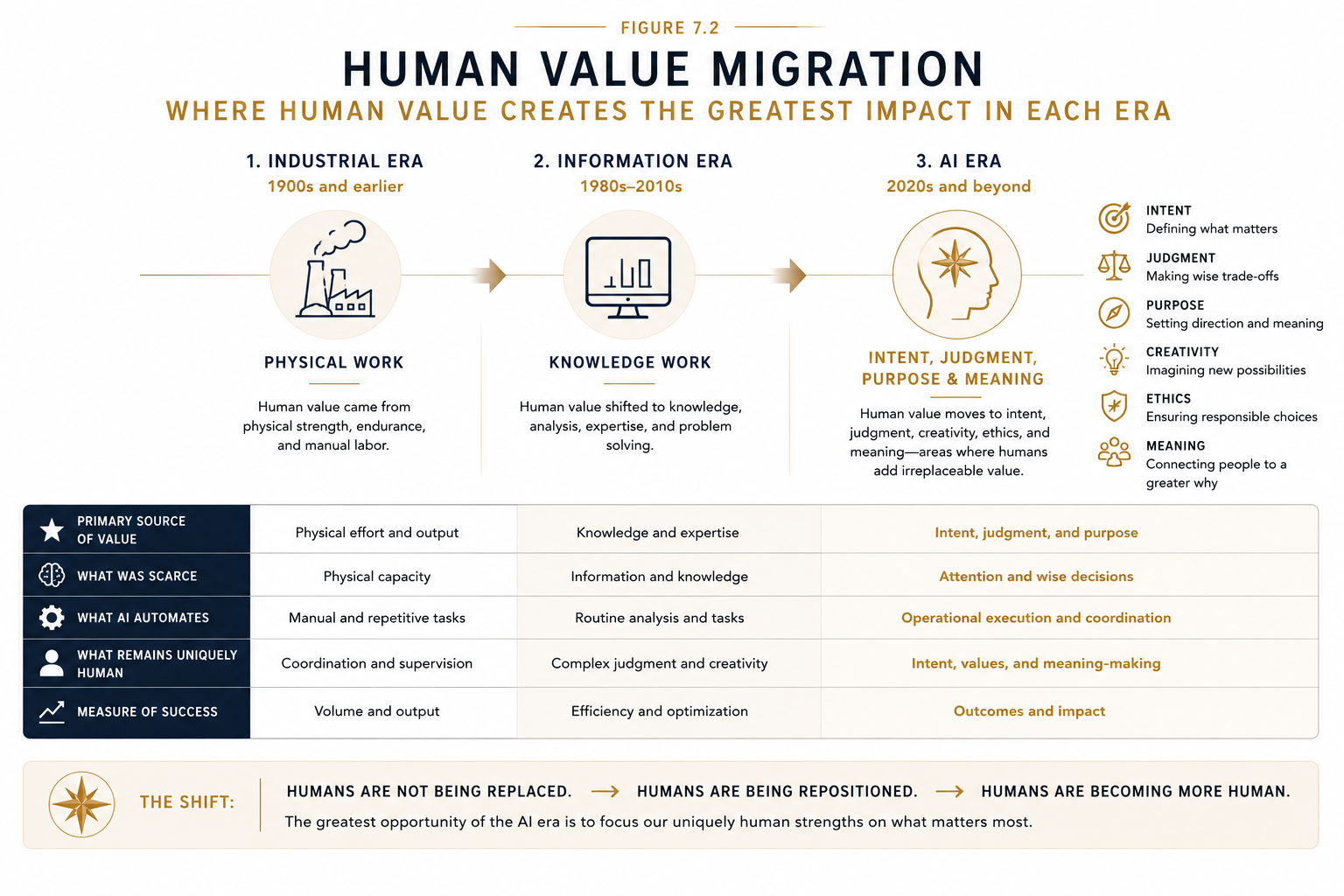
AI does not diminish human value; it elevates the importance of uniquely human capabilities.
The migration figure keeps the argument from becoming a story of human replacement. Human work moves toward the capabilities that make accelerated execution worthy of trust.
Organizations therefore have to develop different leadership capacities. Historically, leaders were rewarded for operational excellence: controlling execution, monitoring performance, managing resources, and reducing variance. These capabilities remain valuable. They are no longer sufficient. The leaders who thrive in AI-native organizations increasingly excel at different capabilities: defining intent, making wise trade-offs, interpreting ambiguity, creating shared meaning, building trust, exercising ethical judgment, and inspiring people around a common purpose. These capabilities become increasingly valuable precisely because they cannot be delegated entirely to intelligent systems. Leadership becomes more human, not less. This may seem paradoxical.
As organizations become more intelligent, the uniquely human contribution becomes increasingly important. Technology expands organizational capability. Leadership determines how that capability is used. This is why leadership remains the defining competitive advantage.
The organizations that succeed in the AI era will not simply employ better technology. They will cultivate leaders capable of expressing clear intent, creating shared purpose, and enabling intelligent systems to execute with coherence. The operating system shift therefore does not reduce the importance of leadership. It transforms it. Leadership is no longer measured by how effectively people control execution. It is measured by how clearly they define the intent that guides execution. That is the new responsibility of leadership.
That responsibility may become the most valuable capability any organization can develop. The leadership bottleneck is not a failure of executives; it is a sign that leadership itself must move to the level where the new constraint now lives.
Executive Takeaway
Leadership is no longer defined by controlling execution. It is defined by defining intent. As AI assumes more operational work, the uniquely human responsibilities of purpose, judgment, ethics, and direction become the organization's greatest source of competitive advantage.