
Integrated Conceptual Model
The preceding sections introduced the components of Correspondence Theory separately: a representation-network ontology, the construct of Organizational Correspondence, the construct of Cognitive Integrity, and the Correspondence Loop as the canonical mechanism. This section integrates those components into a single conceptual model. The model explains how organizations preserve or lose semantic and causal coherence across evolving organizational representations.
Figure 6
Integrated Correspondence Theory Model
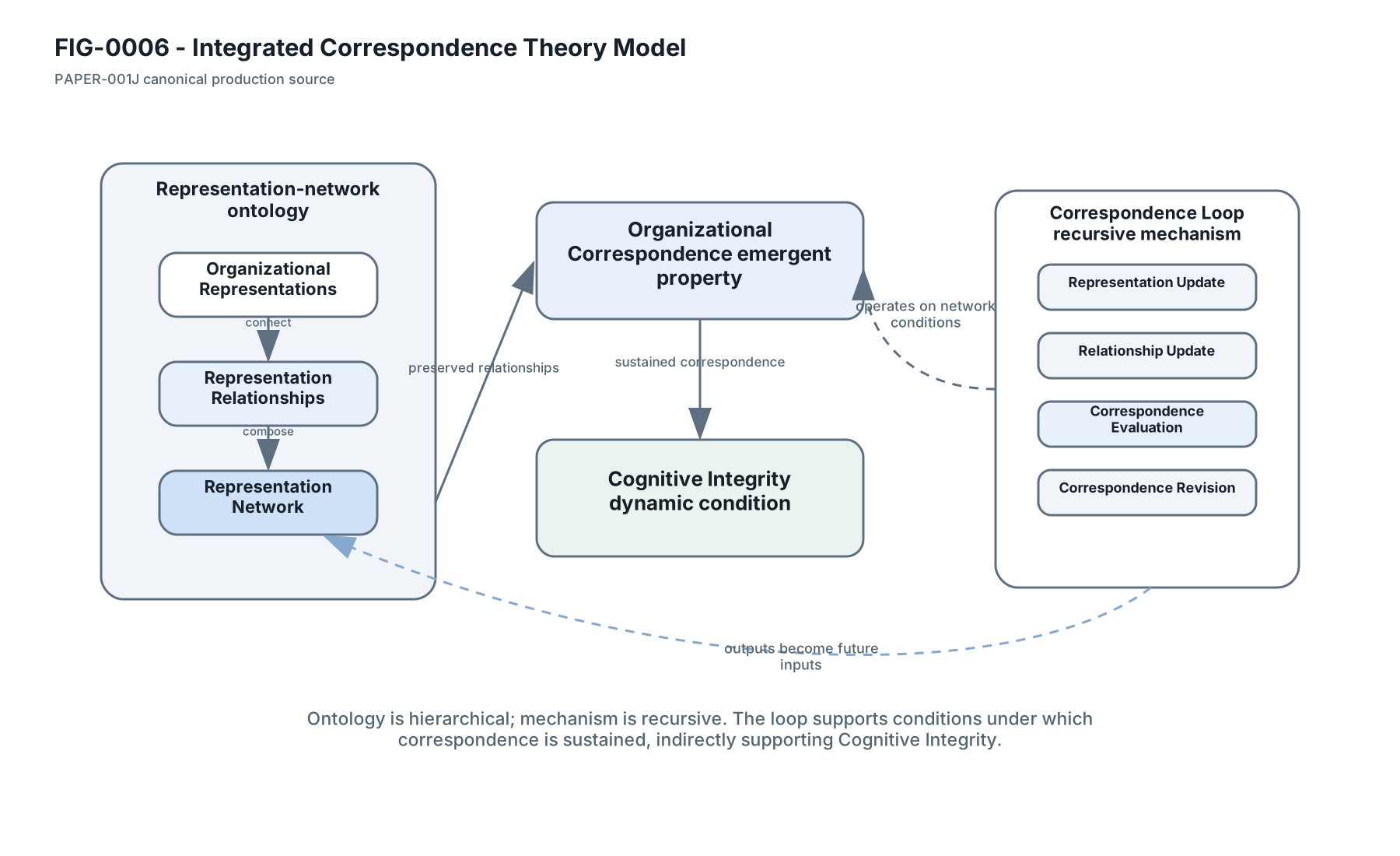
The model begins with organizational representations. These are persistent artifacts, statements, models, records, memories, outputs, or structured expressions through which organizational cognition is represented. They include strategies, decisions, plans, policies, observations, outcomes, governance records, organizational memory, and AI-generated artifacts. Representations matter because they allow organizational cognition to persist beyond a single actor, interaction, or moment.
Representations become theoretically significant through representation relationships. These relationships may be semantic, preserving meaning, interpretation, classification, or implication among representations. They may also be causal, preserving traceability among intent, decision, action, outcome, and learning. The representation network consists of the evolving set of organizational representations and these semantic and causal relationships.
Organizational Correspondence emerges from this network. It is the emergent organizational property by which meaningful semantic and causal relationships among organizational representations are preserved over time. The construct is not a property of isolated artifacts. It depends on the preservation of relationships within the network. A decision, policy, or AI-generated artifact may be internally coherent while still weakening Organizational Correspondence if it is not meaningfully connected to the representations it affects.
Cognitive Integrity is associated with sustained Organizational Correspondence. It is the dynamic organizational condition associated with sustained Organizational Correspondence. This means that Cognitive Integrity depends on the preservation of correspondence conditions across time. It does not refer to individual cognition, organizational performance, or technical sophistication. It names the organization-level condition associated with sustained coherence in represented organizational cognition.
The Correspondence Loop explains how the representation network is maintained, revised, restored, or degraded. The mechanism is recursive and event-driven. It operates on the representation network through four core micro-mechanisms: Representation Update, Relationship Update, Correspondence Evaluation, and Correspondence Revision. These activities preserve or degrade the conditions under which Organizational Correspondence emerges. Cognitive Integrity is therefore sustained indirectly through sustained Organizational Correspondence.
The integrated model should not be read as a simple downstream sequence in which the Correspondence Loop appears after Cognitive Integrity. The ontology is hierarchical, but the mechanism is recursive. The representation network is the substrate. Organizational Correspondence emerges from preserved semantic and causal relationships within that network. Cognitive Integrity is the dynamic condition associated with sustained Organizational Correspondence. The Correspondence Loop recursively operates on the representation network, supporting the conditions under which the constructs are sustained without being ontologically downstream from them.
This architecture preserves the distinctions that make the theory coherent. The representation network is not a construct in the same sense as Organizational Correspondence or Cognitive Integrity; it is the ontological substrate. Organizational Correspondence is not a mechanism; it is an emergent property. Cognitive Integrity is not a capability or process; it is a dynamic organizational condition. The Correspondence Loop is not a construct; it is the mechanism that explains representation-network maintenance.
The integrated model also clarifies the role of AI-native organizations. AI systems may increase the speed, volume, and distribution of organizational representation creation. They may generate new artifacts, revise existing ones, recommend actions, summarize memory, or influence decisions. However, AI does not define the theory. It intensifies the representational problem. The same model applies to human-only, hybrid, and AI-native organizations wherever persistent organizational representations and meaningful relationships among them exist.
The model further clarifies what Correspondence Theory does not explain. It is not a comprehensive theory of performance, strategy, culture, power, leadership, or institutional change. Those phenomena may interact with Organizational Correspondence and Cognitive Integrity, but they are not replaced by them. The conceptual model explains a narrower problem: whether represented organizational cognition preserves meaningful semantic and causal relationships as it evolves. This boundary is important for theoretical precision. It allows the paper to make a distinctive contribution without claiming to account for all sources of organizational success or failure.
The model also establishes the temporal logic of the theory. Organizational representations are not fixed. They are created, revised, retired, reinterpreted, and related through ongoing organizational activity. Correspondence is therefore not a one-time state. It is preserved or degraded over time as the representation network changes. Cognitive Integrity likewise varies as sustained correspondence is maintained, weakened, or restored. The Correspondence Loop explains this dynamic by identifying how organizations update, relate, evaluate, and revise representations and relationships.
The next section presents the theoretical propositions that follow from the integrated architecture. These propositions do not introduce new theory. They express expected relationships among the ontology, constructs, and mechanism already developed. The research agenda then explains how future work can investigate those relationships through observable traces while preserving the distinction between theory, operationalization, and empirical evidence.