
Correspondence Loop
The preceding sections establish the ontology and constructs of Correspondence Theory. Organizational representations and their semantic and causal relationships form the representation network. Organizational Correspondence is the emergent property by which meaningful relationships among those representations are preserved over time. Cognitive Integrity is the dynamic organizational condition associated with sustained Organizational Correspondence. The remaining theoretical requirement is a mechanism explaining how the representation network is maintained, revised, or degraded as organizational cognition unfolds.
The Correspondence Loop is defined as follows: “The Correspondence Loop is a recursive, event-driven network maintenance mechanism operating on the organizational representation network through four core micro-mechanisms: Representation Update, Relationship Update, Correspondence Evaluation, and Correspondence Revision.”
Figure 4
Correspondence Loop
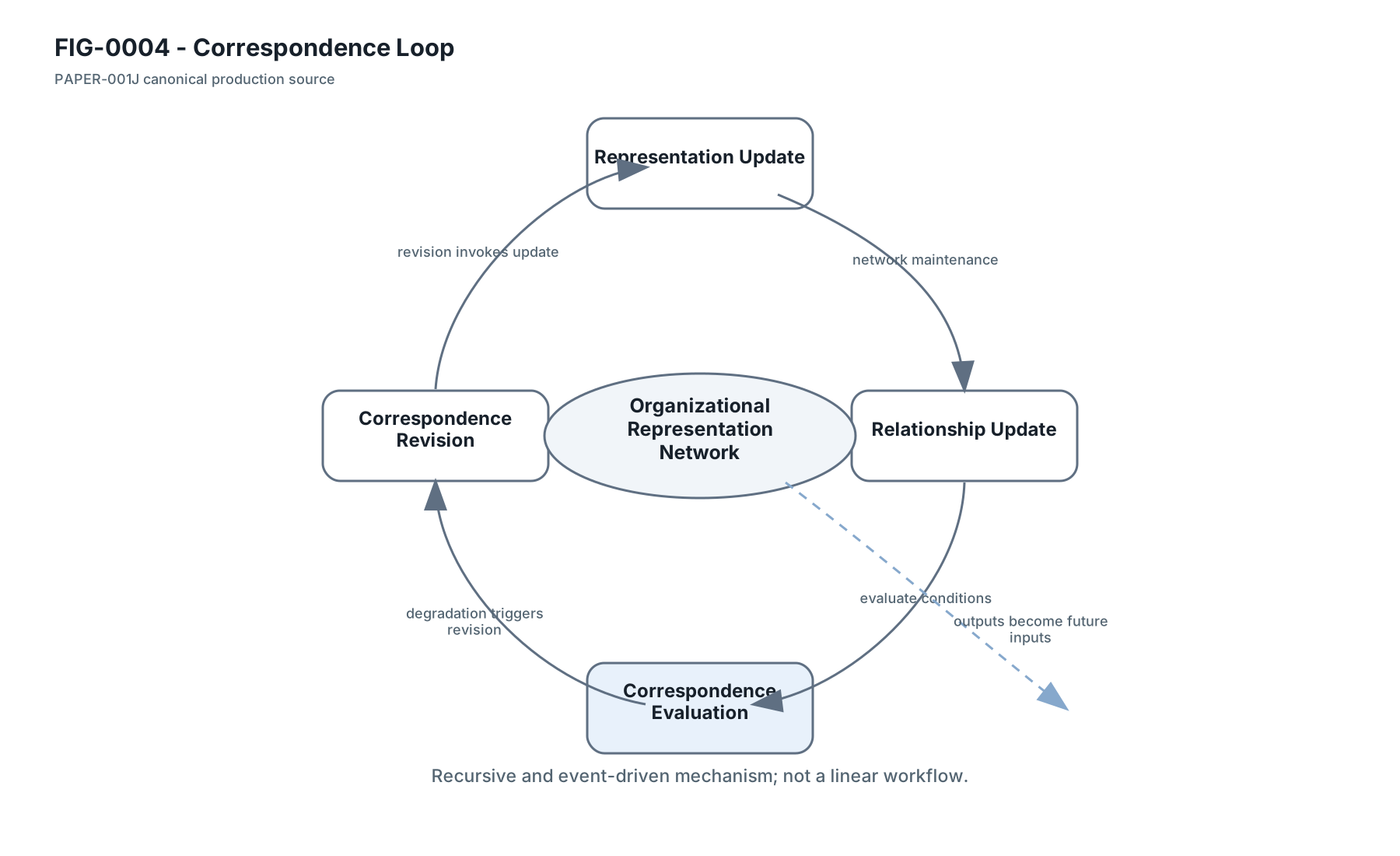
This definition classifies the Correspondence Loop as a mechanism, not a construct. It does not name a property of the organization or a condition of organizational cognition. It explains how an underlying structure changes, is maintained, degrades, or is revised over time. The underlying structure is the organizational representation network. The mechanism is therefore representation-network-centric rather than actor-centric, process-centric, software-centric, or document-centric.
This classification preserves the architecture of the theory. Organizational Correspondence defines the property that may be preserved or degraded. Cognitive Integrity defines the organizational condition associated with sustained correspondence. The Correspondence Loop explains activity directed toward the representation network. Without a distinct mechanism, the theory would identify what must be preserved but would not explain how preservation, degradation, revision, or restoration occurs through ongoing organizational cognition.
The Correspondence Loop is recursive because outputs of one activity may become inputs to later activity. A representation update may require relationship updates. A relationship update may require correspondence evaluation. Correspondence evaluation may trigger revision. Revision may require further representation or relationship updates. The mechanism is event-driven because local activity is activated by organizational events that affect, or may affect, the representation network. Such events may include decisions, representation changes, relationship changes, execution outcomes, contradictions, learning events, governance decisions, AI-generated artifacts, memory updates, or external disruptions.
The term loop should therefore not be read as a simple sequence. The mechanism is not a linear workflow in which each step always follows the same order. Some events may begin with evaluation, such as when a contradiction is detected. Others may begin with representation update, such as when a new decision is recorded. Others may begin with relationship update, such as when an existing artifact is reinterpreted in light of an outcome. The loop is recursive because activities can revisit and reshape earlier representations and relationships.
The mechanism operates through four canonical micro-mechanisms.
Table 3 - Four Core Micro-Mechanisms
Table 3
Four Core Micro-Mechanisms
| Micro-mechanism | Trigger or condition | Core activity | Representation-network effect | Possible observable trace |
|---|---|---|---|---|
| Representation Update | A new, obsolete, duplicated, malformed, reclassified, merged, or reinterpreted organizational representation affects the network | Creates, modifies, retires, merges, reclassifies, or reinterprets organizational representations | Keeps the representation network connected to ongoing organizational cognition by ensuring it contains representations capable of supporting meaningful relationships | Representation change, new decision record, revised plan, retired artifact, memory update, AI-generated artifact |
| Relationship Update | New, modified, or existing representations require semantic or causal connection, reconnection, disconnection, or reinterpretation | Creates, modifies, retires, or reinterprets semantic and causal relationships among organizational representations | Maintains the connective structure from which Organizational Correspondence can emerge | Relationship change, traceability link, revised rationale, updated intent-to-decision or action-to-outcome connection |
| Correspondence Evaluation | Representation-network conditions may preserve, weaken, contradict, fragment, or restore meaningful semantic and causal relationships | Assesses whether representation-network conditions preserve, weaken, contradict, fragment, or restore meaningful semantic and causal relationships | Detects whether representation-network change has preserved or degraded correspondence conditions | Evaluation record, contradiction signal, ambiguity flag, missing-correspondence finding, confirmed-continuity note |
| Correspondence Revision | Degradation, contradiction, ambiguity, fragmentation, or missing correspondence is detected or inferred | Revises representations or relationships when degradation, contradiction, ambiguity, fragmentation, or missing correspondence is detected | Restores local coherence, reduces degradation, resolves contradiction, or defers change when evidence or authority is insufficient | Revision event, corrected representation, repaired relationship, deferred revision record, updated evidence or authority note |
Representation Update creates, modifies, retires, merges, reclassifies, or reinterprets organizational representations. Its purpose is to keep the representation network connected to ongoing organizational cognition. Organizations continuously generate new expressions of intent, decision, observation, action, outcome, and memory. If these representations are missing, obsolete, duplicated, or malformed, correspondence conditions weaken. Representation Update ensures that the network contains representations capable of supporting meaningful relationships.
Relationship Update creates, modifies, retires, or reinterprets semantic and causal relationships among organizational representations. This activity maintains the connective structure of the representation network. It is central because Organizational Correspondence emerges from preserved meaningful semantic and causal relationships. A new representation is not sufficient by itself. It must be related to prior intent, decision, action, outcome, policy, learning, or memory where such relationships are meaningful. Relationship Update therefore preserves the network conditions from which correspondence can emerge.
Correspondence Evaluation assesses whether representation-network conditions preserve, weaken, contradict, fragment, or restore meaningful semantic and causal relationships. This activity detects whether representation-network change has preserved or degraded correspondence conditions. Evaluation may occur before, during, or after representation and relationship updates. It may identify contradiction, ambiguity, missing correspondence, fragmentation, or confirmed continuity. Without evaluation, degradation may remain latent while organizational activity continues.
Correspondence Revision revises representations or relationships when degradation, contradiction, ambiguity, fragmentation, or missing correspondence is detected. It is the corrective activity of the mechanism. Revision may restore local coherence, reduce degradation, resolve contradiction, or defer changes when evidence or authority is insufficient. It is recursive rather than terminal because revision can trigger further representation updates, relationship updates, or evaluation.
Figure 5
Recursive Activity Architecture
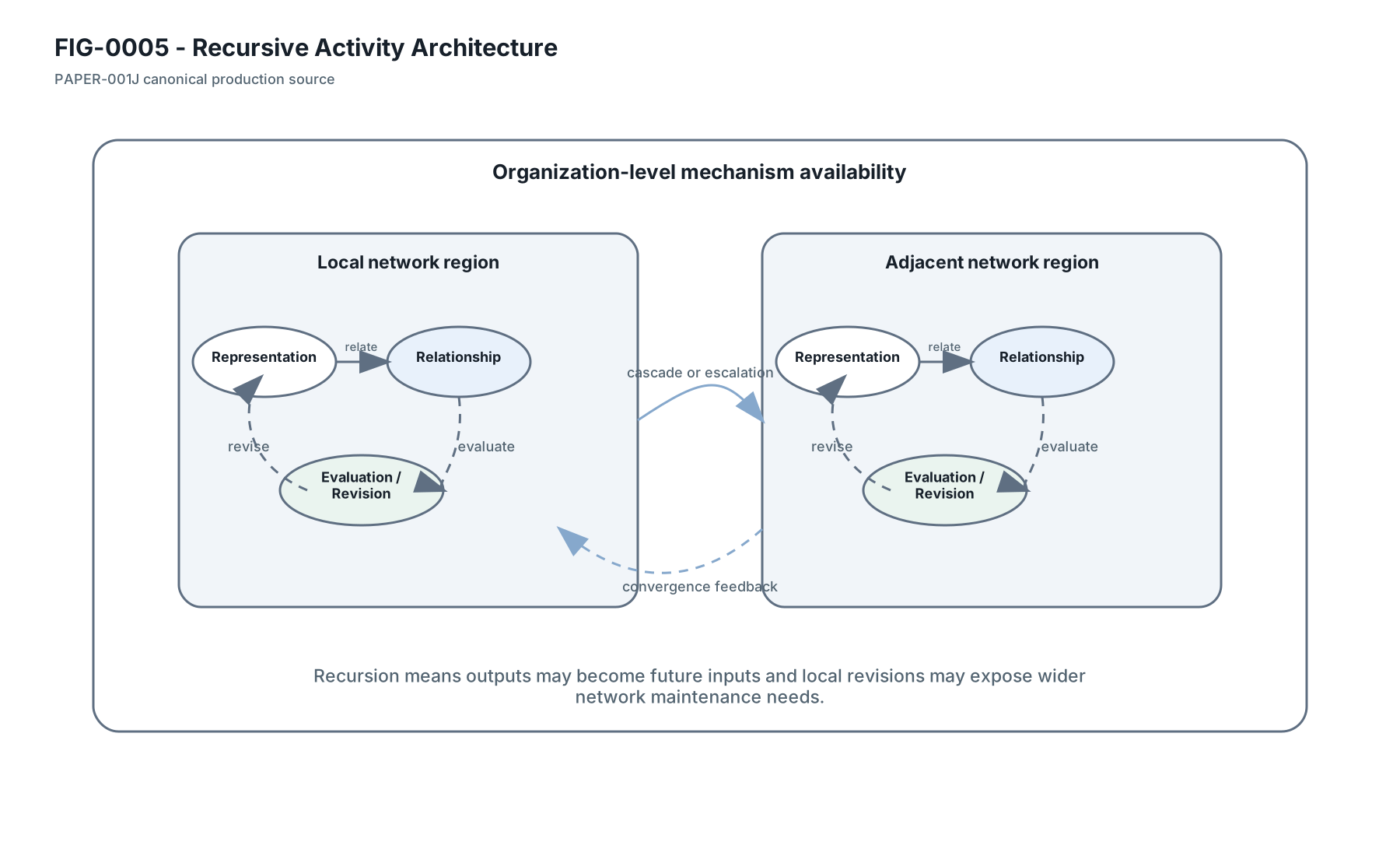
The four micro-mechanisms should not be interpreted as a linear workflow. They form a recursive activity architecture. Representation Update may require Relationship Update because new or modified representations must be connected to the representation network. Relationship Update may trigger Correspondence Evaluation because new or revised relationships may preserve or degrade correspondence conditions. Correspondence Evaluation may trigger Correspondence Revision when degradation is detected. Correspondence Revision may recursively invoke Representation Update and Relationship Update. The activities may operate in different orders, concurrently, conditionally, and repeatedly depending on the triggering event.
In the logistics example, a service complaint may activate Correspondence Evaluation by revealing a contradiction between the reliability strategy and the AI-generated routing recommendation. Correspondence Revision may then require updating the recommendation representation, revising the relationship between routing criteria and strategic intent, and reconnecting the outcome evidence to organizational learning. This illustrates the mechanism without turning it into a fixed workflow: the activities may begin from evaluation, revision, or update depending on where degradation becomes visible.
This recursive architecture is particularly important in complex organizations. A single decision may affect several representations at once: strategic intent, delivery plans, policy commitments, accountability structures, and expected outcomes. Revising one representation may expose missing relationships elsewhere. Updating a causal relationship may require reinterpretation of an earlier decision. In these cases, the mechanism does not run once and stop. It moves through the representation network as the implications of change become visible.
This architecture clarifies how the Correspondence Loop relates to Organizational Correspondence. The mechanism does not directly manipulate Organizational Correspondence. Organizational Correspondence is an emergent property of the representation network. The Correspondence Loop operates on the representation network by updating representations, updating relationships, evaluating correspondence conditions, and revising degraded structures. When these activities preserve meaningful semantic and causal relationships, the conditions under which Organizational Correspondence emerges are preserved. When they fail, Organizational Correspondence may degrade.
The relationship to Cognitive Integrity is similarly indirect. The Correspondence Loop does not directly produce Cognitive Integrity. Cognitive Integrity is the dynamic organizational condition associated with sustained Organizational Correspondence. The mechanism supports Cognitive Integrity by supporting the sustained preservation of Organizational Correspondence. If representation-network maintenance preserves correspondence conditions, Cognitive Integrity may be sustained. If those conditions degrade, Cognitive Integrity may decline.
The Correspondence Loop operates at two levels. At the organization level, the mechanism remains available as long as organizational cognition continues and the representation network remains capable of being updated, evaluated, and revised. Availability does not mean that local activity is always executing. Local activity is activated when a specific organizational event affects, or may affect, a region of the representation network. Such local activity may complete, fail, suspend, cascade, conflict, or trigger future activity.
The mechanism also explains characteristic outputs. Immediate outputs may include updated representations, updated semantic relationships, updated causal relationships, detected correspondence degradation, resolved contradictions, reduced degradation, restored local representation-network coherence, rejected or deferred revisions, and updated organizational memory. These outputs should be distinguished from downstream organizational outcomes such as performance, resilience, adaptability, accountability, execution consistency, or effective human-AI collaboration. The Correspondence Loop may influence such outcomes, but they are not part of the mechanism definition.
The Correspondence Loop is distinct from existing organizational mechanisms. It complements cybernetics, organizational learning, distributed cognition, systems dynamics, adaptive systems, PDCA, OODA, knowledge management, sensemaking, and organizational memory. Those theories explain regulation, learning, cognition distribution, dynamic system behavior, adaptation, process improvement, decision cycles, knowledge flows, interpretation, and memory persistence. The Correspondence Loop addresses the residual explanatory gap: existing theories do not explicitly explain the recursive maintenance of the evolving organizational representation network from which Organizational Correspondence emerges.
The mechanism is not a governance process, software workflow, AI orchestration pattern, documentation routine, graph database, or tool architecture. Human-only, hybrid, and AI-native organizations may all exhibit the mechanism if they possess persistent organizational representations, meaningful semantic or causal relationships, recurring organizational cognition, and the capacity to update, evaluate, and revise the representation network.
The boundary conditions follow from this definition. The mechanism applies where persistent organizational representations exist, where semantic or causal relationships among them are possible, where a representation network can be identified, and where organizational cognition recurs over time. It does not apply where there are no persistent representations, no meaningful relationships, no representation network, or no recurring organizational cognition. This boundary prevents the mechanism from expanding into a general theory of all organizational activity.
The Correspondence Loop can also fail. Trigger failures occur when representation-network events do not activate relevant local activity. Activity failures occur when representation update, relationship update, correspondence evaluation, or correspondence revision fails. Network failures occur when local degradation accumulates into semantic drift, causal traceability collapse, fragmentation, or memory disconnection. These failure modes do not require additional canonical micro-mechanisms. They follow from the four activities and the representation-network substrate on which they operate.
The Correspondence Loop completes the core theoretical architecture of the paper. The representation network provides the substrate. Organizational Correspondence identifies the emergent property at stake. Cognitive Integrity identifies the dynamic organizational condition associated with sustained correspondence. The Correspondence Loop explains the recursive, event-driven mechanism through which organizations maintain, revise, restore, or degrade the representation-network conditions from which correspondence emerges.