
Representation-Network Ontology
The preceding sections identify a gap in how organizational theory explains coherence across evolving organizational representations. To address that gap, the paper first requires an ontology: an account of the basic entities and relationships through which the phenomenon should be studied. Correspondence Theory begins from the premise that organizational cognition can be examined through the representations organizations create, maintain, transform, relate, evaluate, revise, and discard. These representations are not incidental by-products of organizing. They are among the durable media through which organizational cognition persists across actors, systems, decisions, and time.
The first element of the ontology is the organizational representation. Organizational representations are persistent artifacts, statements, models, records, memories, outputs, or structured expressions through which organizational cognition is represented. They may include strategic intent, decisions, plans, work products, observations, outcomes, policies, governance records, AI-generated artifacts, and organizational memory. The category is intentionally broad because organizations do not express cognition through a single medium. A strategy deck, product roadmap, risk register, architectural model, operating policy, decision log, customer analysis, and machine-generated recommendation may all function as organizational representations when they express something the organization knows, intends, decides, observes, or remembers.
The concept of organizational representation does not imply that all organizational cognition is explicit, a boundary consistent with distributed cognition, sensemaking, and sociomaterial perspectives on situated cognition and artifact-mediated organizing (Hutchins, 1995; Orlikowski, 2007; Weick, 1995). Organizations also rely on tacit knowledge, embodied practice, informal judgment, and situated interpretation. Correspondence Theory does not claim to capture the whole of organizational cognition. Its focus is the portion of organizational cognition that becomes represented, related, revised, remembered, or acted upon. Tacit or hidden cognition matters when it affects the representation network. This boundary is important because the theory studies represented organizational cognition without reducing organizations to documents or databases.
This boundary also protects the ontology from becoming too broad. If every thought, habit, feeling, informal exchange, or practice were treated as a representation, the concept would lose analytical precision. The theory is concerned with organizational cognition once it takes a durable or structured form that can be related to other organizational expressions. A conversation may matter because it produces a decision record, revises a plan, changes an interpretation, or alters how an outcome is remembered. In such cases, the theoretical focus falls on the represented consequence and its relationships within the network.
The second element is the representation relationship. Organizational representations become theoretically significant not only because they exist, but because they stand in meaningful semantic and causal relationships to one another. Semantic relationships concern meaning, reference, interpretation, classification, implication, or consistency among representations. For example, a decision may interpret a strategic intent, a policy may define the meaning of a governance commitment, or a project plan may instantiate a broader priority. Causal relationships concern dependency, influence, consequence, traceability, or explanation. For example, a decision may lead to an action, an action may produce an outcome, an outcome may trigger learning, and learning may revise a future decision.
These relationships are central because organizational coherence depends on more than the presence of representations. An organization may have many representations and still lose coherence if relationships among them are missing, outdated, contradictory, or invisible. A plan disconnected from intent, an outcome disconnected from action, a lesson disconnected from decision history, or an AI-generated artifact disconnected from governance constraints can all weaken organizational cognition. The ontology therefore treats relationships as foundational rather than secondary.
The ontology distinguishes semantic and causal relationships because organizations require both. Semantic relationships preserve meaning among representations: whether a policy expresses a principle, whether a plan interprets a strategy, whether a term is used consistently, or whether an artifact retains its intended significance. Causal relationships preserve traceability among representations: whether a decision explains an action, whether an action produced an outcome, whether an outcome generated learning, or whether learning revised future intent. Organizational coherence depends on the interaction of these two relationship types.
The third element is the representation network. The representation network is the evolving network of organizational representations and their semantic and causal relationships. It is not a software graph, database graph, documentation system, or implementation model. It is an ontological substrate: the structure through which represented organizational cognition can be studied. The network evolves as organizations create new representations, retire old ones, revise existing ones, reinterpret prior meanings, add or remove relationships, and learn from outcomes. Because organizations change continuously, the representation network is dynamic rather than static.
The representation network therefore should not be understood as a complete map that an organization already possesses. It is an analytical object. Some relationships may be explicit, some implicit, some contested, and some missing. Some representations may be formal and durable, while others may be provisional or weakly institutionalized. The theory does not require perfect visibility into the network. It requires only that organizations have persistent representations and meaningful relationships among them that can be preserved, degraded, revised, or inferred.
Figure 1
Representation-Network Ontology
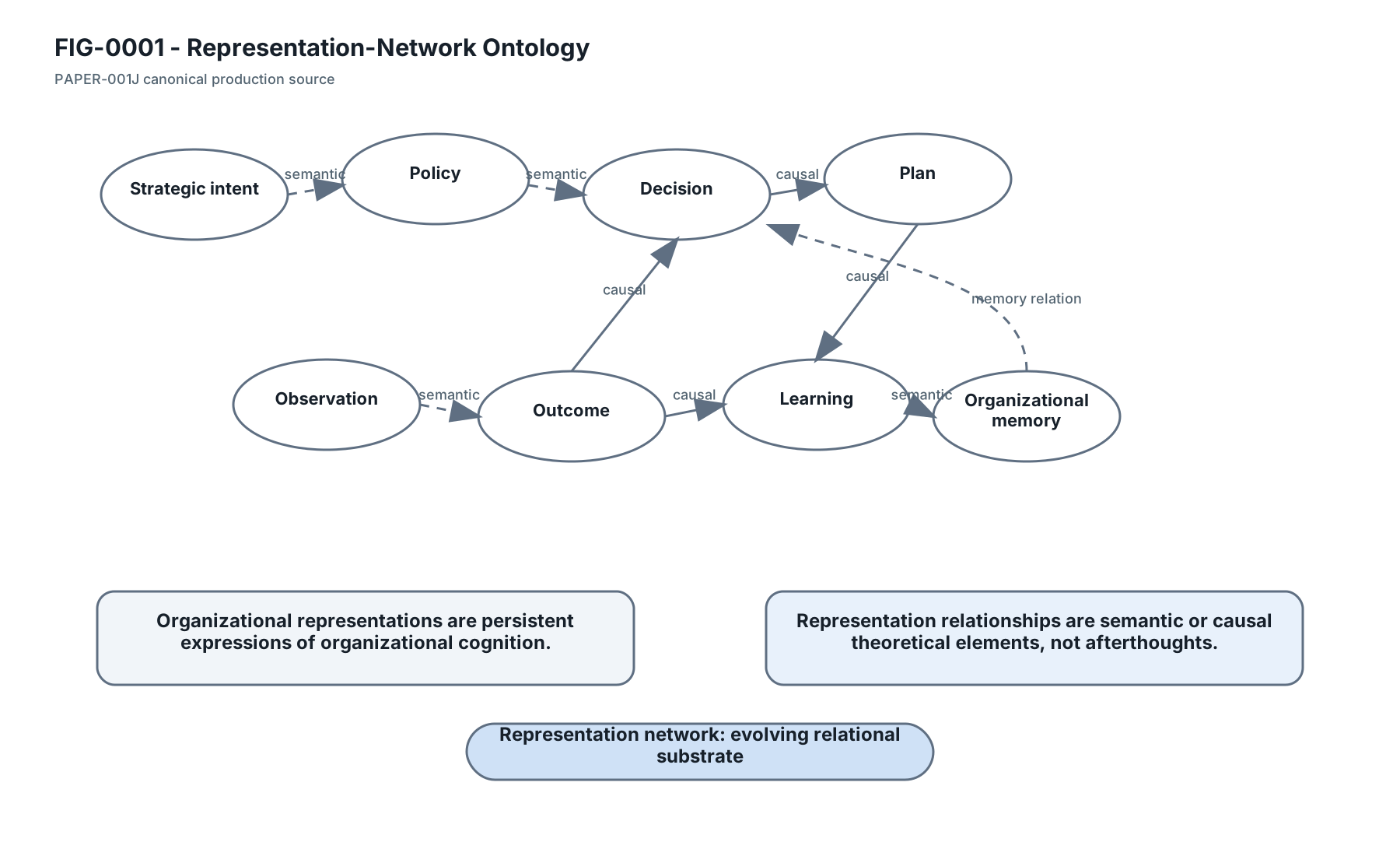
This ontology is representation-network-centric. It does not deny the importance of actors, teams, processes, technologies, governance practices, or AI systems. Rather, it locates their theoretical relevance in relation to the representation network. Actors, teams, processes, documents, systems, governance mechanisms, and AI agents matter because they create, modify, interpret, evaluate, or revise organizational representations and relationships. They are not the primary substrate of the theory. The primary substrate is the evolving network of representations and relationships through which organizational cognition becomes durable enough to be preserved, degraded, restored, or studied.
This distinction is especially important for AI-native organizations. AI systems can generate, modify, summarize, recommend, classify, and act upon organizational representations at high speed and scale. Yet AI does not define the ontology. AI intensifies the need for it. As machine-generated representations enter organizational cognition, the organization must preserve their semantic and causal relationships to prior intent, decisions, policies, evidence, outcomes, and memory. Without an ontology centered on representation networks, the theoretical problem risks being misread as a problem of tooling, automation, communication, or knowledge storage alone.
The ontology also clarifies the sequence of the theory. Organizational representations form the most basic layer. Representation relationships connect them. The representation network emerges from those connected representations. Organizational Correspondence, introduced in the next section, is an emergent property of that network: the preservation of meaningful semantic and causal relationships among organizational representations over time. Cognitive Integrity is then defined as the dynamic organizational condition associated with sustained Organizational Correspondence. The Correspondence Loop later explains how the representation network is recursively maintained.
The representation-network ontology therefore performs three functions in the paper. First, it defines the object of analysis. The paper is not primarily concerned with isolated documents, individual cognition, local workflows, or software artifacts, but with the evolving representational structure of organizational cognition. Second, it establishes the substrate from which the paper's constructs emerge. Organizational Correspondence and Cognitive Integrity are not free-standing concepts; they depend on the representation network. Third, it preserves implementation independence. The theory can apply to human-only, hybrid, and AI-native organizations because the ontology concerns represented organizational cognition rather than any specific technology.
By grounding the theory in organizational representations, representation relationships, and representation networks, the paper can now define the core property at stake. The central question is not merely whether organizations possess representations, knowledge, or memory. It is whether meaningful semantic and causal relationships among those representations are preserved as organizational cognition unfolds over time. That property is Organizational Correspondence.