
Organizational Correspondence
The representation-network ontology establishes the substrate of the theory: organizations create, maintain, transform, and discard representations, and those representations are connected through semantic and causal relationships. The first formal construct of Correspondence Theory identifies the property that becomes possible within that substrate. Organizational Correspondence is the foundational construct of the theory because it names the condition of relationship preservation within the evolving representation network.
Figure 2
Organizational Correspondence
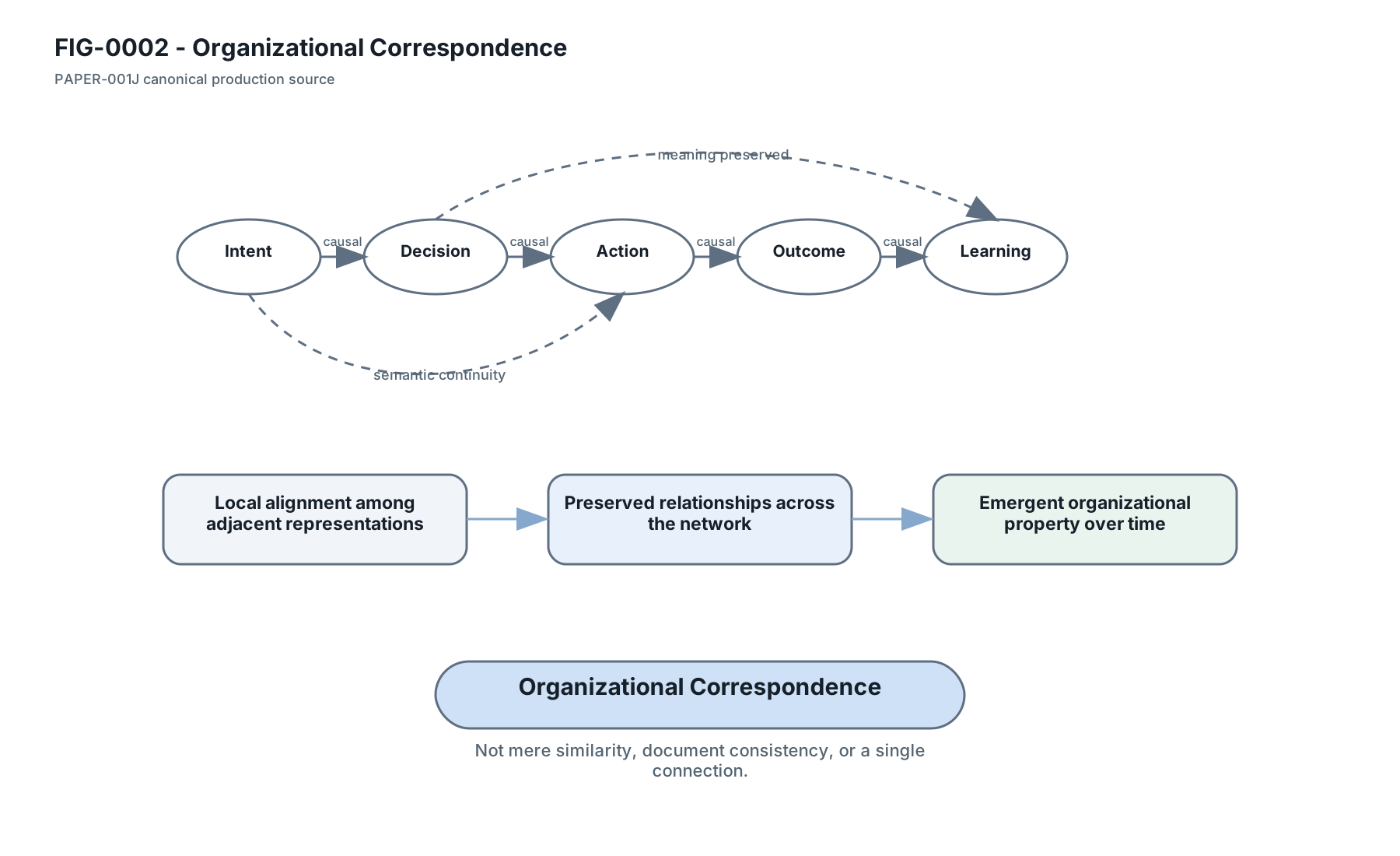
Organizational Correspondence is defined as follows: Organizational Correspondence is the emergent organizational property by which meaningful semantic and causal relationships among organizational representations are preserved over time. This definition is intentionally minimal. It specifies the construct's ontological character without embedding mechanisms, management practices, technologies, diagnostic criteria, or performance outcomes. The construct does not describe a process that organizations perform. It describes a property that emerges when the representation network preserves meaningful relationships across time.
Table 1 - Construct Definitions
Table 1
Construct Definitions
| Construct | Canonical definition | Ontological role | Analytical level | What the construct is not |
|---|---|---|---|---|
| Organizational Representation | Persistent artifact, statement, model, record, memory, output, or structured expression through which organizational cognition is represented. | Basic ontological element | Representation-level | Not all cognition, not tacit practice itself, and not limited to documents or databases |
| Semantic Relationship | Relationship concerning meaning, reference, interpretation, classification, implication, or consistency among organizational representations. | Relationship type within the representation network | Relationship-level | Not causal traceability, communication volume, or agreement by itself |
| Causal Relationship | Relationship concerning dependency, influence, consequence, traceability, or explanation among organizational representations. | Relationship type within the representation network | Relationship-level | Not correlation alone, performance attribution, or a validated causal model |
| Representation Network | The evolving network of organizational representations and their semantic and causal relationships. | Ontological substrate | Network-level | Not a software graph, database graph, documentation system, or implementation model |
| Organizational Correspondence | The emergent organizational property by which meaningful semantic and causal relationships among organizational representations are preserved over time. | Formal construct and emergent property | Organization-level property of the representation network | Not a process, capability, governance mechanism, communication framework, information system, or software architecture |
| Cognitive Integrity | The dynamic organizational condition associated with sustained Organizational Correspondence. | Formal construct and dependent dynamic condition | Organization-level condition | Not a capability, process, mechanism, performance outcome, or governance property |
| Correspondence Loop | The Correspondence Loop is a recursive, event-driven network maintenance mechanism that operates on the organizational representation network through Representation Update, Relationship Update, Correspondence Evaluation, and Correspondence Revision to preserve or restore the conditions under which Organizational Correspondence is sustained. | Canonical mechanism | Mechanism operating on the representation network | Not a formal construct, linear workflow, governance model, software system, process prescription, or execution cycle |
Several features of this definition are important. First, Organizational Correspondence is emergent. It does not reside in any single artifact, decision, actor, model, policy, or system. A strategy document may be carefully written, a decision record may be complete, and an outcome report may be accurate, but correspondence depends on whether meaningful relationships among such representations are preserved. The property arises from the network, not from an isolated representation.
Second, Organizational Correspondence is organizational rather than individual. It concerns collective organizational cognition as represented across durable artifacts and relationships. Individual actors may interpret, remember, decide, or revise, but the construct refers to the organization-level property by which represented organizational cognition remains meaningfully and causally connected. This distinction allows the theory to study organizations whose cognition is distributed across people, teams, tools, routines, and AI systems without reducing the phenomenon to individual cognition.
Third, Organizational Correspondence is dynamic. It concerns preservation over time, not static consistency at a single moment. Organizations continuously produce new representations and revise old ones. Strategies change, decisions accumulate, policies evolve, actions generate outcomes, and learning modifies future interpretation. Correspondence is therefore not equivalent to perfect agreement or frozen alignment. It describes whether semantic and causal relationships remain meaningful as the representation network changes.
Fourth, the construct is representation-centric. The primary unit of analysis is organizational representations and the semantic and causal relationships among them. Examples include strategic intent, policies, decisions, plans, work items, observations, outcomes, organizational memory, governance records, AI-generated artifacts, and future forms of organizational representation. The theory remains open to different media and organizational forms because it does not define correspondence by reference to any specific repository, process, system, or document type.
The semantic dimension of Organizational Correspondence concerns meaning. Representations must remain interpretable in relation to one another. A decision should retain a meaningful relationship to the intent it enacts. A policy should preserve the meaning of the principle or constraint it expresses. A plan should remain interpretable in light of the decision, priority, or assumption it implements. When semantic relationships degrade, organizations may continue to use the same words while attaching different meanings to them. Apparent agreement may conceal interpretive fragmentation.
The causal dimension concerns traceability and consequence. Representations must preserve relationships among intentions, decisions, actions, outcomes, and learning. A decision should be causally related to the action it authorizes. An outcome should remain traceable to the action and assumptions that produced it. Learning should revise the relevant representations rather than remain as disconnected memory. When causal relationships degrade, organizations may lose the ability to explain why a course of action occurred, what it produced, and what should change as a result.
In the logistics example introduced earlier, Organizational Correspondence weakens when the strategic commitment to delivery reliability, the AI-generated routing recommendation, the operational actions taken from that recommendation, and the resulting service complaints no longer remain meaningfully related. The problem is not that the organization lacks representations. It has a strategy, a recommendation, actions, outcomes, and memory. The problem is that the semantic and causal relationships among those representations have degraded.
Organizational Correspondence complements existing organizational theories without replacing them. It is distinct from organizational alignment, organizational cognition, organizational memory, sensemaking, cybernetics, dynamic capabilities, knowledge management, and organizational routines. Those theories explain important phenomena involving actors, knowledge, regulation, interpretation, capabilities, or recurring activity. Organizational Correspondence explains a more specific property: the integrity of meaningful semantic and causal relationships among organizational representations over time.
The distinction from alignment is especially important. Alignment often refers to consistency among goals, structures, incentives, resources, or activities. Organizational Correspondence is narrower and more representational. It does not ask whether all parts of the organization are aligned in a managerial or strategic sense. It asks whether the semantic and causal relationships among organizational representations are preserved. An organization may be strategically aligned in broad terms while losing correspondence among the representations that explain how intent, decisions, actions, outcomes, and learning relate to one another.
The distinction from communication is equally important. Communication may transmit information among actors, but transmission does not guarantee preservation of relationships across the representation network. A decision may be communicated widely while its rationale remains disconnected from prior assumptions. A policy may be announced clearly while its relationship to existing practices remains ambiguous. A lesson may be shared without revising the representations it should affect. Organizational Correspondence concerns the integrity of relationships among represented organizational cognition, not the mere movement of messages.
This distinction matters because organizations may appear strong in adjacent terms while still losing correspondence. They may possess extensive documentation but weak relationship integrity. They may learn quickly but fail to connect learning to prior decisions. They may make decisions rapidly while weakening traceability between intent, action, and outcome. They may use sophisticated AI systems while increasing the volume of representations faster than the organization can preserve relationships among them. Organizational Correspondence names the property at risk in these cases.
The construct applies wherever persistent organizational representations and meaningful relationships among them exist. Artificial intelligence may change the scale and speed of the representational problem, but it does not define the construct. Organizational Correspondence is not directly observable. Researchers infer it through traces of organizational representations and the evolving relationships among them. This does not make the construct speculative; it places it in the same methodological family as many organization-level theoretical constructs that are studied through observable evidence. Future empirical work may investigate dimensions such as semantic continuity, causal traceability, temporal continuity, representation integrity, and learning continuity. In this paper, however, the construct is introduced conceptually rather than operationalized.
The temporal dimension is also essential. Correspondence is preserved or degraded as organizational cognition unfolds. A representation may be coherent when created and incoherent later if the relationships around it change. A decision may accurately reflect intent at one moment but become detached as conditions, actions, or interpretations shift. An outcome may initially be linked to an action but later be remembered without its causal context. Organizational Correspondence therefore concerns continuity across change, not merely consistency at the moment of production.
The theoretical role of Organizational Correspondence is foundational. It explains whether the meaningful relationships among organizational representations remain intact as organizational cognition unfolds. It also provides the parent construct for Cognitive Integrity, introduced in the next section, and the property whose conditions are maintained by the Correspondence Loop. Without Organizational Correspondence, the theory would lack its root explanatory object. The next step is to explain the organizational condition associated with sustained correspondence over time.