
Measurement and Future Research Agenda
Cognitive Integrity cannot yet be measured with a validated scale. The current measurement framework is preliminary and theory-derived.
Figure 8
Measurement Framework
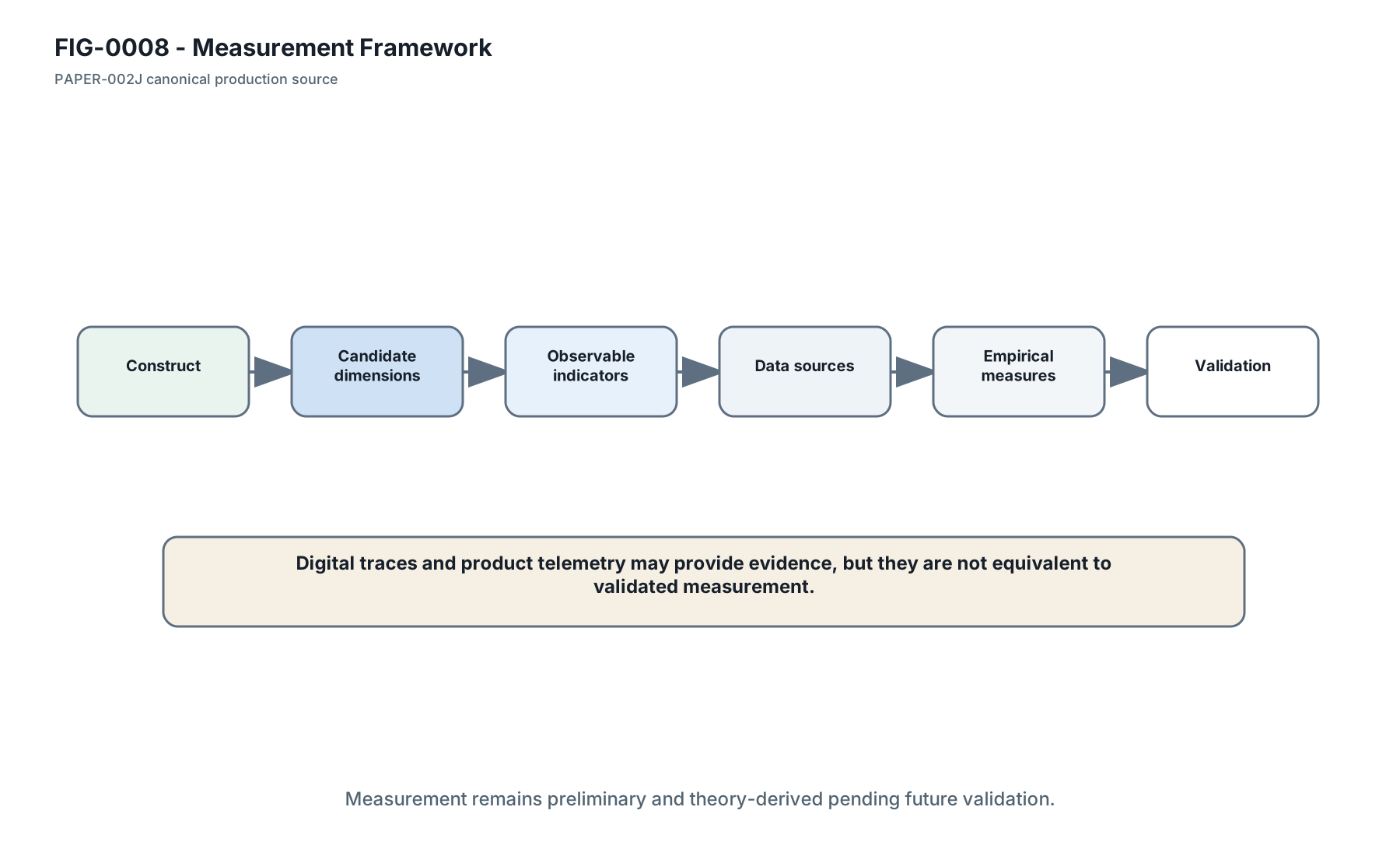
Candidate measurement dimensions include Intent Consistency, Representation Consistency, Correspondence Strength, Decision Traceability, Memory Integrity, Semantic Coherence, Human-AI Agreement, Agent-to-Agent Consistency, Context Preservation, Cognitive Synchronization, Drift Detection, and Adaptation Quality. These dimensions should be treated as provisional. Future research may consolidate, refine, or reject them.
Potential data sources include strategy documents, decision logs, task records, AI agent outputs, human approvals, system-of-record data, organizational memory repositories, enterprise architecture artifacts, workflow histories, communication records, audit logs, digital twin state records, survey responses, interviews, and case study observations.
Measurement research must address several risks. Trace selection bias may occur when visible system data overrepresent formalized work and underrepresent tacit cognition. Archival incompleteness may obscure important representation relationships. Product telemetry may reflect system design rather than organizational cognition. Construct contamination may occur if measures capture documentation maturity, governance maturity, or performance rather than Cognitive Integrity.
Future research should proceed through qualitative case studies, archival trace analysis, computational text and network analysis, survey development, and longitudinal comparative designs. Case studies are especially useful for tracing preservation, degradation, restoration, and learning over time. Scale development should proceed only after content validity, dimensionality, reliability, convergent validity, discriminant validity, and predictive validity are established.