
Paper overview

Nomological Network and Construct Validity

Cognitive Integrity should be positioned within a nomological network that includes antecedents, mediators, moderators, outcomes, and adjacent constructs.

Figure 7

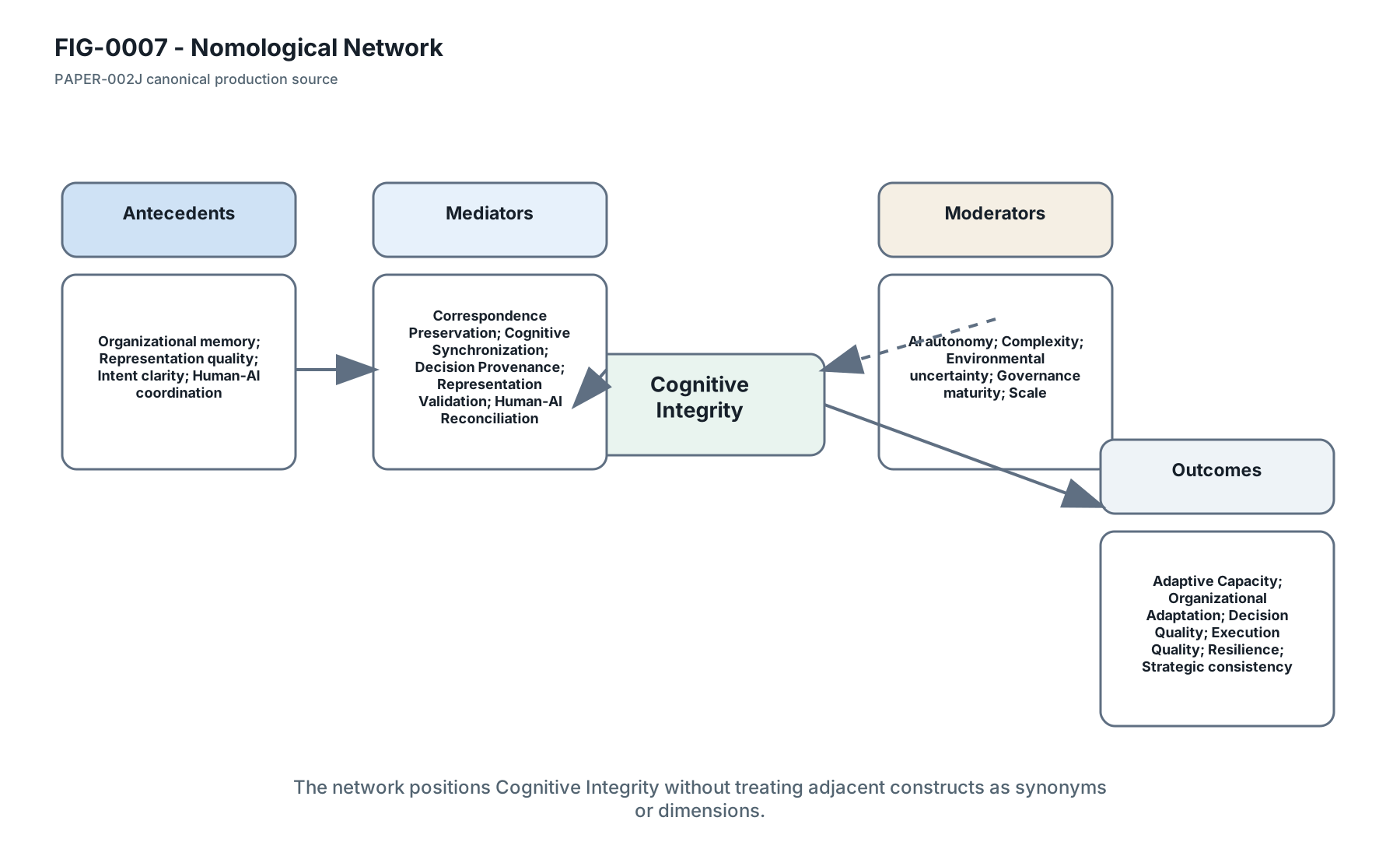
Nomological Network
## Concise Alt Text Position Cognitive Integrity within antecedents, mediators, moderators and outcomes. ## Extended Description The figure titled "Nomological Network" shows Antecedents, Mediators, Moderators, Outcomes, Cognitive Integrity. It uses labelled shapes and arrows to show: Antecedents and mediators relate to Cognitive Integrity; moderators condition effects; outcomes remain downstream.. ## Reading Order 1. Read the title. 2. Read the primary construct or role groups from left to right or top to bottom. 3. Follow solid arrows as primary relationships. 4. Follow dashed arrows as feedback, boundary, moderation or secondary relationships. 5. Read the lower note as the interpretive boundary. ## Construct Descriptions - Antecedents - Mediators - Moderators - Outcomes - Cognitive Integrity ## Relationship Descriptions - Antecedents and mediators relate to Cognitive Integrity; moderators condition effects; outcomes remain downstream. ## Encoding Limitations Color is supportive only. Meaning is preserved by labels, line styles, grouping, shape boundaries, captions and this accessibility description.
Figure 7 - Nomological Network. Figure 7 positions Cognitive Integrity relative to adjacent constructs. Organizational memory, representation quality, intent clarity, and human-AI coordination are expected antecedents. Correspondence Preservation, Cognitive Synchronization, Decision Provenance, Representation Validation, and Human-AI Reconciliation are mediating mechanisms. AI autonomy, organizational complexity, environmental uncertainty, governance maturity, and scale are moderating conditions. Adaptive Capacity, Organizational Adaptation, Decision Quality, Execution Quality, resilience, and strategic consistency are expected outcomes or downstream conditions.

Convergent validity should be expected with constructs related to coherent cognition, traceability, memory quality, coordination quality, knowledge integration, and human-AI collaboration. Discriminant validity should be expected from constructs that appear similar but differ in theoretical domain, including strategic alignment, organizational memory, dynamic capabilities, resilience, enterprise architecture coherence, and digital twin fidelity.

Several empirical distinctions are especially important. Cognitive Integrity should predict coherent adaptation beyond organizational memory volume. It should predict decision quality beyond coordination quality. It should predict adaptive capacity beyond AI governance maturity. It should remain distinguishable from digital twin fidelity because a technically faithful model may still be disconnected from intent, decisions, outcomes, and learning.

Evidence that would challenge Cognitive Integrity includes cases in which organizations maintain high coherent organizational cognition despite persistent degradation of representation relationships, or cases in which Organizational Correspondence has no observable relationship to Cognitive Integrity-relevant outcomes such as adaptive capacity, decision quality, or execution quality.