
Collective Executive Operation, Authority, and Governance
Executive operation is rarely purely individual. Founders, executives, boards, managers, contributors, and AI participants may all be implicated in the same organizational episode. A briefing may begin with one executive but require evidence from contributors, interpretation by managers, delegated review by functional leaders, approval by an executive body, and follow-up by AI-assisted systems. This collective character requires governance to be part of the experience itself.
Figure 5 defines the human-AI authority and responsibility boundary. AI may observe, summarize, infer, recommend, compare, draft, request review, and support bounded execution after authorization. AI must disclose evidence, uncertainty, confidence limits, provenance, and known constraints. AI must not approve, reject, delegate, authorize itself, erase evidence, conceal dissent, or create authoritative organizational commitments without human or institutional authorization. This boundary protects the difference between cognitive support and organizational authority.
<a id="fig-5"></a>
Figure 5
Human-AI Authority and Responsibility Boundary
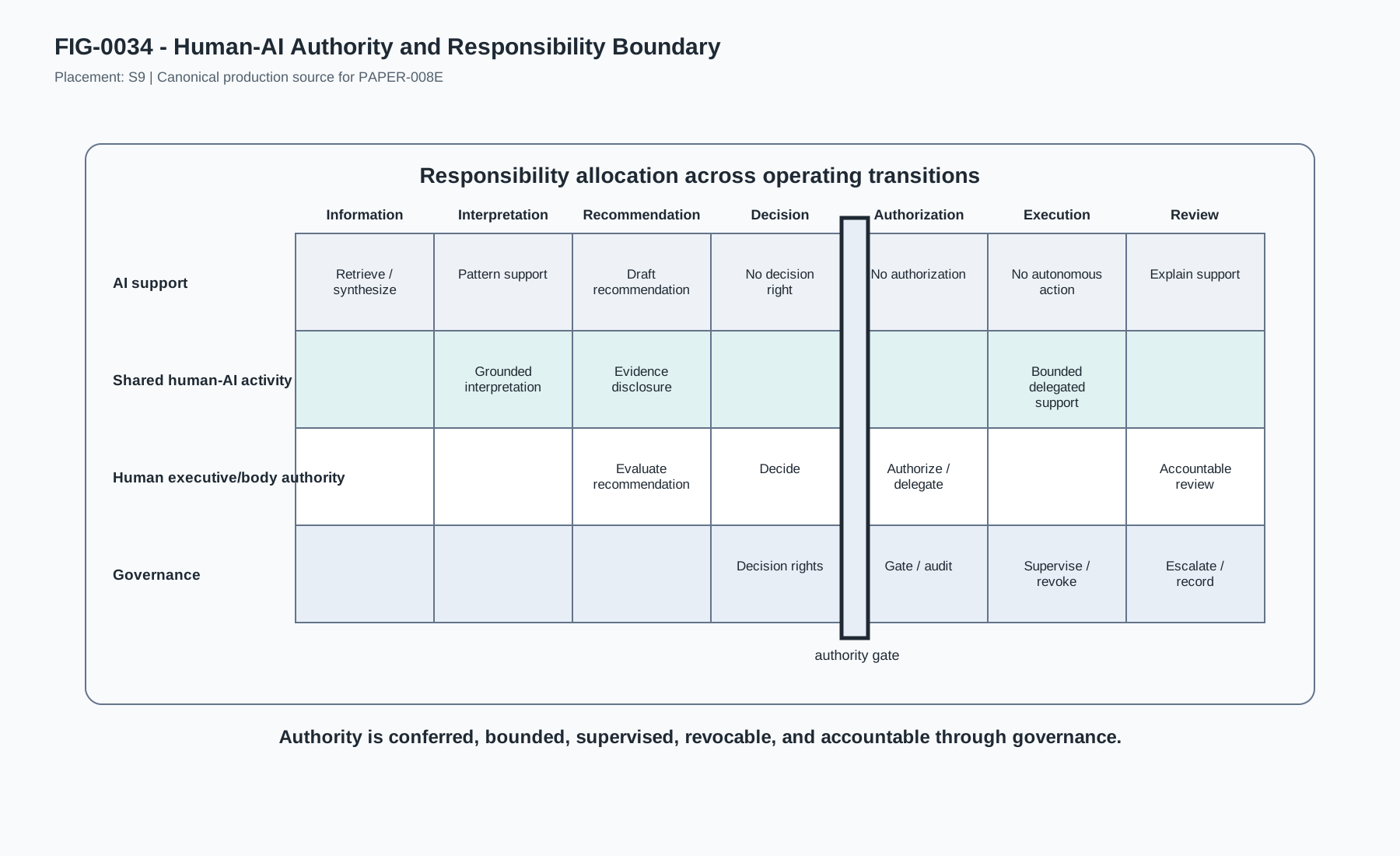
Long description: see `figures/FIG-0034/accessibility.md`.
Governance also protects executive teams from false consensus. Shared operating experiences can strengthen alignment, but only if they preserve dissent, provenance, unresolved disagreement, and decision rights. Otherwise, AI-mediated summarization may erase minority interpretations or turn preliminary convergence into apparent consensus. The model therefore requires contestation as a mechanism and dissent preservation as a governance condition. Executives should be able to challenge a representation, request evidence, defer a decision, escalate authority, record disagreement, or require follow-up without the experience treating disagreement as failure.
Table 6, Governance and Failure Responses, maps failure modes to governance responses.
<a id="table-6"></a>
Table 6. Governance and Failure Responses
| Failure mode | Transition affected | Governance response | Source basis | Residual risk |
|---|---|---|---|---|
| AI recommendation treated as decision. | Recommendation to judgment. | Explicit separation of recommendation, judgment, decision and authorization. | Fama and Jensen; Lee and See; NIST. | Executives may still over-rely on persuasive explanations. |
| Unauthorized organizational change. | Decision to authorization to execution. | Decision-rights check, authority provenance, escalation or rejection. | Aghion and Tirole; Fama and Jensen; Kroll et al. | Informal authority may bypass formal paths. |
| Hidden evidence weakness. | Evidence disclosure. | Provenance, uncertainty, missing-evidence statement and contestability. | Miller; Diakopoulos; Raji et al. | Evidence can overload or mislead if poorly structured. |
| Unreviewed algorithmic influence. | AI synthesis and recommendation. | Internal audit, accountability record and human oversight. | Raji et al.; Kroll et al.; ISO/IEC 42001; NIST. | Licensed standards require final clause verification. |
| Dissent erased by shared briefing. | Team conversation and decision memory. | Dissent trace, repair path and psychological-safety boundary condition. | Clark and Brennan; Edmondson; Cooke et al. | Organizational politics may suppress dissent. |
| Stale memory drives future action. | Memory to future briefing. | Freshness, expiry, correction and supersession. | Walsh and Ungson; Wegner; Orlikowski and Yates. | Memory can institutionalize error. |
Relevant failures include agenda capture by AI prioritization, overconfidence in compressed summaries, stale organizational state, unauthorized action, hidden delegation, memory institutionalizing error, untraceable recommendations, and suppressed dissent. Governance responses include provenance, freshness indicators, uncertainty disclosure, authority gating, revocable delegation, audit trails, contestation, expiry, supersession, and learning review. Residual risk remains. Informal power, political behavior, incentive conflicts, and weak psychological safety can undermine even well-designed governance. The framework therefore treats governance as necessary but not sufficient.
Governance is also temporal. Authority may be valid at one moment and invalid later because circumstances change, delegated rights expire, evidence becomes stale, or a decision is superseded. Memory may preserve a rationale that later turns out to be wrong. An operating episode must therefore make governance reviewable across time, not merely at the moment of decision. This temporal view links authority to continuity and learning: future episodes should be able to recover what was decided, why it was authorized, what uncertainty remained, what evidence was used, what dissent was recorded, and what outcomes followed.