
Evaluation and Research Agenda
Because this paper is conceptual, its propositions require future empirical evaluation. Figure 6 presents an evaluation architecture that treats EOE as a multi-layer phenomenon. Evaluation should examine constructs, transitions, interaction quality, governance, team-level operation, and longitudinal learning.
<a id="fig-6"></a>
Figure 6
Executive Operating Experience Evaluation Architecture
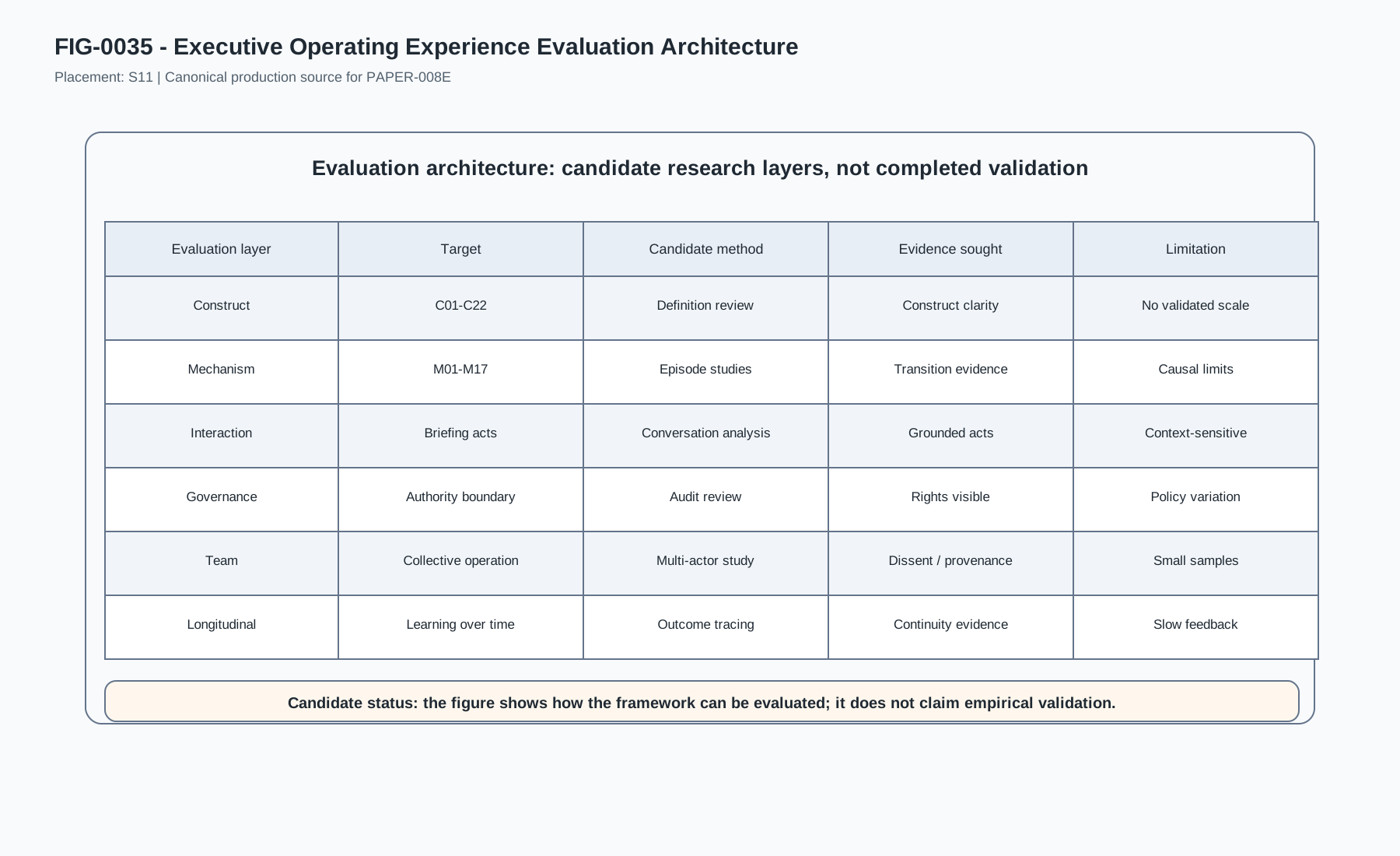
Long description: see `figures/FIG-0035/accessibility.md`.
Table 7, Evaluation Methods, maps these layers to candidate methods and evidence types.
<a id="table-7"></a>
Table 7. Evaluation Methods
| Evaluation layer | Target | Method | Evidence produced | Limitation |
|---|---|---|---|---|
| Construct validity | Construct clarity and boundary consistency. | Expert review, construct mapping and design-science evaluation. | Construct adequacy and boundary defects. | Does not test effects. |
| Briefing cognition | Situation awareness, comprehension and projection. | Situation-awareness measures and scenario studies. | Comprehension/projection scores and uncertainty recall. | Measures require adaptation to executive context. |
| Cognitive load | Burden of briefing and evidence disclosure. | NASA-TLX or adapted workload assessment. | Workload ratings and overload patterns. | Workload alone does not indicate decision quality. |
| Trust and reliance | Reliance on AI-supported recommendations. | Trust/reliance scales and calibration tasks. | Appropriate reliance, misuse/disuse patterns. | Trust measures are not authority measures. |
| Conversation and team operation | Grounding, repair, dissent and shared understanding. | CSCW/team cognition studies. | Repair frequency, dissent trace, shared understanding. | Requires psychologically safe participation. |
| Governance and authority | Unauthorized action, escalation and auditability. | Audit simulation, incident review, governance trace analysis. | Invalid action rates and escalation quality. | Simulation may not capture informal politics. |
| Organizational continuity | Memory, follow-up and learning over time. | Longitudinal case/process study. | Context restoration, outcome comparison, learning uptake. | Field effects are slow and context-dependent. |
At the awareness layer, future studies can examine whether structured briefings improve perception, comprehension, and projection of organizational state compared with dashboards, reports, or conversational summaries, using situation-awareness constructs such as perception, comprehension, and projection while recognizing that executive-organization measures still require operationalization (Endsley 1995). At the attention layer, studies can test whether intent, consequence, uncertainty, reversibility, dependency, and authority improve relevance judgments and reduce distraction. At the trust and reliance layer, studies can evaluate whether progressive evidence disclosure improves calibration relative to confidence-only displays, drawing on trust in automation, automation misuse/disuse, and explanation research while retaining the need for a final method-source table (Lee and See 2004; Parasuraman and Riley 1997; Miller 2019). At the authority layer, studies can test whether separating recommendation, judgment, decision, authorization, and execution reduces unauthorized or poorly understood organizational change.
At the conversational layer, future work can compare grounded conversational operating protocols with unstructured chat. Relevant outcomes include clarification quality, repair, evidence inspection, unresolved-question tracking, and decision traceability. At the memory layer, studies can examine whether session summaries, decision rationale, dissent, evidence, outcome comparison, and follow-up improve continuity across executive episodes. At the collective layer, research can study whether shared executive briefings improve alignment while preserving dissent and avoiding false consensus. At the longitudinal layer, research can examine whether operating memory supports organizational learning without institutionalizing error.
Several research designs are possible. Laboratory studies may isolate attention, evidence disclosure, or authority transitions. Field studies may observe executive briefings in organizations using AI-mediated operating systems. Design science research may instantiate and evaluate prototype operating episodes while preserving conceptual boundaries. Longitudinal case studies may examine how memory and learning evolve over time. Comparative studies may contrast EOE-informed briefings with dashboards, reports, or chat-based executive assistants. The evaluation agenda should remain modest: the framework is evaluable, but it is not yet validated.
Design science research is especially relevant because EOE is proposed as a design-theory framework. Future instantiations should specify the artifact class, kernel theories, design principles, mechanisms, evaluation criteria, and context of use before claiming contribution. Evaluation should then distinguish construct clarity, mechanism performance, interaction quality, governance integrity, and organizational learning effects. This distinction is important: a prototype can illustrate EOE, and a design study can test selected mechanisms, but neither automatically validates the full theory.
Evaluation should also include negative cases. Researchers should examine when EOE fails, when executives ignore evidence, when AI recommendations dominate attention, when dissent is suppressed, when memory preserves obsolete rationale, and when authority checkpoints become ceremonial. These failures are theoretically valuable because the model predicts that correspondence, authority, and continuity depend on transition quality. A mature research program should therefore evaluate not only whether EOE improves outcomes, but also which governance conditions are necessary for it not to degrade executive judgment.
Future research should proceed in staged form. The first stage should refine measurement instruments for EOE constructs and transitions. The second should compare alternative briefing designs under controlled conditions. The third should study executive teams and boards where disagreement, authority, and memory are collective rather than individual. The fourth should examine longitudinal organizational learning across repeated operating episodes. The fifth should study boundary conditions, including organizations with weak governance, contested data, high political sensitivity, or rapidly changing authority structures. This staged agenda protects the framework from premature effect claims while making its propositions empirically reachable.
The staged agenda also prepares the expected downstream Paper 009 through Paper 013 sequence without treating those papers as already registered Canon records. Paper 009 should be able to focus on scholarly review and publication preparation for EOE. Paper 010 should be able to examine empirical or design-science validation of executive briefing mechanisms. Paper 011 should be able to examine collective executive and board operating episodes. Paper 012 should be able to examine memory, continuity, and organizational learning across repeated executive episodes. Paper 013 should be able to examine governance, authority, and risk in AI-native executive operation. This alignment keeps future work connected to the PAPER-008 model while preserving the current manuscript's conceptual boundary.