
Executive Operating Experience: Definition, Unit, and Boundary
Executive Operating Experience is defined as a governed human-AI joint cognitive operating episode through which represented organizational reality is interpreted, prioritized, briefed, inspected, discussed, authorized, acted upon, remembered, and learned from across organizational time.
Several parts of this definition are essential. First, EOE is governed. Authority, evidence, uncertainty, provenance, contestability, delegation, revocation, and auditability are endogenous to the experience, not external controls added after the fact. Second, EOE is human-AI and joint cognitive. AI may participate in observation, synthesis, comparison, recommendation, and bounded support, while human or institutionally authorized actors retain judgment and authority. Third, EOE is an operating episode. It is not the entire organization, and it is not a user interface session. It is a bounded but temporally connected episode in which organizational representation becomes attention, briefing, conversation, decision, action, memory, and learning. Fourth, EOE is representational. It operates through projections of organizational reality, not through complete access to reality itself. Fifth, EOE is temporal. The episode inherits prior memory and produces future continuity.
Figure 2 defines this system boundary. The figure distinguishes the executive operating episode from the organization, the executive participant, AI participants, governance, and the broader organizational operating loop. Its purpose is to prevent two common conflations. The first conflation is treating EOE as a product surface or dashboard. The second is treating AI participation as organizational authority. The figure shows that the operating episode is nested within organizational operation and constrained by governance.
<a id="fig-2"></a>
Figure 2
Executive Operating Experience System Boundary
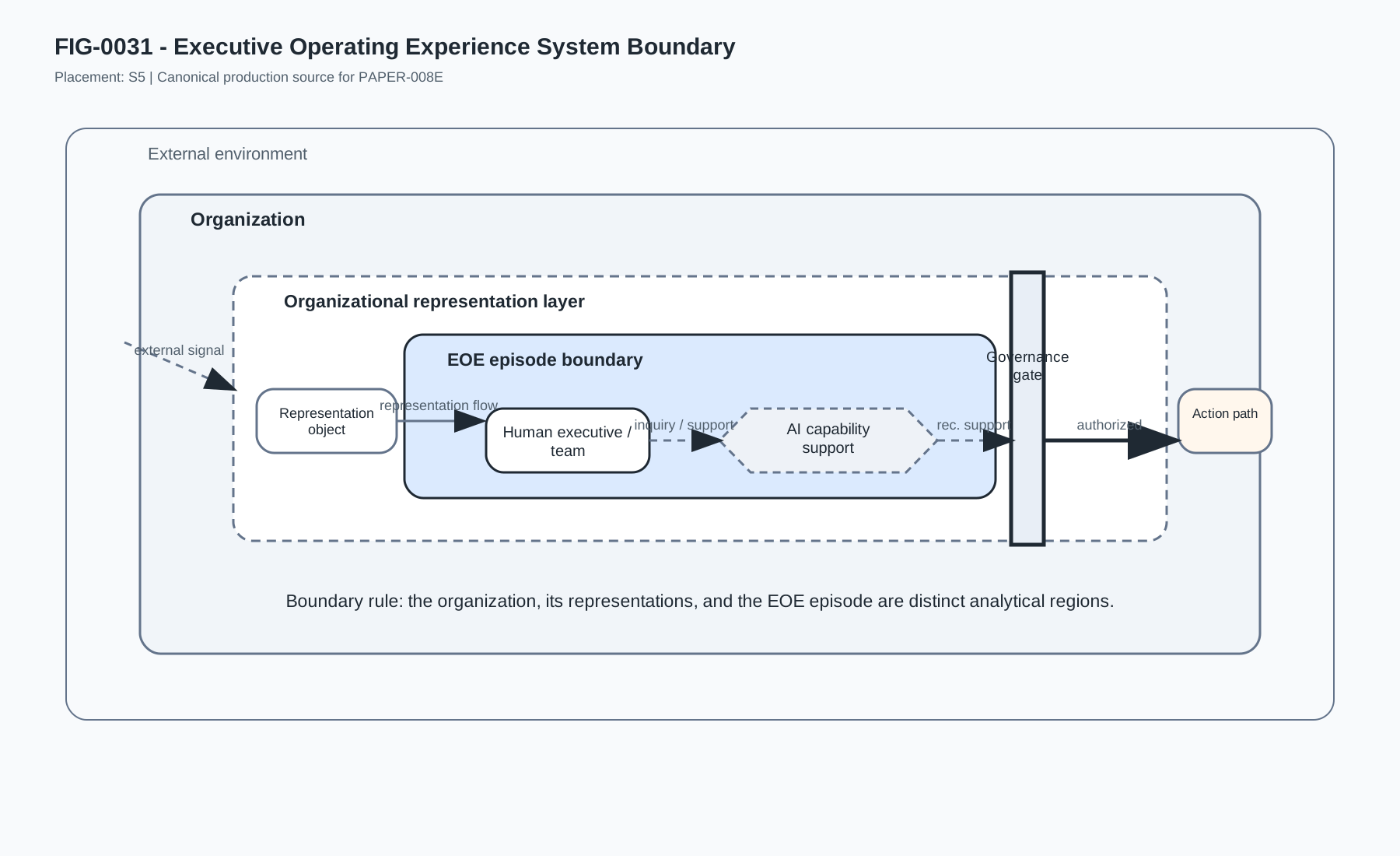
Long description: see `figures/FIG-0031/accessibility.md`.
The unit of analysis matters because it determines what the theory can and cannot claim. At the narrowest level, one can study an individual executive's interaction with a briefing. At a wider level, one can study an executive team or board using a shared briefing to establish understanding, dissent, and commitments. At the organizational level, one can study how briefing episodes feed memory, decisions, learning, and future operating cycles. This paper uses the executive operating episode as the primary unit while acknowledging these nested levels. It does not claim to explain all political, cultural, or informal dynamics of executive life. It models the governed operating sequence by which represented organizational reality becomes consequential executive operation.
The boundary also prevents overextension. EOE is not an empirical measure of organizational performance, though it may affect performance through future mechanisms. It is not a replacement for strategy, governance, leadership, or organizational design. It is not a universal model of all AI use. It is a conceptual account of a specific organizational episode in which executives operate through AI-mediated representations. The theory can therefore make claims about transition quality, authority preservation, correspondence, memory, and evaluability, while leaving broader organizational effectiveness claims to future empirical work.