
Conceptual Model of Executive Operating Experience
The conceptual model integrates twenty-two constructs into a reduced operating sequence. Organizational Reality (C01) refers to the actual, imperfectly known condition of the organization. Organizational Representation (C02) is a structured projection of that reality with meaning, provenance, time, and limits. Organizational State (C03) is the represented condition at an operating horizon. Correspondence Condition (C04) names the degree to which representation faithfully corresponds to organizational reality, including known uncertainty and potential failure. Interpretation (C05) transforms representation into meaning. Executive Context (C06) situates interpretation in current intent, responsibilities, authority, time, and constraints. Executive Attention (C07) selects what requires awareness or action. Executive Briefing (C08) compresses context while preserving evidence, uncertainty, authority, and action options.
Evidence (C09) provides provenanced support for or against a claim, recommendation, decision, or learning. Uncertainty (C10) represents confidence limits, ambiguity, freshness, conflict, or incompleteness. Conversation (C11) enables grounded inquiry, clarification, challenge, comparison, repair, and commitment. Recommendation (C12) proposes an interpretation or course of action grounded in evidence and uncertainty. Executive Judgment (C13) evaluates values, risks, alternatives, consequences, and timing. Decision (C14) is an authorized human or collective commitment. Authorization (C15) is the valid grant of permission to execute, delegate, or commit resources. Action and Execution Trace (C16) record authorized organizational change or work initiation. Outcome (C17) captures resulting effects. Operating Memory (C18) retains episode traces, rationale, evidence, unresolved matters, and outcomes. Continuity (C19) restores relevant context across episodes. Organizational Learning (C20) updates beliefs, representations, routines, priorities, or designs through outcome comparison. Organizational Time (C21) structures operating horizons, rhythm, urgency, freshness, and review. Governance (C22) defines rights, constraints, provenance, contestation, delegation, revocation, and auditability.
Table 3, Construct Definition Summary, provides the concise construct register for manuscript use.
<a id="table-3"></a>
Table 3. Construct Definition Summary
| Construct group | Core constructs | Canonical role | Boundary |
|---|---|---|---|
| Organizational condition | Organizational reality, organizational representation, organizational state, correspondence condition. | Establish what is represented and how representation can align or diverge from organizational reality. | Representation never equals the organization. |
| Executive cognition | Interpretation, executive context, executive attention, executive briefing. | Transform state into significance and attention. | Attention is not a notification queue. |
| Evidence and uncertainty | Evidence, uncertainty. | Ground and qualify claims, recommendations and decisions. | Data is evidence only when tied to a claim. |
| Conversation and recommendation | Conversation, recommendation. | Support inquiry, explanation, challenge, repair and bounded proposals. | Recommendation is not judgment, decision or execution. |
| Authority and action | Executive judgment, decision, authorization, action and execution trace, governance. | Preserve human and organizational authority. | AI cannot self-authorize organizational change. |
| Memory and learning | Outcome, operating memory, continuity, organizational learning, organizational time. | Preserve context, compare outcomes and support future briefings. | Memory requires correction, expiry and supersession. |
Figure 3 shows the core sequence and feedback loops. The model begins with represented organizational state rather than raw data because executive operation depends on meaningful organizational projections. It then moves through interpretation, attention, briefing, evidence and uncertainty disclosure, conversation, recommendation, judgment, decision, authorization, action, outcome, memory, continuity, and learning. Governance surrounds and constrains the sequence. Organizational time shapes the rhythm and relevance of every transition.
<a id="fig-3"></a>
Figure 3
Executive Operating Experience Conceptual Model
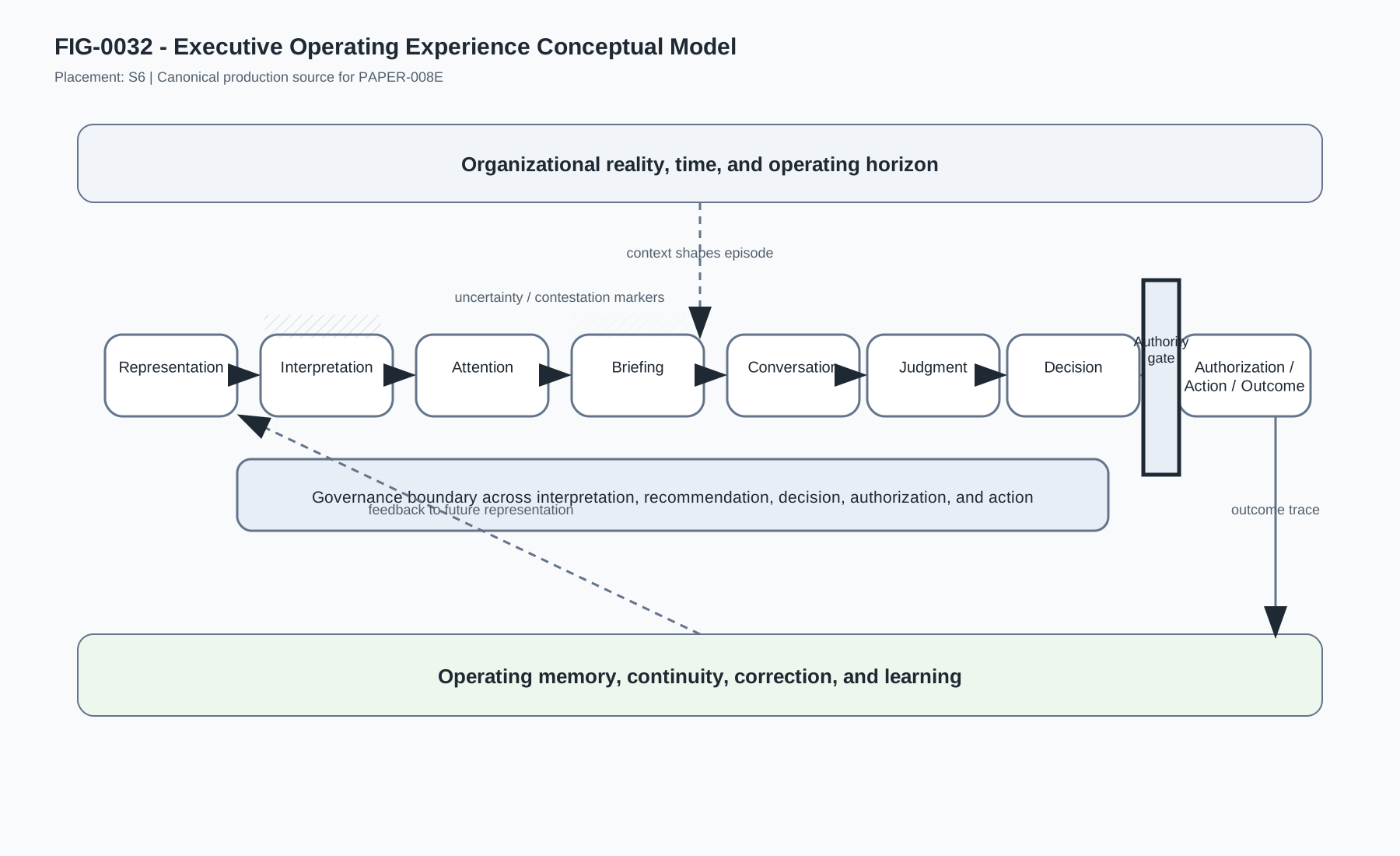
Long description: see `figures/FIG-0032/accessibility.md`.
The model should be read as a conceptual integration, not as a process implementation. It does not specify software behavior, interface controls, or a universal sequence that every executive action must follow in practice. Rather, it identifies the constructs that must remain distinguishable if AI-mediated executive operation is to preserve organizational meaning. The central theoretical concern is correspondence: whether the representations and transitions through which executives operate remain accountable to organizational reality, evidence, authority, and memory.
Two construct distinctions deserve emphasis. The first is the distinction between organizational reality and organizational representation. The model does not assume that the organization can be fully captured. It assumes that executives must act through partial, situated, time-bound representations and that those representations must carry enough provenance, freshness, and uncertainty to remain challengeable. The second is the distinction between recommendation, judgment, decision, authorization, and action. These constructs are often blurred in AI-mediated systems because language can make a proposed course sound complete. The conceptual model keeps them separate because each transition changes responsibility. A recommendation proposes; judgment evaluates; decision commits; authorization grants permission; action changes the organization. Collapsing these distinctions is a governance failure, not a mere interaction flaw.