
Conceptual Foundations and Unit of Analysis
The unit of analysis is the organization as an ongoing knowledge-bearing, authority-bearing, representation-producing social system operating across human actors, AI agents, software systems, routines, decisions, evidence, memory, and governance. OKK is examined as an organizational construct that preserves governed organizational knowledge and correspondence across changing representations, projections, decisions, execution, outcomes, and learning.
An Organizational Knowledge Kernel is a governed, correspondence-preserving organizational knowledge structure through which identity, intent, knowledge, memory, state, representations, projections, decisions, execution, evidence, outcomes, learning, adaptation, provenance, authority, traceability, freshness, confidence, contestability, and lifecycle state remain connected across time.
The construct has six necessary conditions. First, knowledge must be admitted through governance rather than assumed from recorded data. Second, authority must distinguish observation, inference, proposal, recommendation, decision, and authoritative knowledge. Third, memory must be distinguished from current organizational state. Fourth, projections must remain grounded in source knowledge and disclose scope. Fifth, provenance and evidence must remain inspectable. Sixth, correspondence must be preserved across changing representations. If these conditions are absent, the phenomenon may still be a KMS, knowledge graph, digital twin, repository, event store, workflow engine, or AI memory system, but it is not an OKK as theorized here.
The OKK does not explain all organizational cognition, all culture formation, all learning, all governance, or all technology use. It explains governed knowledge continuity under representational plurality and AI-mediated transformation. Figure 2 shows the conceptual architecture.
Figure 2
Organizational Knowledge Kernel Conceptual Architecture
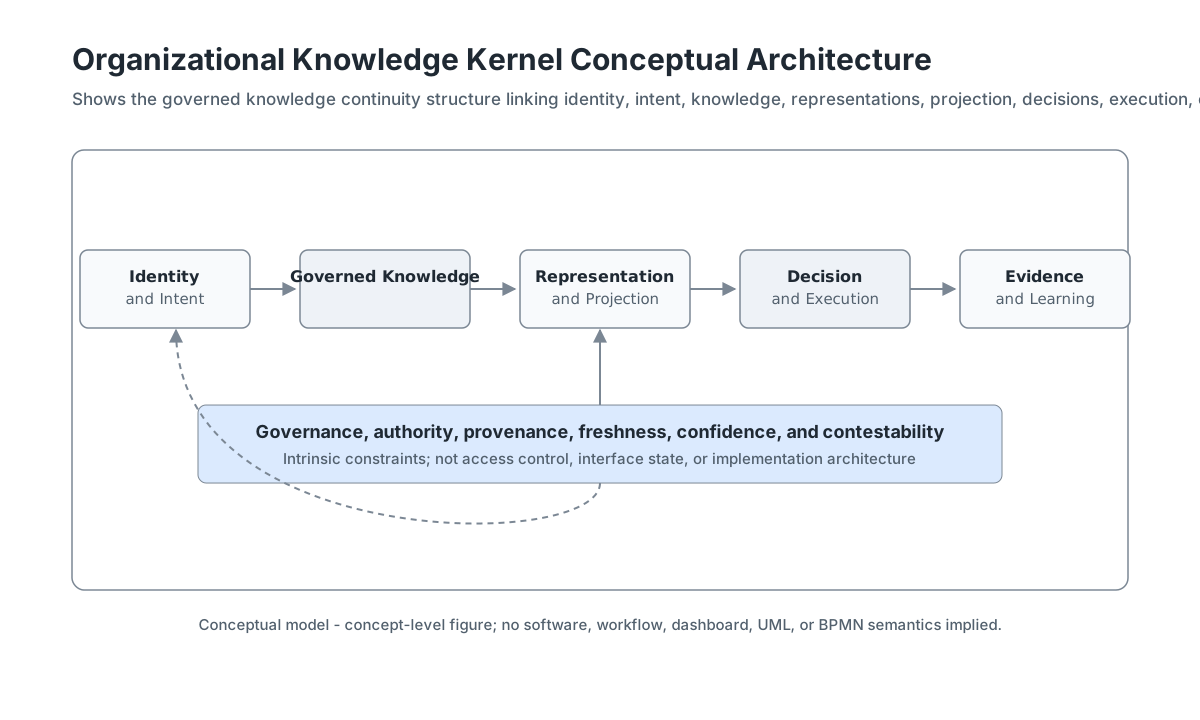
Table 3 summarizes the central mechanisms.
Table 3. Mechanism Catalogue
| Mechanism | Function | Related Propositions |
|---|---|---|
| Identity anchoring | Orients interpretation. | OKK-DP01 |
| Governed admission | Distinguishes data, information, and knowledge. | OKK-DP02 |
| Memory-state separation | Prevents stale-assumption action. | OKK-DP03 |
| Authority qualification | Distinguishes recommendation from decision. | OKK-DP04 |
| Provenance binding | Makes origin and derivation inspectable. | OKK-DP05 |
| Governed projection | Enables plural representations without fragmentation. | OKK-DP06 |
| Correspondence checking | Detects and repairs meaning drift. | OKK-DP07 |
| Decision-execution linkage | Connects intent to work and drift detection. | OKK-DP08 |
| Evidence-grounded learning | Converts outcomes into governed revisions. | OKK-DP09 |
| Governed adaptation | Preserves identity through change. | OKK-DP10 |