
Evaluation Framework
The evaluation framework is explicitly future-oriented. It does not claim empirical validation. It does not define validated instruments, final measures, scales, survey items, or metrics. It identifies candidate observable implications, possible evidence sources, feasible research designs, validity risks, reliability considerations, and rival explanations.
Every proposition is evaluable in principle. For example, identity and intent anchoring may be examined through actor agreement, intent-to-knowledge links, and representation coherence reviews. Governed knowledge admission may be studied through decision artifacts, governance reviews, and archival records. Authority qualification may be examined through AI-assisted decision sessions, review logs, and controlled human-AI studies. Governed projection may be studied through comparisons among briefings, role views, AI summaries, and source artifacts. These are candidate evaluation pathways, not findings.
Table 6 records candidate operationalizations, and Table 7 maps propositions to candidate evidence. Figure 11 presents the evaluation logic as future evidence pathways. Governance remains part of the evaluation because authority, admission, contestation, and revision are model dimensions, not external controls.
Table 6. Candidate Operationalizations
| Construct | Candidate Indicator | Status |
|---|---|---|
| Knowledge admission | Admission records, review logs, accepted/rejected claims | Candidate only |
| Authority qualification | Distinction among recommendations, proposals, and decisions | Candidate only |
| Projection grounding | Links from projection to source knowledge and scope | Candidate only |
| Correspondence preservation | Reconciliation of contradictions across representations | Candidate only |
| Evidence-to-learning conversion | Governed disposition of outcomes into revised knowledge | Candidate only |
Table 7. Proposition-to-Evidence Mapping
| Proposition Family | Candidate Evidence | Rival Explanations |
|---|---|---|
| Identity and intent | Actor agreement, intent-to-knowledge links | Culture, hierarchy |
| Admission and authority | Decision records, governance reviews | Managerial expertise, training |
| Projection and correspondence | Cross-role view comparison, source fidelity checks | Interface quality, boundary objects |
| Execution and learning | Decision-work-evidence links, retrospectives | Project controls, professional expertise |
| Human-AI contribution | Source-grounded AI outputs, escalation logs | AI model quality, user expertise |
Figure 11
Evaluation Logic and Future Evidence Pathways
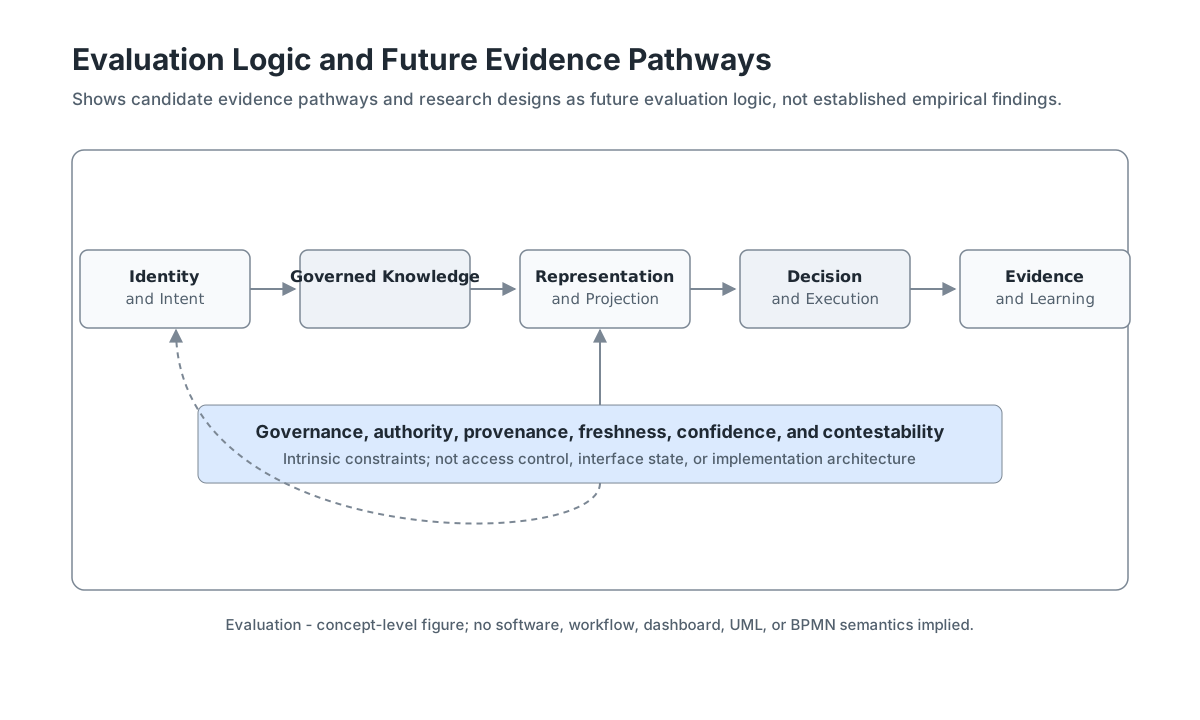
A plausible future study would use a longitudinal comparative case design in knowledge-intensive organizations adopting AI-mediated decision support. Researchers would compare how source grounding, authority qualification, memory-state distinction, and projection governance affect interpretation coherence and decision traceability over time while testing rival explanations such as hierarchy, culture, technical integration, professional expertise, and AI model capability. Such a design would evaluate OKK mechanisms without treating software integration as proof of organizational knowledge continuity.