Formal Propositions
The proposition set is preserved exactly from PAPER-009D. The main text emphasizes four primary propositions; supporting and integrative propositions are presented in Table 4 and Figure 9.
Proposition 1 (Identity and intent anchoring). The stronger the anchoring of organizational knowledge in explicit organizational identity and governed intent, the greater the coherence of knowledge interpretation across representations and actors.
Proposition 2 (Governed knowledge admission). Organizations that distinguish data, information, and organizational knowledge through governed admission will exhibit lower risk of decision incoherence than organizations that treat recorded or processed data as knowledge.
Proposition 3 (Authority qualification). Explicit authority qualification will reduce the likelihood that AI-generated summaries, recommendations, or projections are mistaken for authoritative organizational decisions.
Proposition 4 (Governed projection). Governed projection practices will allow multiple participant-specific representations to coexist without fragmenting organizational knowledge when source, scope, authority, freshness, confidence, and contestability are preserved.
The supporting propositions explain memory-state distinction, provenance and evidence grounding, decision-execution traceability, evidence-grounded learning, freshness and confidence disclosure, and contestability. The integrative propositions explain correspondence preservation, governed adaptation, human-AI contribution, multi-agent coordination, and sociotechnical mediation.
Table 4. Formal Proposition Registry
| ID | Type | Statement |
|---|---|---|
| OKK-DP01 | Primary | The stronger the anchoring of organizational knowledge in explicit organizational identity and governed intent, the greater the coherence of knowledge interpretation across representations and actors. |
| OKK-DP02 | Primary | Organizations that distinguish data, information, and organizational knowledge through governed admission will exhibit lower risk of decision incoherence than organizations that treat recorded or processed data as knowledge. |
| OKK-DP03 | Supporting | Organizations that distinguish retained organizational memory from current organizational state will be better able to use historical knowledge without acting on stale or superseded assumptions. |
| OKK-DP04 | Primary | Explicit authority qualification will reduce the likelihood that AI-generated summaries, recommendations, or projections are mistaken for authoritative organizational decisions. |
| OKK-DP05 | Supporting | Representations with inspectable provenance and admissible evidence grounding will support stronger cross-actor knowledge continuity than representations whose origins and evidentiary basis are opaque. |
| OKK-DP06 | Primary | Governed projection practices will allow multiple participant-specific representations to coexist without fragmenting organizational knowledge when source, scope, authority, freshness, confidence, and contestability are preserved. |
| OKK-DP07 | Integrative | Correspondence preservation across human, AI, workflow, and software-mediated representations will reduce contradictory organizational interpretations during AI-native operation. |
| OKK-DP08 | Supporting | Stronger traceability from intent and evidence to decisions and execution will improve the organization's ability to detect execution drift from authorized organizational commitments. |
| OKK-DP09 | Supporting | Evidence generated through execution will improve organizational learning only when outcomes are interpreted, admitted, and revised through governance rather than treated as self-interpreting results. |
| OKK-DP10 | Integrative | Governed adaptation will preserve organizational identity and improve organizational resilience more effectively than ungoverned representational drift or local learning alone. |
| OKK-DP11 | Supporting | Freshness and confidence disclosure in AI-mediated projections will improve reliance calibration and reduce overreliance on stale, uncertain, or contested organizational knowledge. |
| OKK-DP12 | Supporting | Contestability mechanisms will reduce false closure in organizational knowledge claims, especially when claims are generated, summarized, or transformed through AI systems. |
| OKK-DP13 | Integrative | AI agents will contribute more constructively to organizational cognition when their outputs remain grounded in governed source knowledge and human-accountable authority. |
| OKK-DP14 | Integrative | Sociotechnical mediation will strengthen organizational knowledge continuity when software systems are treated as representational infrastructure rather than sources of organizational legitimacy. |
Figure 9
Formal Proposition Architecture
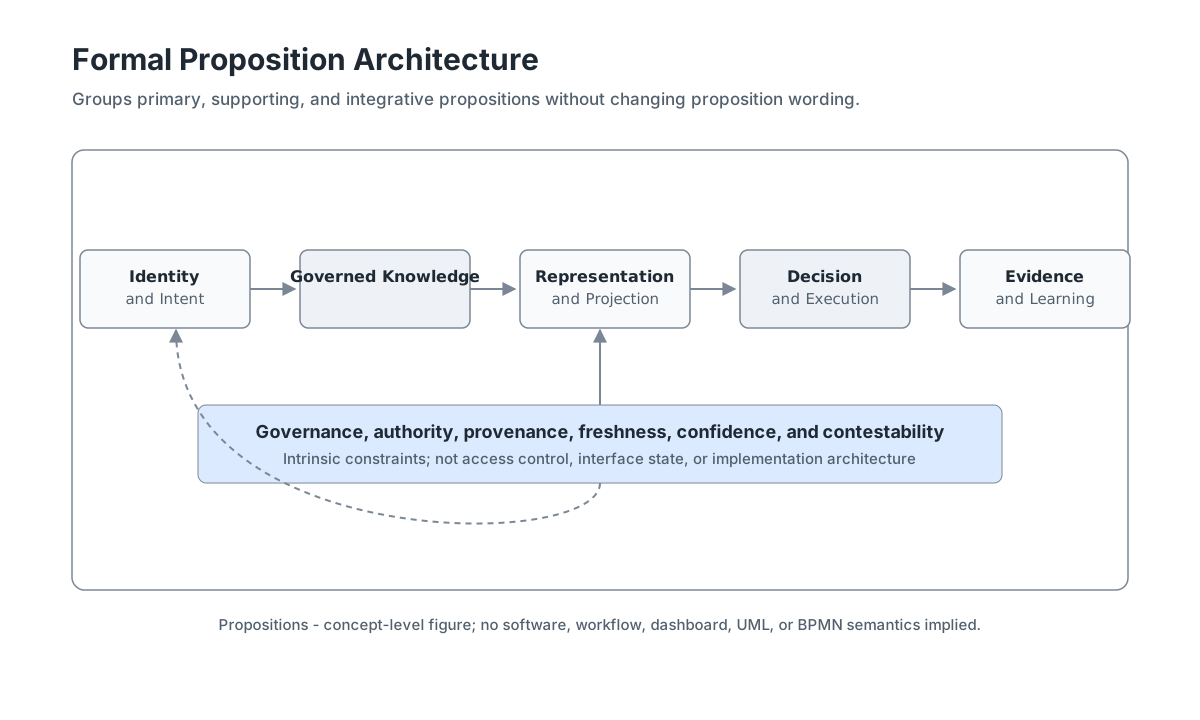
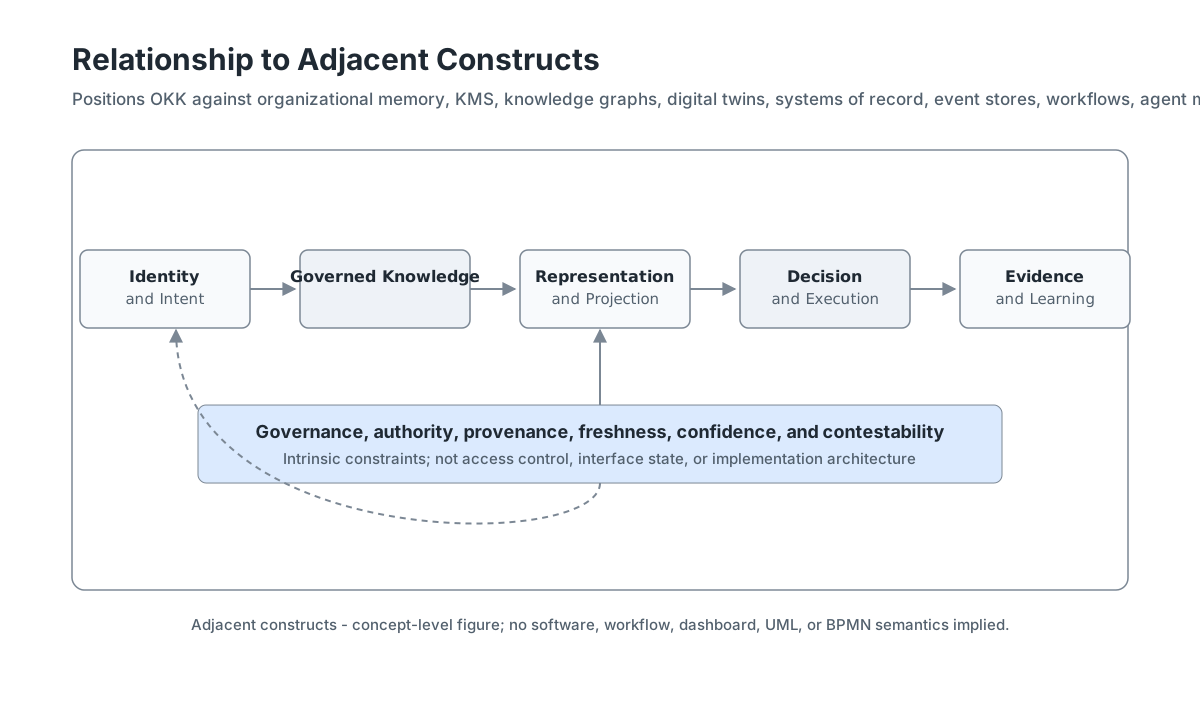
Figure 10 summarizes the relationship between OKK and adjacent constructs. The point is not that adjacent constructs are weak. The point is that each explains a partial domain, while OKK explains their governed integration under AI-native representational plurality.
Figure 10
Relationship to Adjacent Constructs