
Introduction
Organizations increasingly operate through dense networks of representations: strategies, policies, roadmaps, decision records, meeting summaries, work packages, metrics, evidence registers, governance records, diagrams, models, system traces, and AI-generated summaries. These representations do not merely record organizational activity. They shape what actors attend to, what they believe is true, which decisions they consider legitimate, what work becomes authorized, and what later counts as evidence or learning.
The problem becomes sharper in AI-native organizations. AI agents can retrieve records, summarize evidence, generate explanations, compare alternatives, recommend action, prepare briefings, and create new projections from existing organizational material. These capabilities can expand organizational cognition, but they also intensify a familiar risk: recorded data, processed information, or fluent machine output may be mistaken for governed organizational knowledge.
This paper addresses that risk by theorizing the Organizational Knowledge Kernel (OKK). The OKK is not a database, knowledge graph, dashboard, event store, workflow engine, software service, product module, or AI-agent framework. It is a theory-level construct explaining how organizational knowledge remains legitimate, durable, interpretable, projectable, revisable, and actionable across human-AI organizational operation.
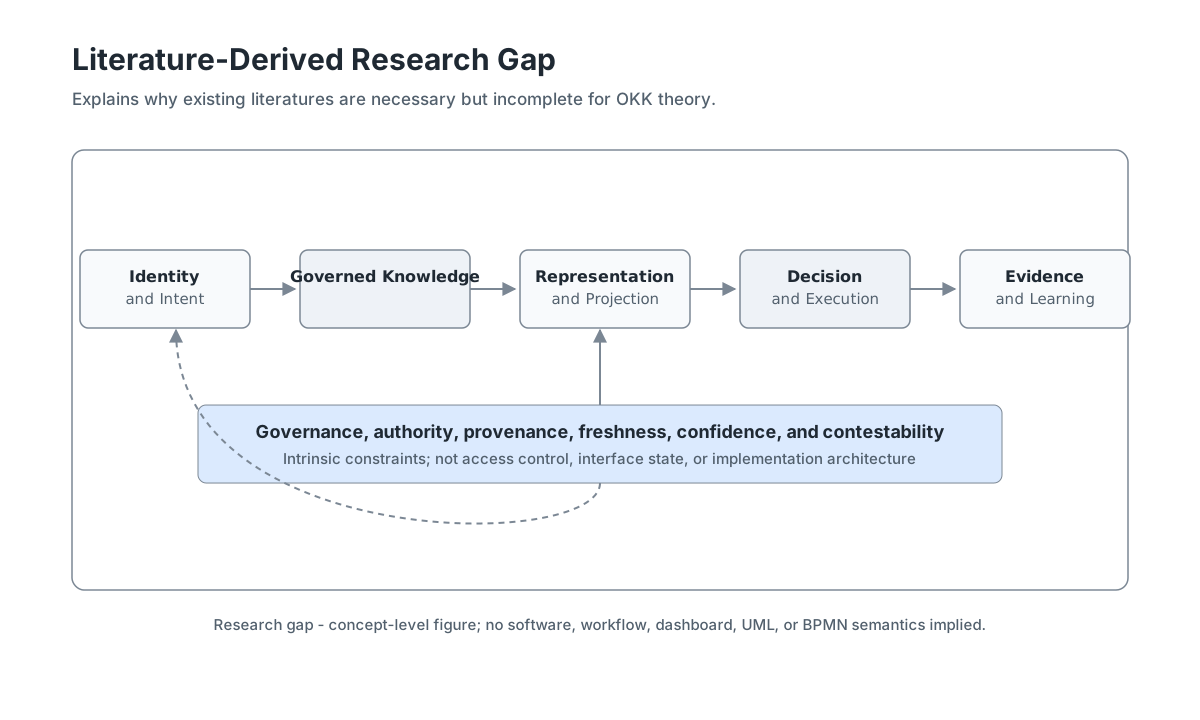
The central argument is shown in Figure 1. AI-native organizations require persistent, governed, machine-interpretable organizational context because organizational knowledge is continuously transformed across actors, artifacts, projections, decisions, execution, evidence, and learning. Existing theories explain important components of this transformation, but no single adjacent construct explains the complete governed continuity problem.
Figure 1
Literature-Derived Research Gap
The paper makes three contributions. First, it defines OKK as an organizational-theory construct distinct from organizational memory, knowledge management systems, enterprise knowledge graphs, digital twins, systems of record, enterprise architecture repositories, event stores, workflow engines, agent memory, and organizational operating systems. Second, it develops the constitutive constructs and mechanisms through which OKK preserves knowledge continuity across identity, intent, authority, provenance, representation, projection, decision, execution, evidence, learning, and correspondence. Third, it presents propositions and a future evaluation framework that make the theory researchable while avoiding unsupported empirical claims.