
Cognitive Integrity
"Correspondence is what organizations do. Cognitive Integrity is what organizations become."
Beyond Consistency
Every organization strives for consistency: consistent branding, reporting, governance, processes, and execution. Consistency creates predictability, and predictability creates confidence. Yet consistency alone cannot explain why some organizations continue making sound decisions while everything around them changes. An organization can consistently optimize the wrong objectives. It can consistently execute an outdated strategy. It can consistently reinforce assumptions that no longer reflect reality. Consistency explains repetition. It does not explain coherent adaptation. Something more is required: not greater control or greater stability, but the ability to preserve coherence while continuously changing. That emergent capability is Cognitive Integrity.
What Emerges from Correspondence
The previous chapter introduced Correspondence as the continuous preservation of meaningful relationships across organizational representations. When those relationships endure over time, something remarkable begins to happen. The organization develops the ability to reason coherently across continuous change. Purpose remains visible in everyday decisions. Strategies evolve without losing their identity. Projects reinforce rather than compete with one another. Learning accumulates instead of disappearing. Artificial intelligence strengthens understanding rather than creating fragmentation. None of these outcomes exists independently. Together they reveal a deeper organizational property: Cognitive Integrity. To understand this emergence, it helps to visualize Cognitive Integrity not as another organizational capability, but as the condition that arises when correspondence is continuously preserved.
Cognitive Integrity is the emergent condition that arises when correspondence is continuously preserved across the Representation Network. It enables organizations to maintain coherent judgment, cumulative learning, and adaptive capability while continuously evolving.
More Than Organizational Intelligence
Organizational intelligence is often described as the ability to gather information, analyze data, and make effective decisions. These capabilities matter. But intelligence alone is not enough. An organization may possess extraordinary analytical capability while gradually becoming incoherent. It may know more than ever before while understanding less.
Cognitive Integrity therefore asks a different question: not "How intelligent is the organization?" but "Does the organization continue thinking as one coherent system?"
The distinction appears subtle. Its consequences are profound. Integrity is not the absence of disagreement. It is the preservation of coherence through change.
Integrity Is Relational
Cognitive Integrity does not reside inside individual people, software systems, or policies. It emerges across relationships. A strategic decision possesses integrity because it remains connected to purpose. A project possesses integrity because it remains connected to strategy. Learning possesses integrity because it continues shaping future decisions. Artificial intelligence contributes to integrity when its outputs remain connected to organizational context. Every meaningful organizational capability depends upon these relationships remaining coherent. Integrity therefore cannot be managed by optimizing isolated parts. It must be cultivated across the entire Representation Network. Organizations preserve integrity not by preventing change, but by preserving the relationships that allow change to remain meaningful.
Thinking Across Time
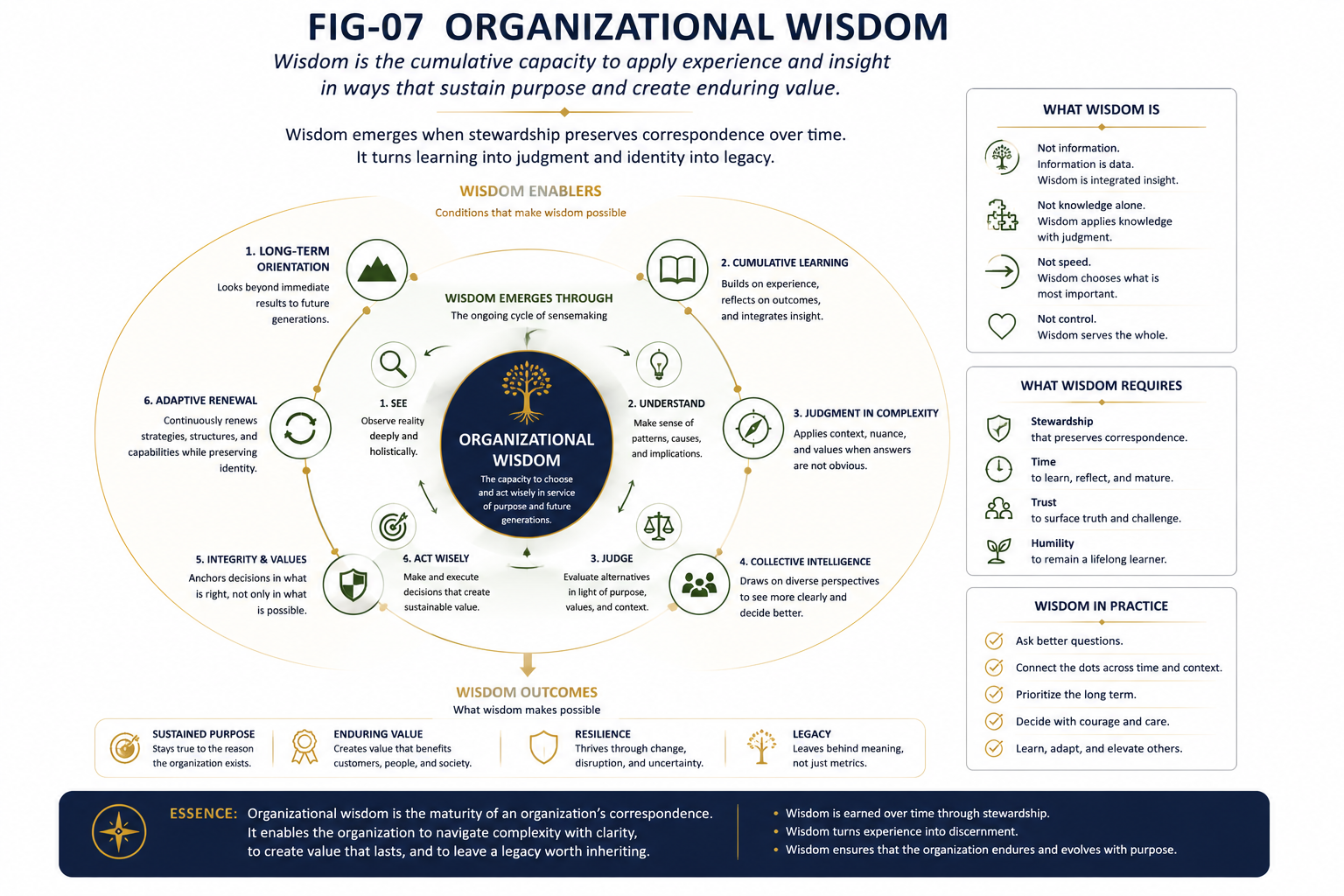
One of the defining characteristics of Cognitive Integrity is continuity. Healthy organizations rarely begin each year from the beginning. They carry understanding forward. Past decisions remain understandable. Lessons continue influencing future work. Purpose survives leadership transitions. Strategies evolve without losing identity. People leave. Technologies change. Markets transform. Yet the organization continues recognizing itself. Time becomes an ally rather than an enemy. Organizations without Cognitive Integrity experience the opposite. Each transformation begins as though no transformation had come before. Knowledge fragments. Learning becomes local. Memory weakens. The organization repeatedly rediscovers what it once knew. Integrity allows organizations to accumulate wisdom rather than merely accumulate experience.
AI and Cognitive Integrity
Artificial intelligence dramatically increases organizational reasoning capacity. It retrieves information instantly, recognizes patterns, summarizes complexity, generates alternatives, and supports decision-making. These capabilities are extraordinary. Yet artificial intelligence cannot create Cognitive Integrity by itself. AI inherits the coherence—or incoherence—of the Representation Network in which it participates. If organizational relationships remain healthy, AI amplifies organizational understanding. If those relationships have fragmented, AI accelerates fragmentation with equal efficiency. The quality of AI-assisted reasoning therefore depends not only on the intelligence of the model, but on the integrity of the organization itself. Future organizations will compete not simply through more capable AI. They will compete through stronger Cognitive Integrity.
Recognizing Integrity
Organizations with high Cognitive Integrity share recognizable characteristics. Purpose remains visible throughout daily work. Different departments describe the organization in remarkably similar ways. Strategic decisions remain understandable years after they were made. Learning consistently influences future priorities. Artificial intelligence produces recommendations that naturally fit organizational context. People rarely ask,
"Why are we doing this?"
because the answer is already embedded throughout the Representation Network. These organizations are not free from disagreement or uncertainty. Their strength lies elsewhere. They preserve coherence while continuously adapting.
Integrity Must Be Cultivated
Cognitive Integrity is never permanent. Every acquisition challenges it. Every reorganization reshapes it. Every new technology influences it. Every AI-generated representation changes it. Organizations therefore do not achieve Cognitive Integrity once. They cultivate it continuously. Every meaningful relationship either strengthens or weakens it. Every decision either reinforces coherence or quietly fragments it. Integrity is not maintained through control. It is maintained through stewardship.
The Leadership Question
Once Cognitive Integrity becomes visible, leadership begins to look different. Traditional leadership asks: How should we direct people? How should we allocate resources? How should we improve performance? These questions remain important. The Correspondence perspective introduces another.
Who is responsible for preserving the conditions under which organizational meaning remains coherent?
That question changes the role of leadership. Leadership is no longer understood primarily as authority. It becomes stewardship. The stewardship of organizational meaning. The next chapter explores what that responsibility requires.