
Correspondence
"Organizations endure not because they preserve everything, but because they preserve what must remain meaningfully connected."
The Missing Property
By now the essential pieces of the puzzle have appeared. Organizations create representations. Representations form networks. Those networks enable organizations to think, remember, learn, and adapt. Yet one question still remains. Why do some organizations preserve coherence while others gradually lose it? Two organizations may possess remarkably similar strategies, structures, technologies, and talent. One becomes increasingly resilient. The other slowly fragments. Why? The difference cannot be explained by the number of representations, the sophistication of technology, or the quality of individual decisions alone. It lies in something far less visible: whether the relationships that give those representations meaning continue surviving as the organization changes. This property has no widely accepted name in organizational theory. In this book, we call it Correspondence.
Beyond Alignment
For decades organizations have pursued alignment: strategic alignment, business alignment, IT alignment, operational alignment, and cultural alignment. These efforts have created enormous value. Alignment helps people move in the same direction. But direction alone cannot explain continuity. An organization can remain perfectly aligned around outdated assumptions. It can execute efficiently while gradually losing sight of its purpose. It can coordinate flawlessly while quietly fragmenting its understanding. Alignment explains direction; Correspondence explains continuity. It asks whether the relationships that give organizational meaning remain intact while everything else changes. To understand this distinction, it helps to visualize correspondence not as another management framework, but as the invisible property that preserves organizational coherence.
Correspondence is the continuous preservation of meaningful relationships among organizational representations. It enables purpose, strategy, decisions, actions, outcomes, learning, and memory to evolve together without losing coherence. Organizations remain healthy not because individual representations remain unchanged, but because the relationships between them continue preserving meaning.
Case Lens: Information Without Correspondence
Case classification: documented case.
The 9/11 Commission Report repeatedly emphasizes failures of information sharing, interpretation, and institutional coordination across agencies. For the purposes of this book, the relevance is not the specific national-security context. It is the broader organizational pattern. Information can exist in many places, and formal responsibility can be distributed across capable institutions, while the relationships needed to turn information into coherent judgment remain weak. That is the difference between data availability and correspondence. More information does not automatically create organizational understanding. Understanding depends on whether purpose, evidence, authority, memory, and action remain meaningfully connected at the moment they are needed.
What Correspondence Preserves
Correspondence does not preserve documents. It preserves meaning by keeping purpose connected to strategy, strategy connected to decisions, decisions connected to actions, actions connected to outcomes, outcomes connected to learning, and learning connected to future strategy. Every representation continues evolving. Correspondence ensures that evolution remains coherent. This distinction changes how we think about organizational change. Healthy organizations should change. Strategies should evolve. Technologies should improve. Artificial intelligence should generate new knowledge. Correspondence does not resist change. It makes meaningful change possible. An organization can transform almost everything about itself while remaining recognizably the same organization. Its identity resides not in static structures. It resides in enduring relationships.
Correspondence Is Continuously Created
Correspondence is never established once. It is renewed every day. Every strategic decision strengthens or weakens it. Every project contributes to it. Every policy influences it. Every AI-generated recommendation participates in it. Every lesson learned either reconnects the organization or quietly disappears. Correspondence is therefore not a governance document, a software platform, or a management process. It is an organizational capability, one that organizations continuously create or continuously lose. Organizations do not succeed because their representations exist. They succeed because those representations continue corresponding to one another as the organization evolves.
AI Makes Correspondence Essential
Artificial intelligence is dramatically expanding organizational cognition. Strategies are generated in minutes. Policies are drafted automatically. Meetings produce immediate summaries. Analyses appear continuously. Software increasingly creates software. Organizations now generate representations faster than ever before. This creates extraordinary capability. It also creates unprecedented responsibility. Without correspondence, every new representation increases fragmentation. Artificial intelligence becomes remarkably efficient at producing disconnected organizational knowledge. With correspondence, AI becomes something entirely different. It can strengthen continuity, reveal hidden relationships, reconnect fragmented understanding, and amplify organizational intelligence instead of organizational complexity. The defining challenge of AI-native organizations is therefore not adopting artificial intelligence. It is preserving correspondence while organizational knowledge continuously evolves. AI does not preserve organizational meaning. It depends upon it.
Seeing Organizations Differently
Once correspondence becomes visible, familiar organizational problems appear in a different light. Communication failures become relationship failures. Knowledge loss becomes correspondence loss. Strategic misalignment becomes broken continuity. Transformation becomes the redesign of relationships rather than structures alone. Organizations are no longer understood as machines executing predefined processes. They become living cognitive systems preserving meaning across continuous change. This is not simply another management perspective. It is another way of seeing organizations. Once seen, it becomes remarkably difficult to stop seeing it.
More Than a Concept
Correspondence is not one concept among many. It is the organizing principle that explains everything introduced so far: why organizational memory survives, why organizational drift occurs, why representations become meaningful, and why Representation Networks generate organizational understanding. Without correspondence, the Representation Network fragments. With correspondence, organizational cognition becomes possible. Correspondence is therefore not simply part of the theory. It is the principle from which the remainder of the theory unfolds.
From Correspondence to Integrity
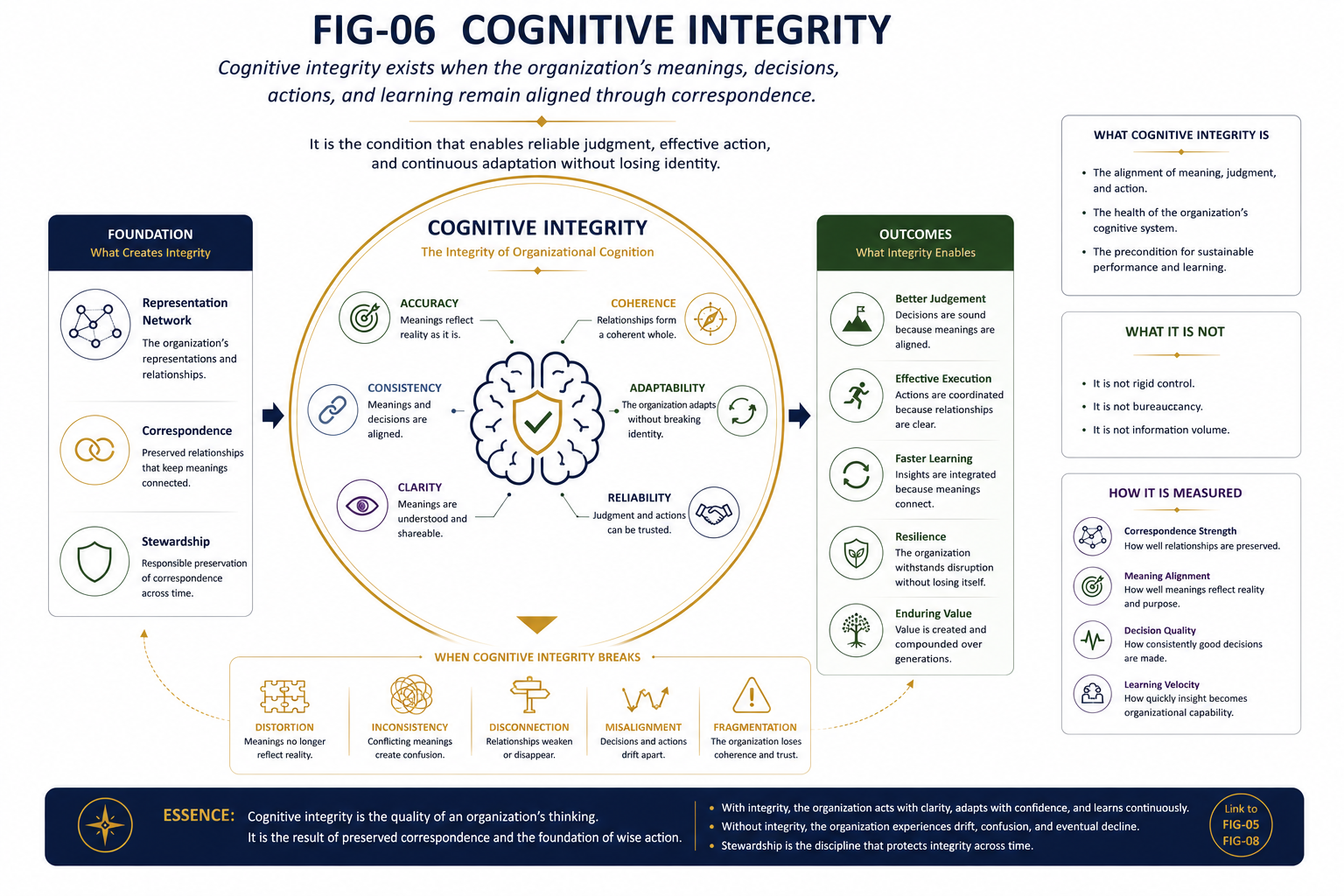
When correspondence is preserved over time, something remarkable begins to emerge. Decisions remain understandable years after they are made. Learning accumulates instead of disappearing. Strategies evolve without losing identity. Artificial intelligence strengthens rather than fragments organizational understanding. The organization develops an extraordinary capacity for coherent judgment across continuous change. Correspondence explains how meaningful relationships are preserved. The next chapter explores what emerges when that preservation becomes sustained: Cognitive Integrity.