
Human and Artificial Intelligence
"The future of organizations is not human intelligence or artificial intelligence. It is the quality of their participation in preserving organizational meaning."
Beyond a False Choice
Much of the public conversation about artificial intelligence has been framed as a choice: humans or machines, automation or employment, judgment or algorithms, control or autonomy. These debates dominate headlines because they are simple. Reality is not. Organizations have never been collections of isolated individuals. They have always been systems of participation. Owners, employees, customers, partners, and technologies all contribute to what the organization can understand and do. Artificial intelligence is the newest participant in that evolving system. The important question is therefore not whether AI will replace people. It is how humans and artificial intelligence should participate together in preserving organizational meaning.
Recent workplace research from major technology providers suggests that AI adoption is moving faster than many organizational designs, governance habits, and management practices. That signal should be treated carefully. It is not a scholarly validation of this book's theory. It is a practical warning: organizations are already changing how representations are produced, summarized, interpreted, and acted upon. The leadership question is therefore immediate. If AI is becoming a participant in organizational cognition, then organizations need a way to decide how that participation remains connected to purpose, authority, evidence, and accountability.
Participation Changes Everything
Traditional information technology supported organizational work. Artificial intelligence increasingly participates in it. AI drafts strategies, summarizes meetings, designs software, generates policies, identifies risks, suggests decisions, discovers patterns, and produces representations continuously. This is fundamentally different from previous generations of enterprise technology. Artificial intelligence is no longer simply processing information. It is participating in organizational cognition, and that participation changes leadership, governance, learning, organizational design, and ultimately the nature of the organization itself. To understand this shift, it helps to see humans and artificial intelligence not as competitors, but as participants contributing different capabilities to the same Representation Network.
Humans and artificial intelligence participate together in the Representation Network. Humans contribute purpose, values, judgment, ethics, creativity, and accountability. Artificial intelligence contributes scale, speed, pattern recognition, memory, and analytical capability. Organizational coherence emerges not from replacing one with the other, but from preserving meaningful Correspondence across both forms of participation.
Different Strengths, Shared Purpose
Humans and artificial intelligence excel at different things. Humans understand purpose, context, values, ethics, ambiguity, and long-term consequences. They recognize meaning beyond explicit information. Artificial intelligence excels at scale, consistency, recall, pattern recognition, simulation, and the exploration of alternatives. These capabilities are complementary. Organizations become stronger when each contributes what it does best. Neither replaces the other. Together they extend the organization's cognitive capability. The objective is not substitution. It is participation. Artificial intelligence does not become part of the organization because it performs work. It becomes part of the organization because it participates in creating organizational meaning.
Representations Created Together
Throughout this book we have argued that organizations think through representations. Artificial intelligence is transforming how those representations are created. A strategic plan may begin with human intent and be expanded by AI. Meeting summaries are generated automatically and refined by participants. Software architectures emerge through collaboration between engineers and AI systems. Customer insights are identified by algorithms and interpreted by people. Representations increasingly have multiple authors. Meaning therefore no longer depends upon who created a representation. It depends upon whether that representation remains connected to the larger Representation Network. Correspondence becomes even more important. As participation expands, the need to preserve meaningful relationships expands with it.
AI Does Not Replace Judgment
Artificial intelligence can recommend, predict, optimize, generate, analyze, and explain. It cannot determine organizational purpose, define values, or assume accountability for organizational consequences. These responsibilities remain fundamentally human. The role of leadership therefore changes. Leaders increasingly become stewards of organizational meaning rather than supervisors of individual tasks. Their responsibility is to ensure that human judgment and artificial intelligence remain connected through Correspondence. The question is no longer whether AI can make a decision. A better question is how humans and AI should participate together in making that decision well.
Trust Through Correspondence
Trust is often described as confidence in technology, data, and algorithms. These matter. The Correspondence perspective introduces another dimension. Organizations trust artificial intelligence when its outputs remain connected to organizational meaning. Recommendations become trustworthy because their relationships are understandable. Decisions become trustworthy because their reasoning remains visible. Learning becomes trustworthy because it influences future action. Trust therefore emerges not from artificial intelligence alone. It emerges from Correspondence. AI earns trust by participating coherently within the organization's cognitive system.
The AI-Native Organization
Artificial intelligence enables organizations to create more representations than ever before. This creates both extraordinary opportunity and profound responsibility. Organizations that merely automate existing fragmentation become faster versions of the same organization. Organizations that preserve Correspondence transform AI into a multiplier of organizational capability: learning compounds, memory strengthens, judgment improves, and stewardship becomes more effective. The Representation Network becomes richer without becoming incoherent. The defining capability of AI-native organizations is therefore not technological sophistication. It is the ability to integrate human and artificial intelligence into one continuously evolving system of organizational meaning.
Emerging Signal: Adoption Before Coherence
Case classification: emerging signal.
The Microsoft Work Trend Index describes rapid workplace experimentation with AI and the managerial challenge of turning individual adoption into organizational capability. Used cautiously, this signal illustrates a central risk of AI-native work: people can adopt powerful tools faster than organizations develop the correspondence needed to govern their use. The implication is not to slow learning. It is to make participation explicit. Leaders need to know where AI is producing representations, how those representations influence decisions, who remains accountable, and how lessons return to organizational memory.
A New Form of Collaboration
The future of organizations will not be determined by whether people or AI perform more work. It will be determined by how effectively they think together. Human intelligence contributes imagination and judgment. Artificial intelligence contributes exploration and perspective. Human purpose provides direction; artificial intelligence expands possibility. The organization becomes stronger because both participate. Participation replaces replacement as the defining principle of AI-native organizational design.
Looking Beyond Technology
Artificial intelligence may become the defining technology of this century. Technology alone, however, will not determine the future of organizations. The decisive factor will be whether organizations preserve the relationships that allow human and artificial intelligence to contribute to one coherent organizational system. Organizations that achieve this will not simply become more efficient. They will become more adaptive, more resilient, and more capable of continuous renewal. The future belongs not to organizations with the most powerful AI. It belongs to organizations with the strongest Correspondence.
Toward a New School of Thought
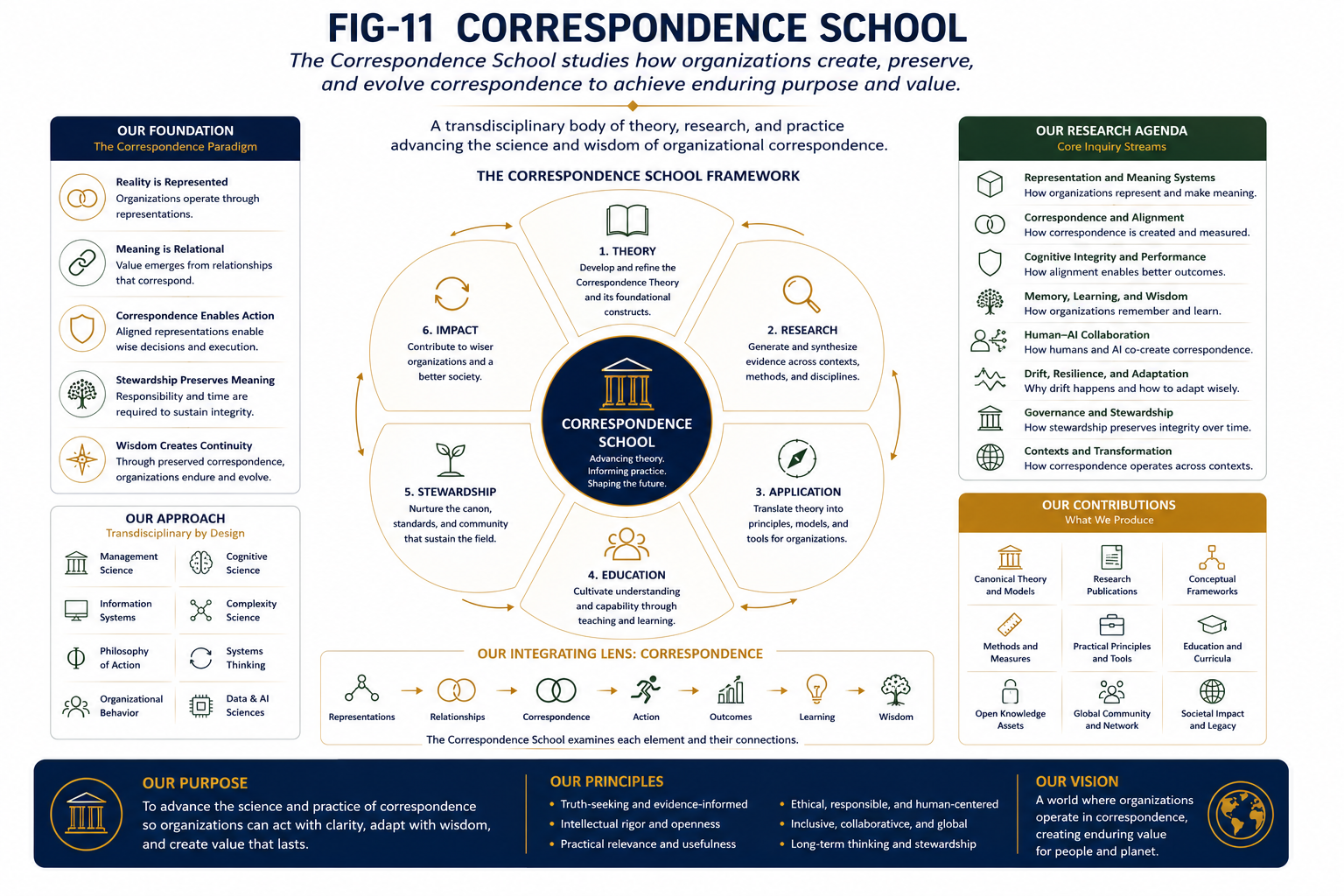
The ideas developed throughout this book extend beyond organizational practice. They suggest a different way of studying organizations themselves. If Representations, Correspondence, Cognitive Integrity, Stewardship, and Organizational Wisdom explain organizational continuity, they also define a new research agenda. The remaining chapters step beyond management practice and ask whether these ideas can become more than a theory: whether they can become the foundation of a new discipline, the Correspondence School.