
The Correspondence School
"Every enduring discipline begins when people learn to see something that was always present but previously unnamed."
Beyond a Single Theory
Every enduring management perspective begins with a different way of seeing organizations. Scientific Management made work visible. Systems Thinking made relationships visible. Organizational Learning made adaptation visible. Knowledge Management made knowledge visible. Information Processing Theory made information visible. Each perspective revealed something that had always existed, and each expanded what organizations could understand about themselves.
This book proposes another perspective. Organizations are not simply systems of work, information, knowledge, or learning. They are systems of meaning. More precisely, they are systems that continuously preserve—or fail to preserve—the meaningful relationships through which organizational understanding endures. If that perspective proves useful, it deserves continued exploration, not merely as a theory, but as the beginning of a broader conversation.
Why New Schools Emerge
Scientific disciplines rarely emerge because entirely new phenomena are discovered. They emerge because familiar phenomena become visible in new ways. Gravity existed before Newton. Natural selection existed before Darwin. Information existed before Information Theory. The same may be true for organizations. Correspondence has always existed. Representations have always existed. Organizational memory has always existed. Leadership has always shaped organizational meaning. Artificial intelligence has simply made these relationships increasingly difficult to ignore. The Correspondence perspective does not claim to invent organizational meaning. It proposes a language capable of describing it more precisely. To appreciate that possibility, it helps to view Correspondence not merely as a theory, but as a potential foundation for future research.
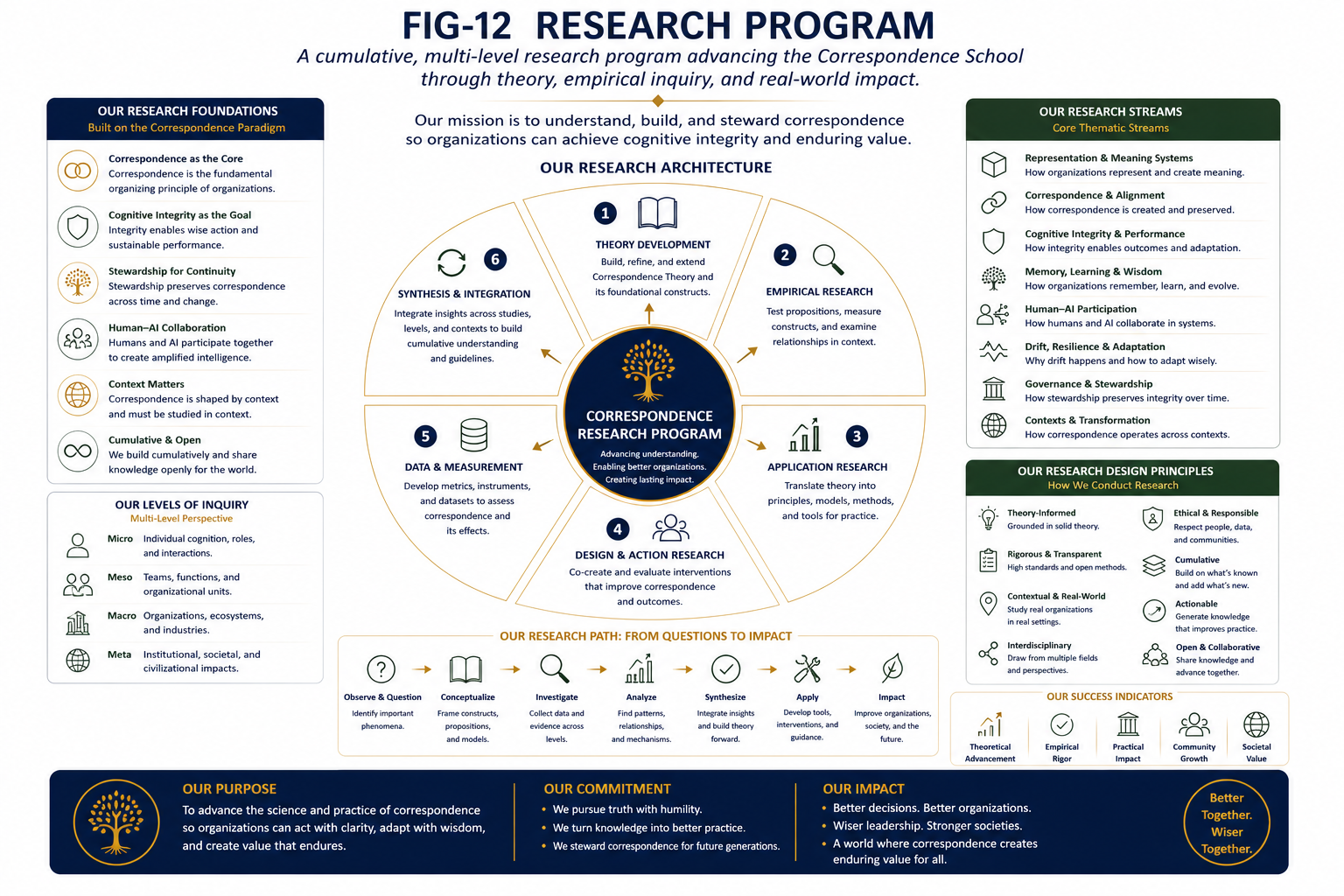
The Correspondence School places meaningful relationships at the center of organizational analysis. It integrates Representations, Representation Networks, Correspondence, Cognitive Integrity, Stewardship, Organizational Wisdom, and Human–AI Participation into a unified research program for understanding AI-native organizations.
A Different Unit of Analysis
Most organizational theories begin with people: individuals, teams, departments, organizations, and markets. The Correspondence perspective begins somewhere else. It begins with representations, not because people become less important, but because organizations increasingly think, remember, and learn through representations created by both humans and artificial intelligence. Representations become the observable expressions of organizational understanding. Relationships become the carriers of meaning. Correspondence becomes the property that preserves continuity.
The question is therefore no longer simply, "What are people doing?" It becomes, "How is organizational meaning being preserved?" That shift may open new possibilities for organizational research.
A Common Language
Every mature discipline develops a shared vocabulary. Economics introduced concepts such as markets, incentives, and opportunity cost. Systems Thinking introduced feedback, emergence, and leverage. The Correspondence perspective contributes another conceptual language: Representations, Representation Networks, Correspondence, Cognitive Integrity, Stewardship, Organizational Wisdom, and Human–AI Participation. These concepts are not intended as fashionable terminology. They are intended as analytical tools. Language shapes observation, observation shapes research, and research shapes understanding. Without a common language, cumulative scientific progress becomes difficult.
A Research Program
The value of a theory is measured not only by the questions it answers. It is also measured by the questions it enables others to ask. The Correspondence perspective therefore proposes not merely a theory, but a research program. How can Correspondence be measured? How can Cognitive Integrity be assessed? How do Representation Networks evolve over time? How does Stewardship influence organizational resilience? What distinguishes organizations that accumulate wisdom from those that repeatedly lose it? How does artificial intelligence strengthen—or weaken—organizational Correspondence? How should Representation Networks be designed for AI-native organizations? These questions define an agenda rather than a conclusion. Their answers belong to future empirical research.
Beyond Management
Although developed within organizational science, the Correspondence perspective may have implications far beyond management, including enterprise architecture, digital transformation, knowledge management, corporate governance, artificial intelligence, public administration, healthcare, education, scientific collaboration, and complex adaptive systems. Any domain that continuously creates, connects, and evolves shared meaning may benefit from understanding Correspondence. The perspective therefore invites interdisciplinary collaboration rather than remaining confined to a single field.
Building Upon Earlier Theories
The Correspondence perspective does not seek to replace existing organizational theories. It builds upon them. Systems Thinking explains interaction. Organizational Learning explains adaptation. Knowledge Management explains knowledge creation. Information Processing Theory explains decision capability. The Correspondence perspective asks another question: How do all of these remain meaningfully connected while organizations continuously evolve? Rather than competing with earlier theories, it seeks to integrate them through a common explanatory principle.
An Invitation Rather Than a Doctrine
Every enduring scientific discipline evolves through criticism, debate, replication, refinement, and empirical testing. The Correspondence perspective should be no different. Some concepts introduced in this book will undoubtedly require revision. Others may prove incomplete. New constructs will emerge, and evidence will challenge assumptions. That is not a weakness. It is how disciplines mature. The purpose of this book is therefore not to establish a finished doctrine. It is to begin a conversation.
Looking Forward
Artificial intelligence is transforming organizational cognition. Organizations increasingly require theories capable of explaining not only how work is coordinated, but how organizational understanding itself evolves. The Correspondence perspective is offered as one possible contribution to that future. Whether it ultimately becomes an enduring research tradition will not be determined by this book alone. It will be determined by researchers, leaders, architects, engineers, students, and organizations willing to test, challenge, refine, and extend these ideas. That journey has only just begun.
Beyond the School
Every theory ultimately leads to a larger question. Why does this matter? Why should organizations adopt this perspective? Why now? The final chapter steps beyond theory itself. It asks what kind of organizations may emerge if Correspondence becomes a defining principle of organizational design. Not simply better organizations. Organizations capable of continuous renewal without losing themselves. The organization that endures.