
Organizational Drift
"Organizations rarely lose their way because of one catastrophic decision. They lose their way because thousands of good decisions gradually stop belonging to the same story."
Drift Rarely Announces Itself
No executive arrives at work intending to disconnect strategy from execution. No project team sets out to weaken the organization's future. No manager deliberately creates fragmentation. Yet every enduring organization eventually encounters the same unsettling realization. The organization begins producing outcomes that no one intended. Projects succeed while strategy quietly loses influence. Departments improve their own performance while the organization becomes less coherent. Customers receive excellent service from individual teams, yet experience growing inconsistency across the organization as a whole. Nothing appears fundamentally broken. And yet something is. This is organizational drift. It rarely begins with failure. It begins when meaningful relationships weaken so gradually that no individual decision seems responsible.
Consider how major failures are often reconstructed after the fact. Investigations rarely find that every participant was careless or malicious. More often, they reveal a pattern in which signals existed, warnings moved through established channels, and formal responsibilities remained in place, yet the relationships among evidence, authority, interpretation, and action weakened over time. The point is not that every organization faces catastrophe. The point is that drift can remain invisible precisely because each local action still appears reasonable.
A One-Degree Change
Imagine a ship crossing the Atlantic Ocean. The captain adjusts the course by a single degree. No one on board notices. The horizon appears unchanged, the engines continue running, and the destination still feels certain. Hours later, the difference is almost invisible. Days later, the ship is hundreds of kilometers from where it was meant to arrive. The ocean did not change. The crew remained competent. The navigation system continued functioning. A tiny deviation simply accumulated over time. Organizations drift in exactly the same way: rarely through dramatic mistakes, and almost always through countless reasonable decisions that appear correct when viewed individually. Drift is not created by one large error. It emerges from the accumulation of many small ones that gradually stop pointing toward the same future.
When Good Decisions Produce Bad Outcomes
One of the most difficult realities for leaders to accept is that organizational drift is often created by good decisions. A product team improves customer experience. Finance increases cost efficiency. Engineering modernizes infrastructure. Operations raise productivity. Human Resources redesigns performance management. Every initiative creates value. Every decision is rational. Viewed individually, each deserves support. Viewed together, something unexpected begins to happen. The relationships between those decisions slowly weaken. The organization becomes increasingly successful at optimizing its parts while gradually losing coherence as a whole. The problem is not the quality of the decisions. It is the quality of the relationships between them. To understand how this happens, it helps to visualize drift not as a sudden breakdown, but as the gradual weakening of organizational correspondence.
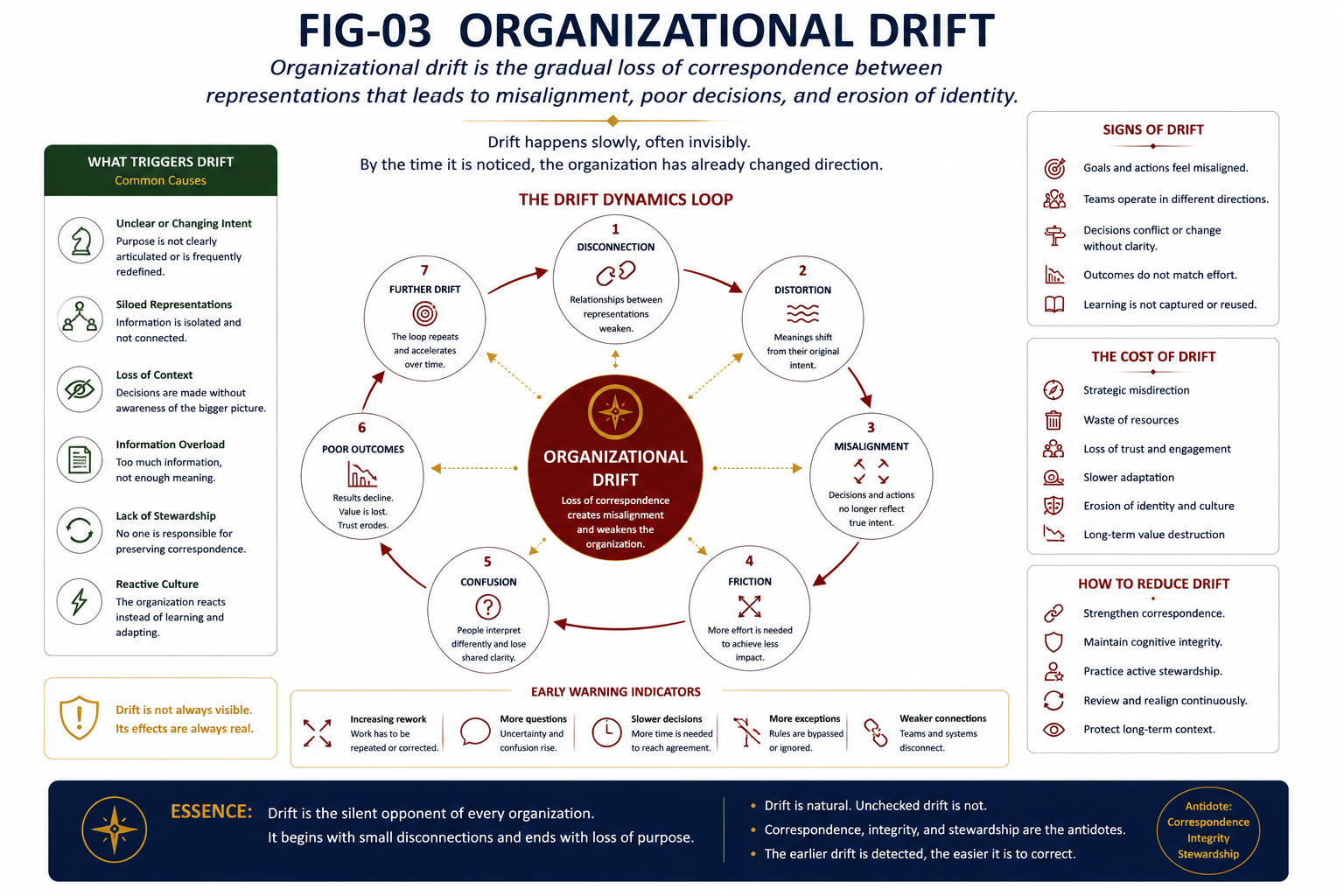
Organizational drift occurs when meaningful relationships gradually weaken over time. Individual representations continue evolving, but their connections to purpose, strategy, decisions, actions, outcomes, and learning become increasingly fragmented. Drift rarely begins with failure. It begins with accumulated disconnection.
Case Lens: Drift Before Breakdown
Case classification: documented case.
The Challenger accident is often studied not only as a technical failure, but as an organizational failure of interpretation, escalation, and decision context. The official investigation record shows why drift matters for leaders: evidence, engineering concern, launch pressure, and decision authority did not remain sufficiently connected as a coherent organizational judgment. This book does not use Challenger as an analogy for ordinary management. It uses it as a severe reminder that organizations can retain formal process while losing the correspondence that gives process meaning.
For executives, the lesson is narrower and more practical. Drift should be examined before it becomes visible as failure. The question is not simply whether a process exists. The question is whether the process still preserves the relationship between what the organization knows, what it decides, and what it is willing to authorize.
Drift Begins in the Invisible Organization
During the early stages of drift, the visible organization often appears remarkably healthy. Projects remain on schedule. Budgets are achieved. Performance indicators stay green. Meetings continue. Customers remain satisfied. The organizational chart does not change. Everything leaders can easily observe suggests that the organization is functioning well. But drift rarely begins in the visible organization. It begins within the invisible one. Purpose slowly separates from everyday priorities. Policies remain while the assumptions behind them disappear. Projects continue long after the reasons for starting them have been forgotten. Learning remains inside individual teams instead of strengthening the organization as a whole. Nothing visible has failed. Yet the organization has already begun changing into something different.
Why AI Can Accelerate Drift
Artificial intelligence is dramatically increasing the speed at which organizations evolve. Strategies are revised continuously. New analyses appear every hour. Recommendations are generated instantly. Policies are rewritten. Software changes daily. Organizations now create representations faster than at any point in history. This creates extraordinary opportunities. It also magnifies organizational drift. Every new representation introduces new relationships that must remain connected to the rest of the organization. If those relationships are not actively preserved, fragmentation grows faster than organizational understanding. Artificial intelligence does not create organizational drift. It reveals—and accelerates—the condition that already exists. Healthy organizations become more adaptive. Fragmented organizations become fragmented more quickly. AI does not determine organizational coherence. It amplifies it.
Recognizing Drift
Drift rarely announces itself as crisis. Instead, it appears as small signals that leaders often dismiss. Teams begin using different language to describe the same strategy. Projects unknowingly duplicate one another. Policies contradict operational practice. Employees increasingly depend upon individuals who "know how things really work." Lessons learned are documented but rarely influence future work. Artificial intelligence produces recommendations that appear reasonable but somehow feel disconnected from organizational reality. Each signal seems insignificant. Together they reveal something much deeper. The organization is slowly losing correspondence. By the time drift becomes visible in financial performance or customer outcomes, it has often been developing quietly for years.
Drift Is Not Failure
This distinction matters. Organizations do not drift because they are poorly managed. Many exceptionally successful organizations experience drift. Growth accelerates it. Innovation accelerates it. Acquisitions accelerate it. Artificial intelligence will almost certainly accelerate it. Drift is not evidence of incompetence. It is the natural consequence of continuous organizational change. The question is therefore not,
"How do we eliminate drift?"
A better question is,
"How do we preserve coherence while the organization continuously evolves?"
That shift changes the role of leadership. Leadership becomes responsible not only for directing change, but for preserving the relationships that allow change to remain meaningful.
From Drift to Design
Recognizing organizational drift changes how we understand organizations themselves. If drift emerges because meaningful relationships gradually weaken, then organizations cannot be understood simply as collections of people, departments, or processes. They must also be understood through the things those relationships connect: strategies, policies, decisions, projects, actions, learning, and memory. Each is an expression of organizational understanding. Each captures how the organization interprets itself at a particular moment in time. Each is a representation. Understanding organizations therefore begins not with hierarchy, but with representations. The next chapter explores these representations and why they become the fundamental building blocks of organizational correspondence.