
The Memory of Organizations
"Organizations do not remember because people remember. They remember because meaning survives change."
A Simple Thought Experiment
Imagine arriving at work on Monday morning and discovering that every employee has been replaced overnight: every executive, manager, engineer, analyst, salesperson, and administrator. The buildings, products, software, customer contracts, strategies, policies, and documentation all remain. Would the organization still exist? Most people instinctively answer no. After all, organizations are made of people. Or are they? History suggests something more complicated. Organizations routinely survive the departure of founders, changes of CEOs, mergers, acquisitions, and generational change. Entire leadership teams disappear while the organization continues operating. Individual memory changes continuously. Yet something larger persists. Somehow the organization remains recognizable. Somehow decisions made years earlier continue shaping decisions made today. Somehow new employees inherit ways of thinking they never personally experienced.
Organizations remember. But saying that merely postpones the real question.
What exactly survives?
More Than Information
When organizations talk about memory, they usually think about storage: knowledge bases, document repositories, databases, policies, meeting minutes, enterprise systems, and lessons learned. These are valuable; without them, organizations would repeatedly lose information. But information is not memory. Every experienced executive has encountered the same situation. The document exists, the presentation can be found, the approval is recorded, and the project is archived. Yet when someone asks,
"Why did we make this decision?"
the room becomes quiet. The organization remembers what happened, but it no longer remembers why. Meaning has quietly disappeared. The information survived; the memory did not. The distinction matters. Information can be stored. Knowledge can be explained. Memory preserves meaning across time.
When Organizations Forget Without Losing Information
Consider a newly appointed CEO. Soon after joining, she reviews a pricing model that has guided the company for years. The spreadsheets are immaculate. The calculations are correct. The reports are complete. She asks a simple question.
"Why are we using this model?"
No one knows. Some believe it was introduced after a market downturn. Others think it originated from a customer request. Several assume it reflects a board decision. The executive who created it retired years ago. The documentation describes how the model works, but nothing explains why it exists. The organization preserved the artifact while losing the meaning that gave the artifact its purpose. This is organizational forgetting: not the disappearance of information, but the disappearance of relationships that make information intelligible.
Memory Preserves Meaning
Think about your own memory. You rarely remember isolated facts; you remember relationships. A place reminds you of a conversation, a conversation reminds you of a decision, and a decision reminds you of an experience. Human memory is relational. Organizational memory is remarkably similar. A strategy derives meaning from the purpose that inspired it. A decision derives meaning from the strategy that justified it. A project derives meaning from the decision that initiated it. An outcome derives meaning from the actions that produced it. A lesson derives meaning from the outcome from which it was learned. None of these representations possesses complete meaning in isolation. Meaning exists within the relationships that connect them. Organizational memory therefore does not reside inside documents, databases, or individual people.
It emerges across relationships. To understand why organizations remember despite constant change, it helps to visualize memory not as storage, but as a living network of relationships.
Organizations remember by preserving meaningful relationships between representations across time. Memory is not stored in isolated documents or databases. It emerges from the correspondence connecting purpose, strategy, decisions, actions, outcomes, and learning.
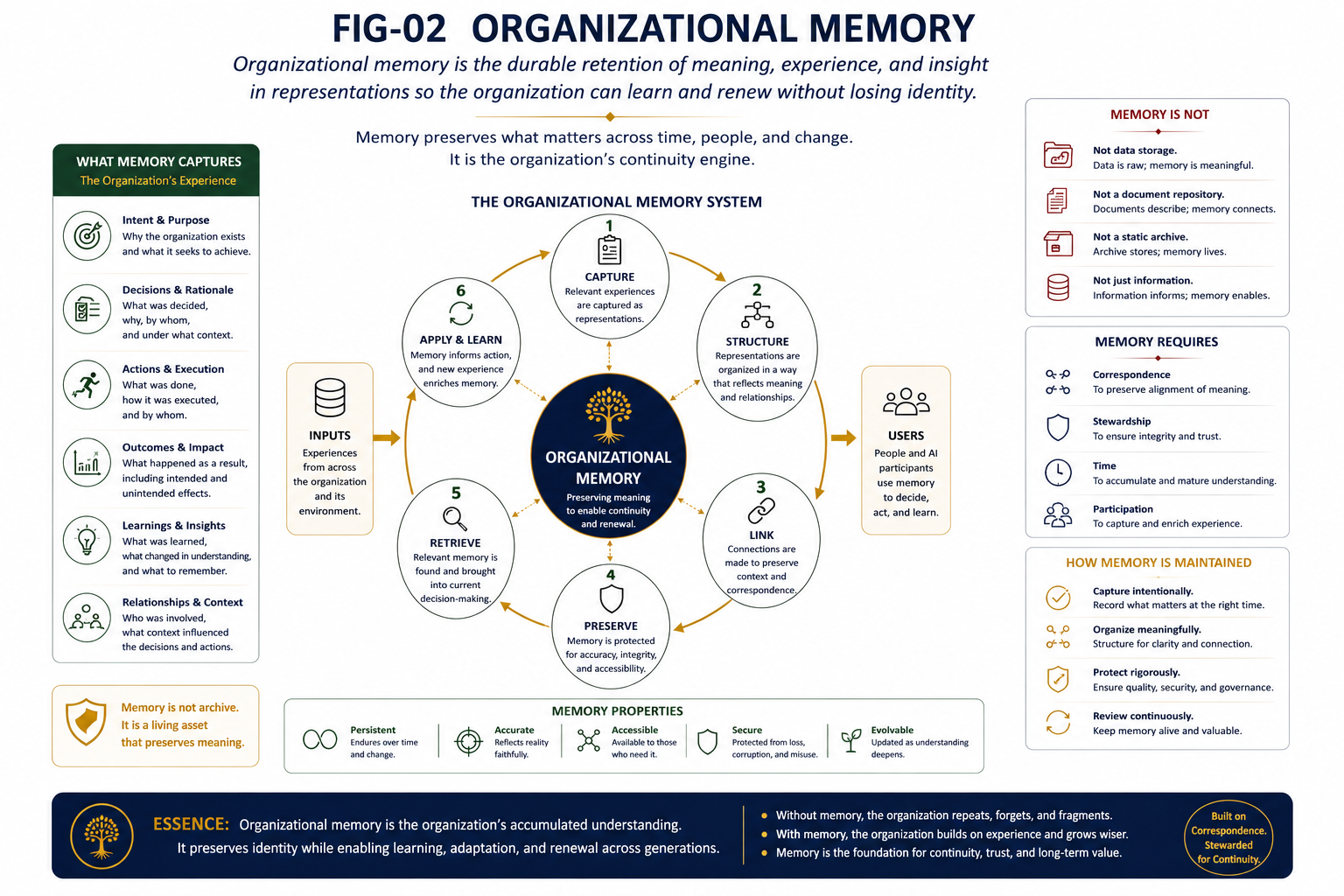
The figure illustrates an important shift in perspective. Traditional organizations often treat memory as something that can be archived. Correspondence Theory views memory differently. Memory is the continuity of meaningful relationships that allows an organization to remain coherent while everything inside it changes. The real purpose of memory is therefore not preserving the past. It is preserving continuity. Organizations change constantly. People leave. Leaders retire. Strategies evolve. Markets shift. Technologies become obsolete. Artificial intelligence continuously generates new knowledge. Almost everything changes. Yet healthy organizations somehow remain themselves. Purpose continues guiding decisions. Past learning continues shaping future action. Identity survives transformation. Memory is what makes this possible. Without continuity, every strategic planning exercise begins from the beginning. Every transformation ignores the previous one. Every lesson must be learned again.
The organization continues operating. But it slowly stops recognizing itself.
Why Organizations Forget
Organizations rarely forget because someone deletes information. They forget because relationships gradually disappear. A strategic objective changes. Older decisions are never reinterpreted. A policy evolves. Existing practices continue without understanding their original purpose. Projects conclude successfully. Their lessons remain isolated inside project reports. Artificial intelligence generates thousands of new representations. The reasoning that connects those representations to organizational intent is never preserved. Each individual change appears reasonable. Collectively, they weaken continuity.
Forgetting is rarely dramatic. It happens one disconnected relationship at a time. The danger is especially great in AI-native organizations. Never before have organizations created representations so quickly. A single meeting now produces transcripts, summaries, action items, recommendations, scenarios, and analyses. Information grows exponentially. Meaning does not. Artificial intelligence accelerates representation, but it does not automatically preserve understanding. That responsibility remains organizational.
What Organizations Actually Remember
Organizations do not remember every document. They do not remember every meeting. They do not remember every decision. They remember the relationships that continue connecting purpose, strategy, decisions, actions, outcomes, learning, and future adaptation. These relationships allow one generation of employees to inherit more than files: context, judgment, shared understanding, and ways of thinking. The organization remembers not because every detail survives. It remembers because enough meaning survives for coherent action to continue.
Organizational memory does not reside in individual documents, databases, or people. It emerges from the meaningful relationships connecting purpose, strategy, decisions, actions, outcomes, learning, and future adaptation. Information can be stored indefinitely. Meaning survives only when those relationships are continuously preserved. Organizations rarely lose themselves through a single catastrophic failure. They lose themselves one broken relationship at a time. The next chapter explores how that gradual loss of continuity becomes organizational drift.