
Foundational Axioms of Correspondence Theory
A.1 Purpose
This appendix states the formal foundation of Correspondence Theory. Its purpose is to identify the definitions, axioms, propositions, invariants, relationships, and scope conditions on which the theory rests. The main text develops the theory as an extended scientific argument. This appendix specifies the theory in compact form for readers who need a stable reference.
The appendix is not a summary of the book. It does not repeat the chapter argument, restate the research program, or translate the theory into executive guidance. It defines the formal commitments that should remain stable when the theory is applied, extended, assessed, measured, or criticized.
The intended audience includes researchers developing or testing the theory, practitioners designing assessment or measurement work, and readers who need a precise statement of the theory's boundaries. The appendix should be read as a normative specification: it defines what belongs to Correspondence Theory, what follows from it, and what remains outside it.
A.2 Canonical Definitions
The following definitions are authoritative for Correspondence Theory. They are stated here for normative use and should be interpreted consistently throughout the book.
Correspondence Theory is the scientific theory explaining how intelligent organizations preserve meaningful semantic, causal, evidential, temporal, and governance relationships among organizational representations over time.
Correspondence is the preservation of meaningful relationships among representations within the Correspondence Theory vocabulary.
Organizational Correspondence is the emergent organizational property by which meaningful semantic, causal, evidential, temporal, and governance relationships among organizational representations are preserved over time.
Correspondence Preservation is the maintenance, revision, restoration, or governed acceptance of relationships needed for Organizational Correspondence.
Representation is a durable expression of organizational meaning, condition, intent, evidence, decision, assumption, action, outcome, or memory.
Representation Network is the evolving network of organizational representations and the meaningful relationships among them.
Semantic Relationship is a meaning-preserving relationship among representations.
Causal Relationship is a relationship explaining how one representation produces, constrains, explains, or follows from another.
Evidential Relationship is a relationship by which evidence supports, challenges, qualifies, contradicts, or limits a representation or claim.
Temporal Relationship is a relationship specifying sequence, validity interval, revision history, preservation, drift, or change over time.
Governance Relationship is a relationship specifying authority, permission, accountability, review, legitimacy, or revision conditions.
Cognitive Integrity is the emergent organizational state associated with sustained Organizational Correspondence.
Cognitive Debt is accumulated unresolved correspondence degradation that increases the burden of understanding, governing, adapting, or repairing represented organizational cognition.
Correspondence Loop is the recursive, event-driven mechanism through which the Representation Network is maintained, revised, restored, or degraded.
Correspondence Architecture is representation-centric organizational architecture for preserving Organizational Correspondence across evolving organizational representations.
Canonical Organizational Object is a stable semantic object that preserves the identity of an important organizational thing across representations.
Correspondence Assessment is a theory-guided organizational capability for making context-bounded, criteria-guided, evidence-grounded, confidence-qualified, and traceable judgments about correspondence state within a bounded Representation Network.
Assessment Context is the bounded organizational, temporal, governance, theoretical, and representation-network setting in which a Correspondence Assessment is interpreted.
Assessment Subject is the bounded Representation Network object whose correspondence state is being assessed.
Assessment Criteria are explicit theory-derived expectations or evaluative dimensions used in Correspondence Assessment.
Assessment Evidence is identifiable material that supports, challenges, qualifies, contradicts, or limits an assessment conclusion.
Assessment Method is the disciplined reasoning approach that interprets evidence against criteria in Correspondence Assessment.
Assessment Result is warranted assessment knowledge about correspondence state.
Assessment Confidence is confidence, uncertainty, or evidential sufficiency attached to an Assessment Result.
Assessment Traceability is the reasoning chain linking assessment context, subject, criteria, evidence, method, result, confidence, and recommendation.
Assessment Recommendation is an advisory implication derived from an Assessment Result.
Governance Input is assessment-derived knowledge made available to accountable governance.
Correspondence Measurement is the systematic, construct-grounded, relational, multi-level, evidence-based, temporally explicit, and uncertainty-aware operationalization of Organizational Correspondence.
Correspondence Measurement Instance is the bounded record of a Correspondence Measurement execution.
Measurement Object is the relationship, pathway, network region, decision chain, evidence chain, governance relation, memory relation, or temporal condition being measured.
Measure is an observed or derived value for a specified object under a specified procedure.
Metric is a governed reusable specification for producing measures.
Indicator is a theoretically justified, context-bounded, interpretation-bearing signal derived from one or more measures or metrics.
Profile is a structured collection of non-equivalent measures or indicators.
Index is an aggregated composite representation that requires explicit validity, weighting, normalization, compensability, and interpretation assumptions.
Methodological Assurance is the validity, reliability, traceability, reproducibility, comparability, contestability, uncertainty, validation-status, and claim-permission system that governs Correspondence Measurement interpretation and use.
Claim Permission is the permitted interpretation or use of a measurement or assessment result given its theory, evidence, method, and validation status.
Evidence is a represented observation, artifact, trace, record, measurement, or source used to support, challenge, qualify, contradict, or limit organizational claims.
Provenance is the source, derivation, transformation, authority history, and use lineage of a representation, claim, measurement, projection, or decision.
Traceability is the preserved ability to follow relationships among representations, claims, evidence, decisions, authority, execution, outcomes, memory, and learning.
Governance is the representation and enactment of authority, accountability, review, revision, legitimacy, and use conditions.
Authority is the legitimate right or permission to make, authorize, revise, delegate, contest, or act on organizational representations, decisions, or actions.
Decision is a governed commitment or choice that changes organizational meaning, authority, resource allocation, execution, or future interpretation.
Execution is authorized organizational action that changes work, state, evidence, outcomes, memory, or future learning.
Learning is governed revision of organizational understanding, memory, knowledge, representations, routines, or future action based on evidence and outcomes.
Boundary Conditions are the limits under which a construct, proposition, assessment, or measurement may be interpreted.
A.3 Foundational Axioms
The following axioms state the smallest complete set of assumptions necessary for Correspondence Theory as developed in this book. Each axiom is independent in the sense that removing it would leave a distinct explanatory gap. Together they support the theory's constructs, propositions, assessment logic, and measurement boundaries.
Axiom 1 - Representational Mediation. Organizations preserve and use meaning through representations.
Rationale: Organizational intent, decision, evidence, memory, action, and learning cannot remain inspectable across people, time, systems, and governance unless they take represented form.
Implications: Correspondence Theory studies represented organizational cognition rather than private mental states alone. It does not reduce organizations to documents or data, but it treats durable representations as necessary for organizational meaning to persist beyond immediate interaction.
Axiom 2 - Relational Meaning. A representation has organizational meaning only through its relationships with other representations.
Rationale: A strategy, decision, metric, policy, model output, evidence item, or memory object is not organizationally meaningful in isolation. Its meaning depends on how it relates to intent, authority, evidence, prior commitments, execution, outcomes, and future revision.
Implications: Correspondence cannot be inferred from the correctness of a single artifact. It must be evaluated in the Representation Network.
Axiom 3 - Relationship Plurality. Organizational meaning depends on multiple relationship classes, including semantic, causal, evidential, temporal, and governance relationships.
Rationale: Meaning may be preserved in one relationship class while degrading in another. A representation may use the correct language while lacking evidence, may follow evidence while lacking authority, or may have authority while becoming temporally stale.
Implications: Correspondence Theory rejects single-dimension accounts of alignment, consistency, traceability, or information quality. Organizational Correspondence requires preservation across relationship classes.
Axiom 4 - Temporal Revision. Representation Networks change over time, and change is not equivalent to degradation.
Rationale: Organizations revise strategies, roles, technologies, assumptions, policies, evidence, and decisions. A stable theory of organizational meaning must explain continuity through revision, not only consistency at a moment.
Implications: Correspondence Preservation includes maintenance, revision, restoration, and governed acceptance. The theory distinguishes preservation from rigidity and drift from legitimate change.
Axiom 5 - Emergence. Organizational Correspondence is an emergent organization-level property of a Representation Network, not a property of a single representation.
Rationale: The coherence of represented organizational cognition depends on patterns of relationship preservation across many representations, actors, systems, memories, and decisions.
Implications: A representation may be accurate locally while still contributing to organization-level degradation. Conversely, a local inconsistency may be acceptable when it is governed, bounded, traceable, and interpretable within the network.
Axiom 6 - Governance Necessity. Correspondence Preservation requires governance relationships that specify authority, accountability, legitimacy, review, and revision.
Rationale: Organizational representations do not preserve meaning merely by being connected. The organization must know who or what may rely on, revise, authorize, contest, or act on those representations.
Implications: Governance is intrinsic to Correspondence Theory. It is not an external compliance layer added after meaning has been represented.
Axiom 7 - Evidence and Warrant. Claims about correspondence require evidence, traceability, confidence qualification, and claim permission.
Rationale: Correspondence cannot be asserted responsibly without making the supporting material, reasoning, uncertainty, and permitted interpretation reviewable.
Implications: Assessment produces warranted judgment, not proof. Measurement produces bounded operationalization, not the construct itself. Evidence, traceability, confidence, and claim permission remain distinct.
Axiom 8 - Operationalization Boundary. Measurement of correspondence must preserve the construct's relational, multi-level, temporal, evidential, and governance character.
Rationale: A universal score would obscure the relationships that make Correspondence Theory explanatory. Operationalization is useful only when it states what is measured, under what conditions, by what procedure, with what evidence, and with what interpretation limits.
Implications: Profiles are generally preferred over universal indices. Indices require explicit validity, weighting, normalization, compensability, and claim-permission assumptions.
Axiom 9 - AI Participation Intensification. AI participation increases the rate, volume, and transformation of organizational representations without removing the need for human-held organizational authority and governance.
Rationale: AI systems can create, summarize, classify, recommend, transform, and route representations at organizational scale. These capabilities intensify the burden of correspondence maintenance because more representations and relationships can be created, altered, or misread.
Implications: AI-native organizations require stronger, not weaker, Correspondence Preservation. AI participation may support represented cognition, but it does not itself create organizational authority, legitimacy, or warranted claim permission.
A.4 Derived Propositions
The following propositions follow from the axioms. They are theoretical expectations, not established empirical findings. They do not introduce new assumptions; they state what should hold if the axioms are accepted.
Proposition A.1 - Representation Dependence. The more an organization depends on persistent representations for decision, execution, memory, and learning, the more its ability to act coherently depends on the preservation of relationships among those representations.
Theoretical justification: If organizational meaning is mediated by representations and meaning is relational, coherence depends on relationship preservation rather than artifact accumulation.
Dependency: Axioms 1, 2, and 3.
Implications for organizations: Organizations that scale strategy, AI, data, knowledge, or distributed work without preserving representational relationships should experience greater interpretive burden and higher risk of misaligned action.
Proposition A.2 - Local Accuracy Insufficiency. Accurate local representations are insufficient for Organizational Correspondence when their semantic, causal, evidential, temporal, or governance relationships are weak, missing, or contradictory.
Theoretical justification: Relational meaning and relationship plurality imply that no representation can be judged solely in isolation.
Dependency: Axioms 2, 3, and 5.
Implications for organizations: Improving documents, dashboards, summaries, or AI outputs one by one may fail to improve organization-level coherence if network relationships remain degraded.
Proposition A.3 - Cognitive Debt Accumulation. Unresolved correspondence degradation accumulates as Cognitive Debt when organizations continue to rely on representations whose required relationships are stale, broken, unwarranted, or unauthoritative.
Theoretical justification: Temporal revision creates continual maintenance demands; relationship degradation increases the burden of understanding and repair.
Dependency: Axioms 3, 4, 5, and 6.
Implications for organizations: Organizations may appear operationally functional while accumulating hidden interpretive and governance burdens that surface during change, crisis, audit, delegation, or AI-mediated execution.
Proposition A.4 - Governance-Mediated Coherence. Governance relationships mediate the effect of representation-network preservation on Cognitive Integrity.
Theoretical justification: Relationship preservation must include authority, accountability, legitimacy, review, and revision conditions; otherwise represented meaning may remain connected but not governable.
Dependency: Axioms 3, 5, and 6.
Implications for organizations: Coherence depends not only on what representations say, but on whether the organization can determine who may trust, challenge, revise, or act on them.
Proposition A.5 - Revision-Compatible Preservation. Organizations preserve correspondence more effectively when revision is governed, traceable, and interpretable than when preservation is treated as static consistency.
Theoretical justification: Temporal revision distinguishes legitimate change from degradation and preservation from rigidity.
Dependency: Axioms 4, 6, and 7.
Implications for organizations: Change programs, strategy revisions, AI deployment, and organizational redesign should preserve continuity by making revision relationships visible and governable.
Proposition A.6 - Assessment Warrant. Correspondence Assessment is theoretically warranted only when it specifies context, subject, criteria, evidence, method, result, confidence, traceability, recommendation, and governance input.
Theoretical justification: Claims about correspondence require evidence, traceability, confidence qualification, and claim permission.
Dependency: Axioms 7 and 8.
Implications for organizations: Assessment outputs should be interpreted as bounded judgments rather than universal conclusions, decisions, commands, or measures.
Proposition A.7 - Measurement Validity Boundary. Correspondence Measurement is valid in principle only when the measurement object, procedure, evidence, uncertainty, temporal condition, governance condition, and claim permission are explicit.
Theoretical justification: Operationalization must preserve the construct's relational, multi-level, temporal, evidential, and governance character.
Dependency: Axioms 3, 7, and 8.
Implications for organizations: A measure may support interpretation, but it does not by itself establish correspondence, cognitive integrity, governance adequacy, or organizational performance.
Proposition A.8 - Profile Preference. Multidimensional profiles are theoretically safer than universal indices for representing correspondence unless the index assumptions are explicitly justified and bounded.
Theoretical justification: Relationship plurality and operationalization boundaries make compensating unlike dimensions risky without explicit warrant.
Dependency: Axioms 3 and 8.
Implications for organizations: Leaders should expect correspondence evidence to appear as differentiated profiles of relationship conditions rather than as a single maturity score.
Proposition A.9 - AI Amplification of Correspondence Burden. AI participation increases the need for Correspondence Preservation when it increases the production, transformation, or operational use of organizational representations.
Theoretical justification: AI participation intensifies representation-network change without removing the need for governance, authority, evidence, and claim permission.
Dependency: Axioms 1, 4, 6, 7, and 9.
Implications for organizations: AI adoption should be accompanied by stronger provenance, traceability, contestability, evidence, freshness, and governance relationships.
Proposition A.10 - Architecture Requirement. Organizations require Correspondence Architecture when representation-network complexity exceeds the organization's ordinary informal capacity to preserve meaningful relationships.
Theoretical justification: Emergent organizational correspondence depends on systematic preservation across many representations and relationship classes.
Dependency: Axioms 2, 3, 5, and 6.
Implications for organizations: As scale, specialization, AI participation, or organizational change increase, correspondence preservation becomes an architectural problem rather than an informal coordination practice.
Proposition A.11 - Learning Through Relationship Revision. Organizational Learning strengthens Cognitive Integrity only when evidence and outcomes revise representations and relationships in governed, traceable, and interpretable ways.
Theoretical justification: Learning is not storage alone; it is governed revision of represented understanding under evidence and temporal change.
Dependency: Axioms 4, 6, and 7.
Implications for organizations: Lessons learned, postmortems, retrospectives, and AI-generated recommendations improve organizational intelligence only when they change the relationships that guide future interpretation and action.
Proposition A.12 - Correspondence Repair Boundary. Repair reduces correspondence degradation only when it restores, revises, qualifies, or accepts degraded relationships under appropriate governance and claim permission.
Theoretical justification: The theory distinguishes repair from correction, replacement, local improvement, and static consistency.
Dependency: Axioms 3, 4, 6, and 7.
Implications for organizations: Correcting an artifact may not repair correspondence unless the relevant semantic, causal, evidential, temporal, and governance relationships are also addressed.
Figure A.1 - Axiom-to-Proposition Dependency Map
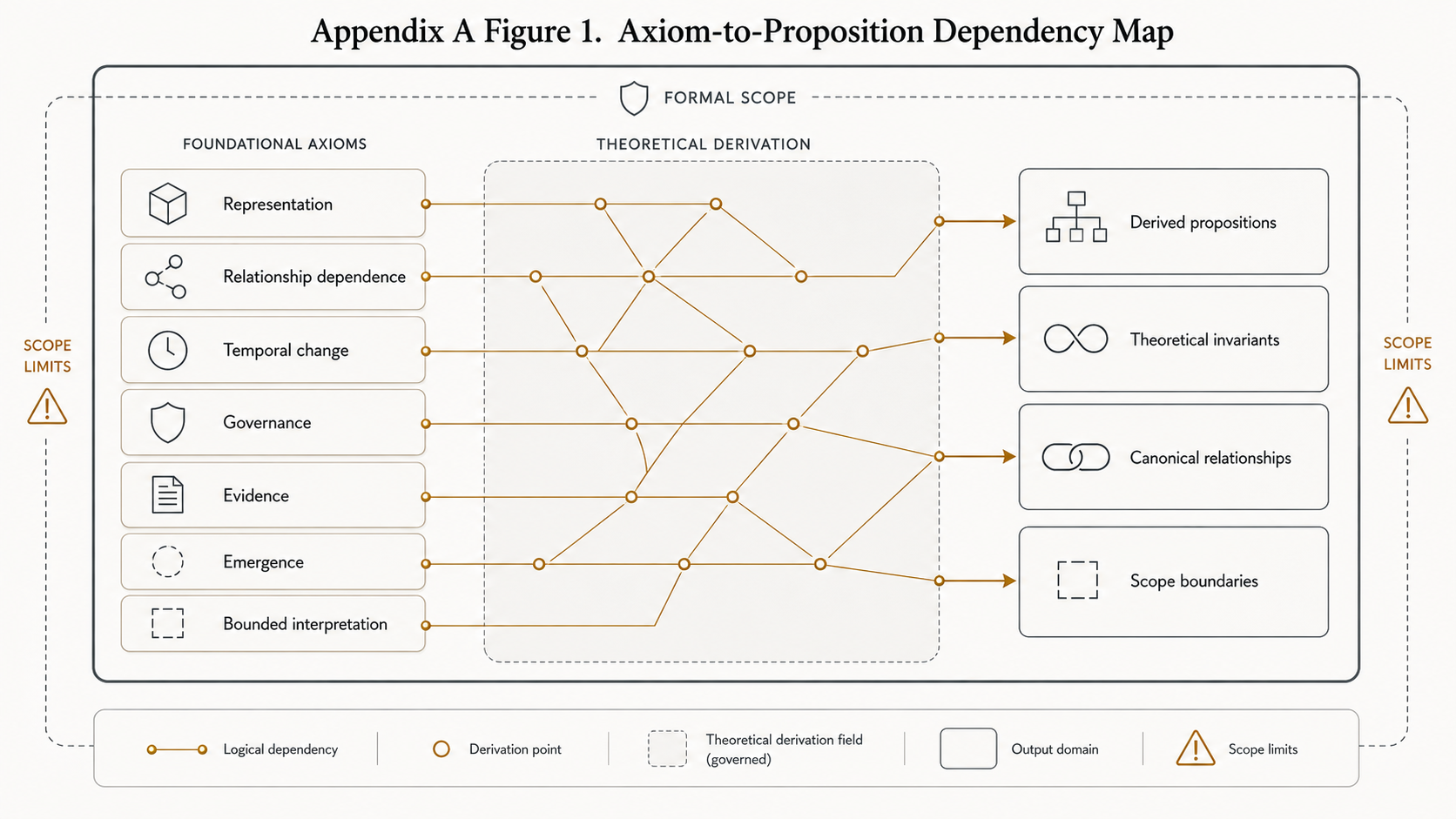
The formal propositions of Correspondence Theory derive from a compact set of axioms about representation, relationship dependence, temporal change, governance, evidence, and bounded interpretation.
A.5 Theoretical Invariants
The following invariants are expected to hold across organizations, industries, technologies, cultures, organizational sizes, and levels of AI maturity. They are not claims that all organizations perform correspondence well. They specify properties the theory expects to remain true wherever represented organizational cognition matters.
Invariant 1 - Meaning is relational. Organizational meaning depends on relationships among representations. This invariant governs interpretation. When violated, organizations may treat isolated artifacts as sufficient, creating degradation between intent, evidence, decision, execution, memory, and learning.
Invariant 2 - Representations are partial. No representation exhausts the organization's meaning. This invariant governs humility in interpretation. When violated, organizations may treat documents, dashboards, models, or AI outputs as complete substitutes for the represented relationships they only express partially.
Invariant 3 - Time alters correspondence conditions. Representations and their relationships have temporal conditions. This invariant governs freshness, revision, validity, and drift. When violated, stale or superseded representations may retain false authority.
Invariant 4 - Governance is intrinsic. Organizational meaning becomes actionable only under authority, accountability, review, legitimacy, and revision conditions. This invariant governs use. When violated, connected representations may still fail to support legitimate action.
Invariant 5 - Evidence is contextual. Evidence supports, challenges, qualifies, contradicts, or limits claims within a context. This invariant governs warrant. When violated, evidence may be overstated as proof or used beyond its claim permission.
Invariant 6 - Traceability is necessary but insufficient. Traceability supports reviewability but does not equal correspondence. This invariant governs methodological caution. When violated, organizations may mistake connectivity or auditability for preserved meaning.
Invariant 7 - Assessment is not decision. Correspondence Assessment produces warranted judgment and possible governance input, not organizational action by itself. This invariant governs authority. When violated, analytical outputs may be treated as commands without legitimate decision.
Invariant 8 - Measurement is not the construct. Correspondence Measurement operationalizes bounded aspects of Organizational Correspondence. This invariant governs interpretation. When violated, scores or indicators may replace the relational construct they are intended to inform.
Invariant 9 - AI output is not organizational authority. AI systems may participate in creating, transforming, recommending, summarizing, detecting, or interpreting representations, but they do not remove the need for authority, governance, evidence, provenance, and contestability. This invariant governs AI-native operation. When violated, capability may be confused with legitimacy.
Invariant 10 - Preservation includes revision. Correspondence is preserved not by preventing change, but by maintaining, revising, restoring, or accepting relationships under governed conditions. This invariant governs adaptation. When violated, organizations may confuse coherence with rigidity or change with degradation.
A.6 Canonical Relationships
Correspondence Theory defines organizations as represented, relational, temporal, and governed cognitive systems. The following relationships specify how the theory connects its core constructs to adjacent organizational constructs without collapsing their distinct meanings.
Intent orients representations. Organizational Intent belongs primarily to the Organizational Operating System vocabulary, but Correspondence Theory explains that intent becomes organizationally preservable only when it is represented and related to decisions, authority, execution, evidence, outcomes, memory, and learning.
Representations carry organizational meaning in durable form. They do not carry that meaning alone. A representation becomes organizationally interpretable through semantic, causal, evidential, temporal, and governance relationships within the Representation Network.
Decisions change organizational meaning when they commit authority, resources, interpretation, or future action. Correspondence Theory does not define the full operating architecture of decision, but it explains that a decision preserves coherence only when its relationships to intent, evidence, authority, execution, outcomes, memory, and learning remain meaningful and reviewable.
Execution changes work, state, evidence, outcomes, memory, or future learning. Correspondence Theory treats execution as a represented and consequential relationship in the network. Execution that is authorized but not connected to evidence, outcome, and memory may be operationally active while weakening correspondence.
Evidence warrants claims by supporting, challenging, qualifying, contradicting, or limiting them. Evidence does not become proof merely by being attached to a claim. Its meaning depends on provenance, context, method, confidence, uncertainty, traceability, and claim permission.
Learning revises organizational understanding, memory, knowledge, representations, routines, or future action based on evidence and outcomes. Correspondence Theory explains that learning strengthens coherence only when revision is represented, traceable, and governed rather than merely stored or announced.
Governance specifies the conditions under which representations may be relied on, revised, contested, authorized, delegated, or acted upon. Governance relationships are therefore part of correspondence itself. They are not external controls placed around an already coherent network.
Authority makes organizational use legitimate. It defines who or what may make, authorize, revise, delegate, contest, or act on representations, decisions, or actions. Correspondence degrades when authority relationships are absent, ambiguous, stale, or contradicted by operational use.
Delegation transfers or assigns authority within explicit constraints and accountability. Correspondence Theory treats delegation as a governance relationship whose preservation matters because delegated action changes the meaning of future decisions, evidence, execution, and learning.
Organizational Identity anchors continuity through change. Correspondence Theory does not own the deepest definition of Organizational Identity, but it explains how identity becomes vulnerable when representations of purpose, commitment, authority, memory, and future action lose preserved relationships.
The Organizational Constitution defines rule-order conditions for legitimate operation in the Organizational Operating System vocabulary. Correspondence Theory relates to the constitution through governance relationships: authority, delegation, accountability, review, revision, and repair must remain represented and interpretable.
Organizational State records current or historical operating conditions. It is distinct from memory, execution, projection, and correspondence. A state representation contributes to correspondence only when its relationships to intent, evidence, authority, decision, execution, outcome, memory, and time are preserved.
The Organizational Runtime is the organization in operation through actors, systems, authority, evidence, decision, execution, feedback, memory, and learning. Correspondence Theory explains the relationship-preservation conditions under which runtime activity remains cognitively coherent.
Organizational Memory retains represented meaning, decisions, commitments, evidence, outcomes, and learning in interpretable form. Correspondence Theory explains that memory preserves more than storage: it preserves relationships that make past representations usable for present interpretation and future action.
The Organizational Knowledge Kernel is the governed construct that preserves authoritative, situated, traceable, projection-ready organizational knowledge across time. Correspondence Theory provides part of its theoretical foundation by specifying how semantic, causal, evidential, temporal, and governance relationships must be preserved for knowledge to remain coherent.
Projection is a situated governed view derived from organizational knowledge or state for a purpose. Correspondence Theory explains why multiple projections can coexist without fragmenting knowledge only when their relationships to source knowledge, evidence, authority, freshness, and use conditions remain preserved.
Provenance and traceability support correspondence but do not replace it. Provenance explains origin, derivation, transformation, authority history, and use lineage. Traceability preserves reviewable paths among representations. Correspondence requires these paths to preserve meaningful relationships, not merely links.
A.7 Scope and Boundaries
Correspondence Theory explains how represented organizational cognition remains coherent through preserved relationships among representations over time. It explains why organizations can degrade cognitively even when they possess abundant information, accurate local artifacts, capable systems, or extensive documentation. It explains why AI participation increases the burden of relationship preservation. It explains why assessment and measurement of correspondence must remain context-bounded, evidence-grounded, confidence-qualified, traceable, and governed.
The theory explains organizational coherence, not all organizational performance. It does not claim that correspondence alone determines financial results, competitive advantage, innovation, legitimacy, employee commitment, resilience, or strategic success. These outcomes may be affected by correspondence, but they also depend on resources, markets, institutions, capabilities, leadership, culture, technology, timing, power, conflict, and external shocks.
The theory explains represented cognition, not consciousness. It does not attribute mind, intention, agency, or moral status to organizations or AI systems as literal persons. It treats organizations as cognitive systems in an analytic sense: they preserve, transform, rely on, contest, and revise represented meaning through actors, artifacts, routines, systems, governance, and time.
The theory explains relationship preservation, not software architecture. It does not specify a database, knowledge graph, workflow engine, dashboard, agent platform, event store, repository, or product architecture. Such systems may support correspondence, but none is equivalent to Correspondence Theory or Organizational Correspondence.
The theory explains warranted assessment and bounded measurement, not universal scoring. It does not permit correspondence to be reduced to a single score unless the relevant construct, evidence, procedure, weighting, aggregation, uncertainty, validity, reliability, comparability, and claim permission are explicitly justified.
The theory assumes that organizational activity leaves or uses durable representations sufficient for relationship preservation to matter. It is less explanatory in settings where organizational action is minimally represented, where relationships among representations do not materially affect the phenomenon under study, or where outcomes are dominated by external events unrelated to represented organizational cognition.
Correspondence Theory is complementary to organizational theory, information systems, knowledge management, organizational learning, sensemaking, institutional theory, sociotechnical systems, enterprise architecture, measurement theory, governance theory, and AI governance. It does not replace these disciplines. It specifies a distinct problem they often touch but do not fully center: the preservation of meaningful relationships among organizational representations as organizations and their technologies change.