
Toward a Science of Intelligent Organizations
Correspondence Theory provides a scientific foundation for studying intelligent organizations as represented, relational, temporal, and governed cognitive systems. Its core argument is simple but demanding: organizational intelligence depends not only on what an organization knows, remembers, decides, or measures, but on whether the meaningful relationships among those representations are preserved as the organization changes.
The theory contributes six linked elements. It defines the Representation Network as the substrate of represented organizational cognition. It defines Organizational Correspondence as the focal relationship-preservation construct. It defines Cognitive Integrity as the emergent organizational state associated with sustained correspondence. It defines the Correspondence Loop as the dynamic mechanism of maintenance, degradation, restoration, and revision. It defines Correspondence Architecture as preservation architecture. It defines Correspondence Assessment and Correspondence Measurement as distinct downstream methods for warranted judgment and disciplined operationalization.
The research program should proceed cumulatively. Conceptual work should refine boundaries with adjacent theories without redefining the focal constructs. Qualitative research should study representation-network fragmentation, restoration, and governance in real organizations. Comparative case studies should examine why organizations with similar strategies, resources, and technologies differ in Cognitive Integrity. Archival and computational research should investigate traceable relationships among intent, decision, action, evidence, outcome, and memory. Measurement research should develop bounded metrics, profiles, and validity arguments before attempting universal indices. AI-native studies should examine how machine-generated representations alter the burden of correspondence maintenance.
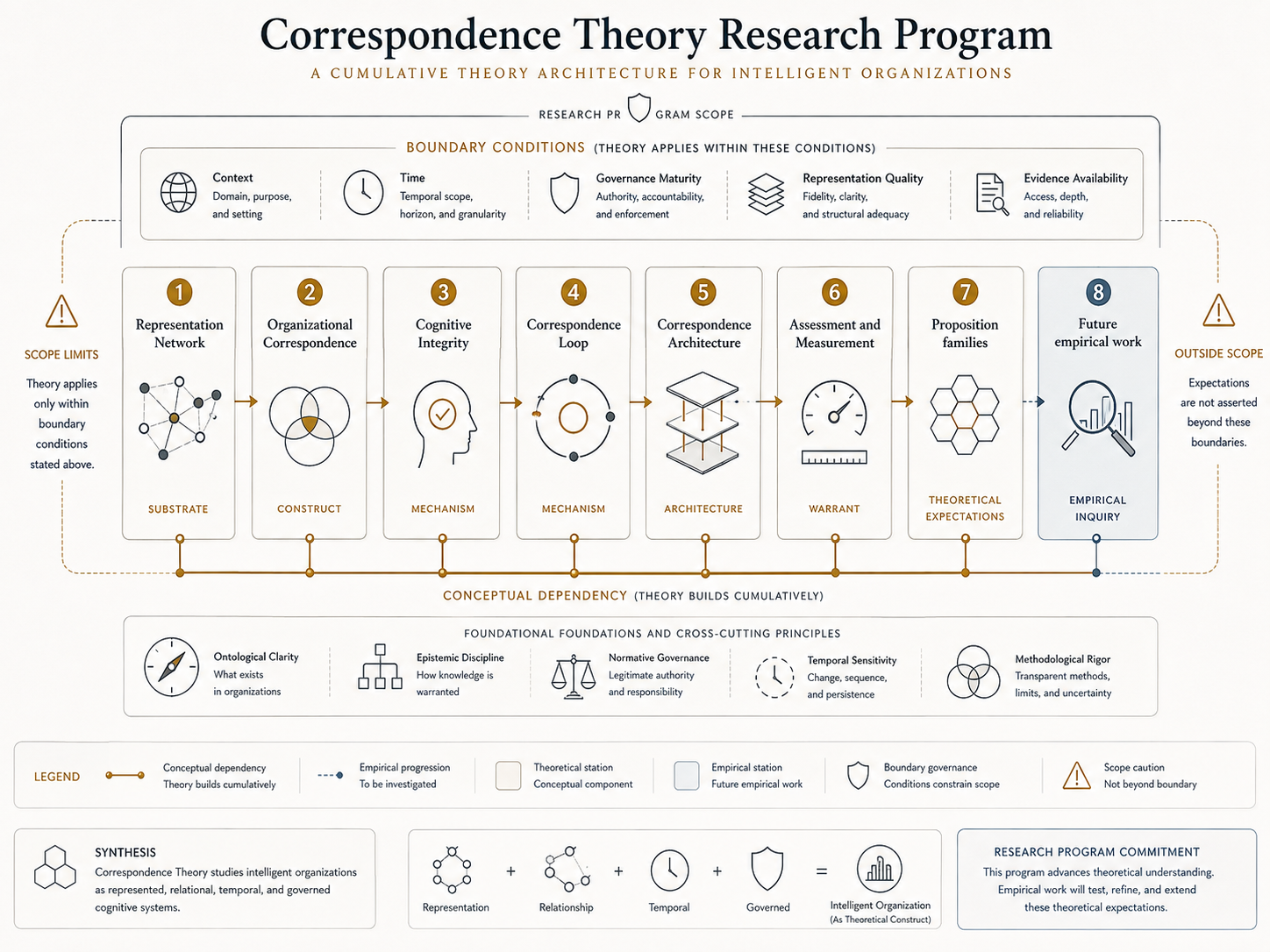
This program should remain cautious. Correspondence Theory is not validated merely because it is conceptually coherent. Its propositions require future operationalization and empirical testing. Its assessment and measurement frameworks require refinement, comparison, reliability evidence, validity arguments, and contestability protocols. Its implications for performance, resilience, adaptation, and governance should be treated as theoretical expectations, not established facts.
That caution is part of the contribution. The theory gives researchers a precise phenomenon to investigate and gives practitioners a disciplined way to ask better questions, but it does not ask either audience to treat a conceptual model as settled evidence.
The promise of the theory lies in the precision of its question. Organizations do not become intelligent by accumulating representations alone. They become intelligible to themselves when the relationships among those representations remain meaningful, reviewable, revisable, and governable over time. Correspondence is the condition that makes represented organizational cognition coherent. Correspondence Theory is the attempt to make that condition scientifically visible.