
Correspondence Architecture
The architectural answer is Correspondence Architecture: representation-centric organizational architecture for preserving Organizational Correspondence across evolving organizational representations. It is organizational because it concerns the structures through which organizational cognition is represented, related, remembered, governed, and revised. It is representation-centric because its primary object is not a process, department, system, capability, data entity, or workflow, but the Representation Network and its relationships. It is implementation-independent because documents, routines, platforms, ontologies, knowledge graphs, human practices, AI systems, or governance procedures may support it without reducing it to any of them.
Correspondence Architecture includes several architectural elements. Intent anchors meaning. Canonical organizational objects stabilize the semantic identity of important organizational things such as commitments, decisions, capabilities, policies, risks, outcomes, and learning objects. Representations express those objects from different perspectives. Relationships connect representations semantically, causally, evidentially, temporally, and governably. Memory retains prior representations and relationships in ways that allow later review. Evidence supports, challenges, or qualifies claims. Governance specifies authority, accountability, review, revision, and legitimacy. Learning converts evaluated experience into governed revision.
The architecture can be described through layers, but the layers should not be mistaken for a software stack. The intent layer preserves purposive direction. The representation layer preserves forms and relationships of represented meaning. The knowledge layer preserves interpretation, evidence, provenance, and memory. The runtime layer records decisions, work, outcomes, and changes as represented organizational events. The assessment layer evaluates correspondence state. The learning layer governs revision into future understanding.
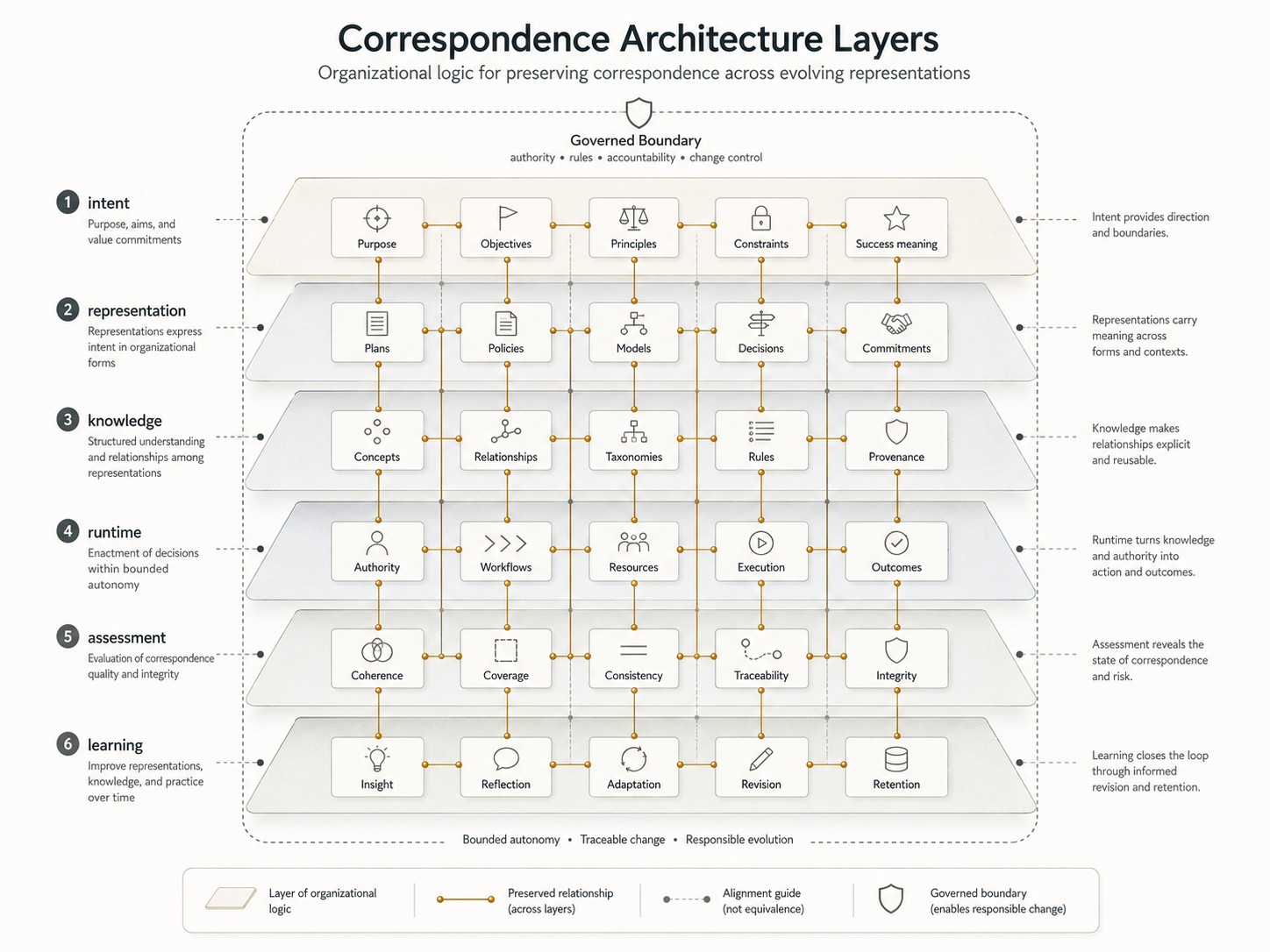
The layers are a reading device, not a claim that organizations must adopt a particular implementation. They help the reader see why a decision is not only a decision, why evidence is not only evidence, and why memory is not only storage. Each element matters because it carries a different part of the relationship-preservation burden.
Correspondence Architecture is distinct from enterprise architecture, knowledge management, digital twins, process architecture, and organizational design. Enterprise architecture may map capabilities, systems, data, and processes, but Correspondence Architecture asks whether representations remain meaningfully related. Knowledge management may store and transfer knowledge, but Correspondence Architecture asks whether stored knowledge remains linked to provenance, decisions, evidence, outcomes, and future intent. Digital twins may model operational states, but Correspondence Architecture asks whether models correspond to organizational meaning, authority, and learning.
The architecture does not guarantee Cognitive Integrity. It provides the conditions under which Organizational Correspondence can be preserved, assessed, repaired, and learned. This distinction matters. Architecture makes preservation possible; it does not prove that preservation has occurred.