
Memory, Evidence, Governance, and AI Participation
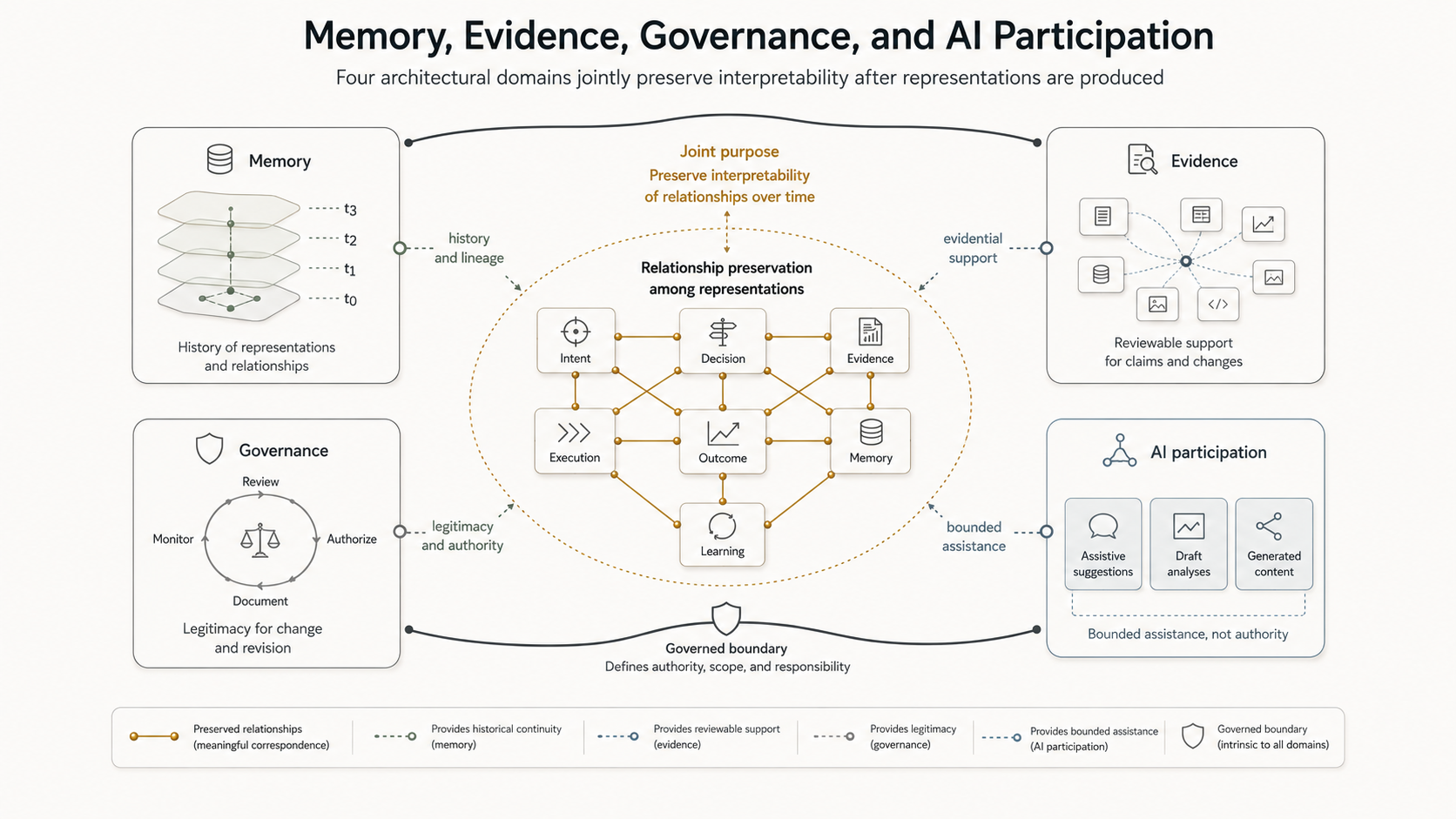
Four architectural domains carry special weight in Correspondence Theory: memory, evidence, governance, and AI participation. They matter because each one determines whether represented cognition remains interpretable after the moment in which it was produced.
Organizational Memory is the architectural capability for retaining representations and relationships in ways that preserve meaning over time. It is not merely storage. A repository may retain documents while losing why they were created, what they supported, which assumptions governed them, which decisions relied on them, what outcomes followed, and whether later evidence challenged them. Memory supports correspondence when it preserves the relationship history needed for future interpretation.
Evidence is represented support, challenge, qualification, contradiction, or limitation for organizational claims. Evidence does not become authoritative merely because it is stored or visible. It must be related to claims, methods, provenance, temporal validity, uncertainty, and permissible use. Evidence preserves correspondence by making claims reviewable rather than self-contained.
Governance is intrinsic to correspondence preservation. It specifies who or what may create, revise, authorize, challenge, accept, retire, or restore representations and relationships. Without governance, correspondence can become either accidental or coercive: accidental because relationships depend on informal habits, coercive because representations can appear authoritative without legitimate authority. Governance makes correspondence accountable.
AI participation intensifies all three domains. AI systems can generate representations, infer relationships, summarize evidence, recommend revisions, and detect contradictions. Yet AI participation must remain bounded. AI can assist represented organizational cognition, but it should not become the source of organizational truth. Its outputs require provenance, review, authority boundaries, uncertainty, contestability, and integration into memory.
The boundary is theoretical as much as practical. Correspondence Theory is not a theory of AI autonomy. It is a theory of relationship preservation in represented organizational cognition. AI matters because it changes the rate, volume, and form of representation-network change. It does not eliminate the need for human and organizational governance.
Architecture therefore prepares the organization for assessment. It makes relationships more explicit, evidence more reviewable, memory more usable, and governance more accountable. But the existence of architecture does not settle whether correspondence state is preserved. The organization still needs warranted judgment.
Part IV introduces the epistemic discipline of the theory. Architecture can make relationship preservation more possible, but it cannot declare that correspondence has been preserved. Assessment is the bridge between a theory of coherence and a warranted judgment about a bounded correspondence state.