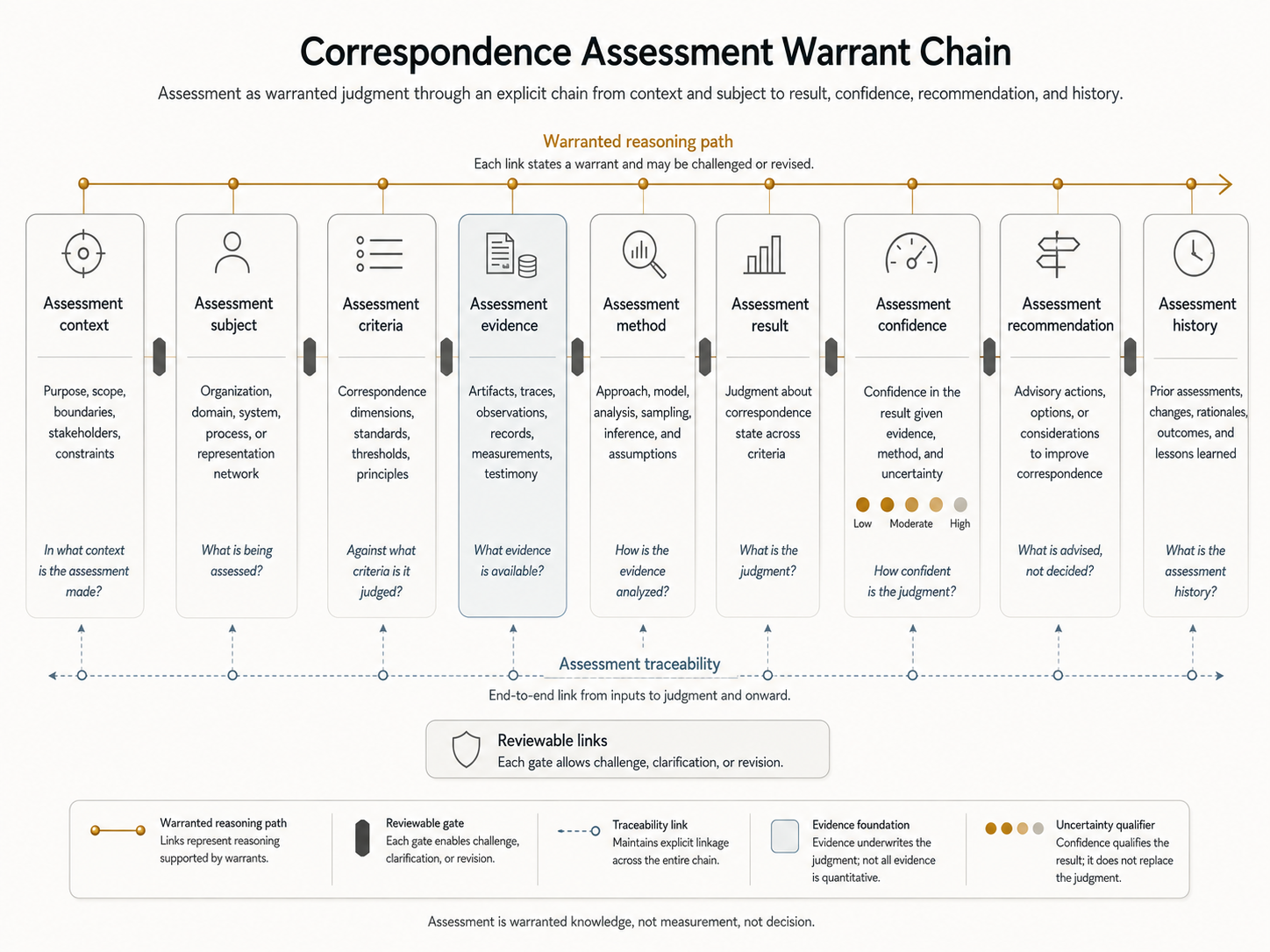
Correspondence Assessment
Correspondence Assessment is a theory-guided organizational capability for making context-bounded, criteria-guided, evidence-grounded, confidence-qualified, and traceable judgments about correspondence state within a bounded Representation Network. This definition contains the assessment architecture. Assessment is theory-guided because criteria derive from Correspondence Theory rather than from whatever data happens to be available. It is context-bounded because judgments are interpretable only within a specified organizational and temporal setting. It is criteria-guided because assessment requires explicit expectations about semantic, causal, evidential, temporal, and governance relationships. It is evidence-grounded because judgments require identifiable support, challenge, qualification, or limitation. It is confidence-qualified because assessment results carry uncertainty and evidential sufficiency. It is traceable because the reasoning chain must be reviewable.
An assessment includes several elements. Assessment Context defines the setting. Assessment Subject defines the bounded representation-network object. Assessment Criteria define the theory-derived expectations. Assessment Evidence identifies materials that support or challenge the judgment. Assessment Method defines the disciplined reasoning approach. Assessment Result expresses warranted assessment knowledge about correspondence state. Assessment Confidence qualifies uncertainty and evidential sufficiency. Assessment Traceability links the reasoning chain. Assessment Recommendation may state advisory implications, but it is not a decision or command. Assessment History retains prior contexts, subjects, evidence, judgments, confidence, recommendations, and outcomes.
The assessment result is not correspondence itself. It is knowledge about correspondence state. This distinction protects the theory from confusing the phenomenon with the judgment about the phenomenon. A strong assessment result may be wrong if evidence is incomplete, criteria are poorly specified, context is misunderstood, or method is flawed. Assessment Confidence exists precisely because warranted judgment remains fallible.
Assessment also protects against data opportunism. Organizations often assess what they can easily observe. Correspondence Assessment requires the reverse discipline: specify the correspondence claim first, then identify what evidence can responsibly support, challenge, or qualify it. Available data may be useful, but availability does not determine construct validity.
This reversal is one of the theory's most important methodological lessons. If the question is whether a strategic decision still corresponds to the evidence and assumptions that warranted it, the assessment cannot be reduced to the presence of a decision record or an activity metric. The claim defines the evidence need.