
Evidence, Confidence, Traceability, and Learning
Correspondence Assessment becomes scientific only when its judgments are reviewable, contestable, and learnable. Evidence, confidence, traceability, and history provide these warrant conditions.
Assessment Evidence includes records, artifacts, traces, observations, decisions, outcomes, governance records, AI outputs, interviews, system logs, or other materials that bear on correspondence state. Evidence can support a claim, challenge it, qualify it, contradict it, or limit its interpretation. It is not equivalent to proof. Evidence gains meaning through its relationship to criteria, context, method, and claim.
Assessment Confidence qualifies the result. It may reflect evidence sufficiency, evidence quality, coverage, uncertainty, disagreement, temporal validity, method limits, or unresolved contradiction. It should not be treated as correspondence strength or statistical confidence unless a separate measurement framework supports that interpretation. Confidence explains how strongly the assessment result should be relied upon.
Assessment Traceability links context, subject, criteria, evidence, method, result, confidence, recommendation, governance input, learning, and assessment history. Traceability does not make a judgment correct, but it makes the judgment reviewable. A non-traceable assessment cannot be responsibly challenged, reproduced, revised, or learned from.
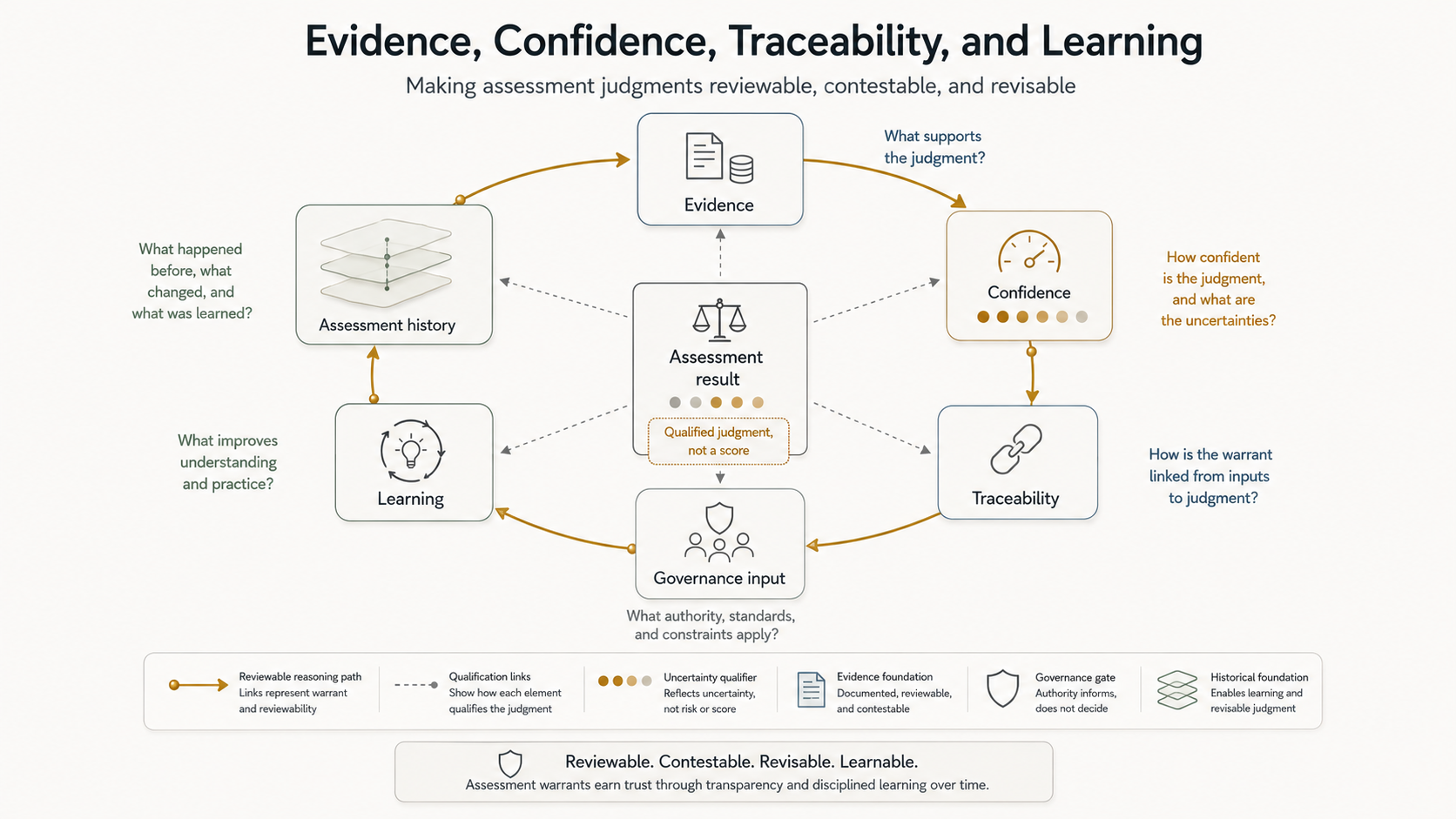
Learning enters assessment after judgment. An assessment may reveal that a representation relationship is missing, stale, unsupported, ambiguous, contradicted, or unauthorized. Governance may then decide whether to revise a representation, repair a relationship, qualify a claim, update memory, change criteria, or accept a known limitation. The assessment itself does not take action; it informs accountable action.
This boundary is essential in AI-native organizations. AI can assist evidence gathering, relationship detection, contradiction identification, summary, and assessment preparation. It should not erase the distinction between evidence, judgment, recommendation, decision, authority, and action. Assessment remains warranted judgment, not automated command.
Assessment creates the bridge to measurement, but it does not collapse into measurement. A judgment may be warranted without being measured. A measure may inform a judgment without replacing it. To operationalize correspondence responsibly, the theory must now define a stricter methodological boundary.
Part V explains how a relational theory can become measurable without being flattened. Measurement is necessary for cumulative science, but Correspondence Theory cannot be responsibly measured as a single score or dashboard signal. Measurement must preserve the theory's relational, temporal, evidential, and governance structure.