
The Correspondence Loop
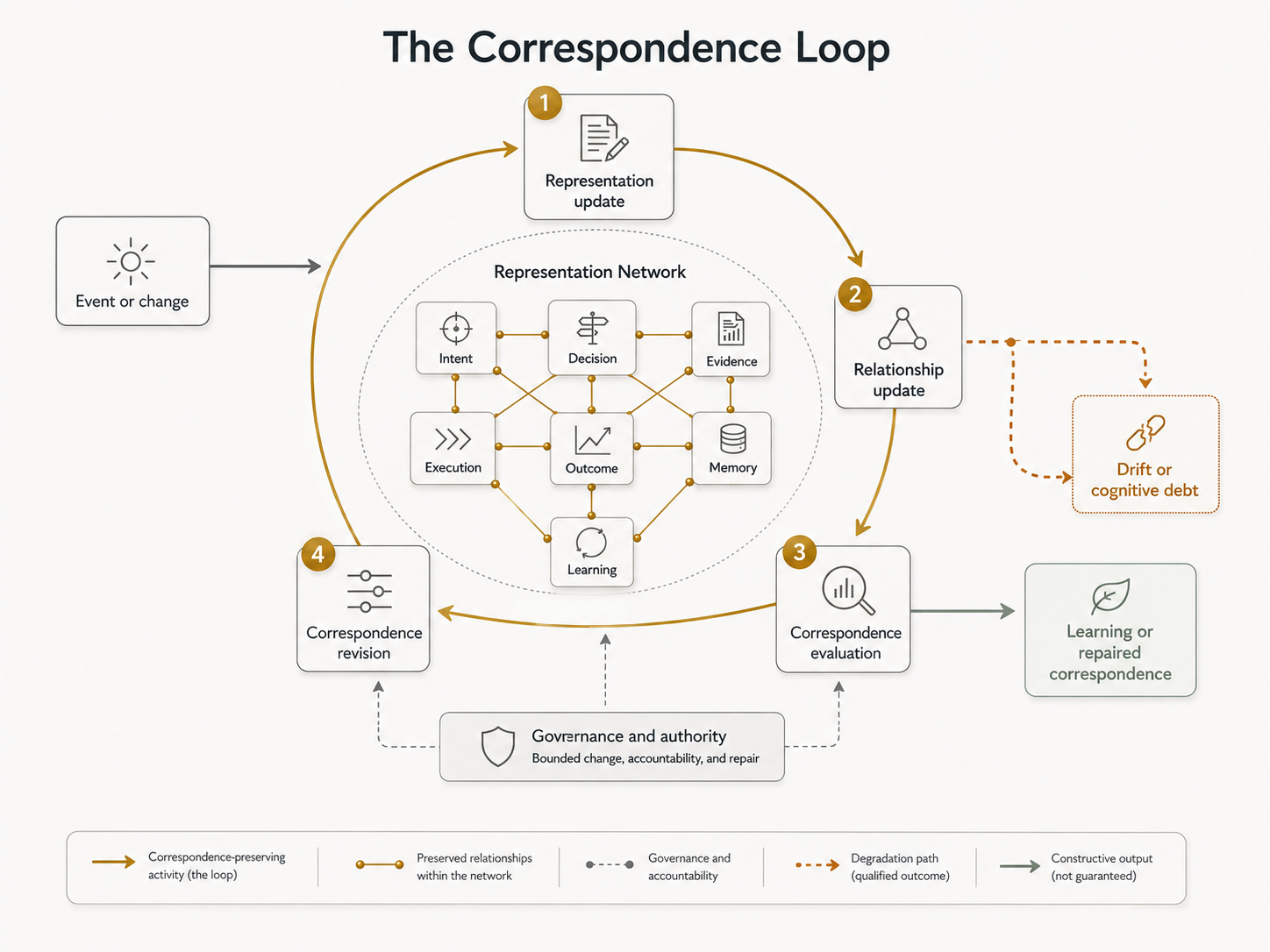
Cognitive Integrity requires a dynamic mechanism. The Correspondence Loop is the recursive, event-driven mechanism through which the Representation Network is maintained, revised, restored, or degraded. The loop is not an execution cycle, decision process, governance workflow, or software routine. It is a theoretical mechanism for explaining how organizational representations and their relationships change over time. It shows why correspondence may be sustained in one region of the network and degraded in another, why local updates can create wider inconsistency, and why repair requires more than adding information.
The loop contains four mechanism families. Representation Update occurs when the organization creates, revises, retires, or reinterprets a representation. Relationship Update occurs when the organization establishes, revises, breaks, or qualifies relationships among representations. Correspondence Evaluation occurs when the organization judges whether relationships remain meaningful, valid, supported, current, and authorized. Correspondence Revision occurs when the organization restores, reworks, qualifies, or deliberately accepts correspondence degradation.
These mechanism families are recursive because each update can create further updates. Revising a strategic priority may require revising plans, metrics, authority boundaries, AI prompts, decision records, outcome interpretations, and lessons learned. Correcting an evidence claim may require revising a recommendation, decision, policy, or memory object. Restoring correspondence in one location may reveal degradation elsewhere.
The loop is event-driven because meaningful organizational events activate the need for maintenance. Events may include new evidence, changed intent, changed conditions, policy revision, decision reversal, outcome discovery, AI-generated recommendations, detected contradiction, governance review, failed action, or learning. These events do not automatically preserve correspondence. They create maintenance demands.
In the recurring chain, a new outcome may reveal that the original evidence was weaker than believed. That single event can require a revision to the lesson, a qualification of the decision record, a change in future execution, and a governance review of who may reuse the claim. The loop names that recursive maintenance demand.
When the Correspondence Loop functions well, the organization can preserve semantic, causal, evidential, temporal, and governance relationships as its representations evolve. When the loop is weak, degradation accumulates. The book uses cognitive debt to describe accumulated unresolved correspondence degradation: the burden created when representations continue to be used while their relationships to meaning, cause, evidence, time, or authority have weakened.
Cognitive debt is not a new focal construct. It is failure-mode language for the consequences of poor maintenance. It helps explain why organizations can continue to operate while becoming harder to understand, govern, and adapt. The Correspondence Loop therefore closes the initial theory: representation networks provide the substrate, Organizational Correspondence names the preserved relationship condition, Cognitive Integrity names the emergent state, and the loop explains dynamic maintenance or degradation.
The next problem is scale. A loop can describe maintenance, but organizations also need structures that make maintenance possible across boundaries, systems, actors, memories, and AI participation. That need leads from integrity to architecture.
Part III moves from theory to preservation conditions. If correspondence is an emergent property and Cognitive Integrity is a fragile state, the organization needs more than intention, discipline, or local expertise. It needs architecture that makes the relevant relationships explicit enough to preserve, assess, and repair.