
Cognitive Integrity
The state supported by sustained Organizational Correspondence is Cognitive Integrity. The concept matters because relationship preservation is not only a property of artifacts. When the relevant relationships are sustained, the organization is better able to understand itself, explain its action, revise its memory, and learn from outcomes without losing the meaning of what changed.
This construct names the condition in which represented organizational cognition remains coherent, consistent, and traceable enough to support responsible understanding, decision, action, memory, learning, and adaptation. It is not a property of an individual mind, an AI model, a database, a dashboard, or a management team. It is an organization-level state arising from sustained correspondence across the representation network.
The distinction between Organizational Correspondence and Cognitive Integrity is foundational. Organizational Correspondence names the preserved relationship condition among representations. Cognitive Integrity names the emergent organizational state associated with that sustained condition. Correspondence is the underlying property; Cognitive Integrity is the organization-level cognitive condition that property supports.
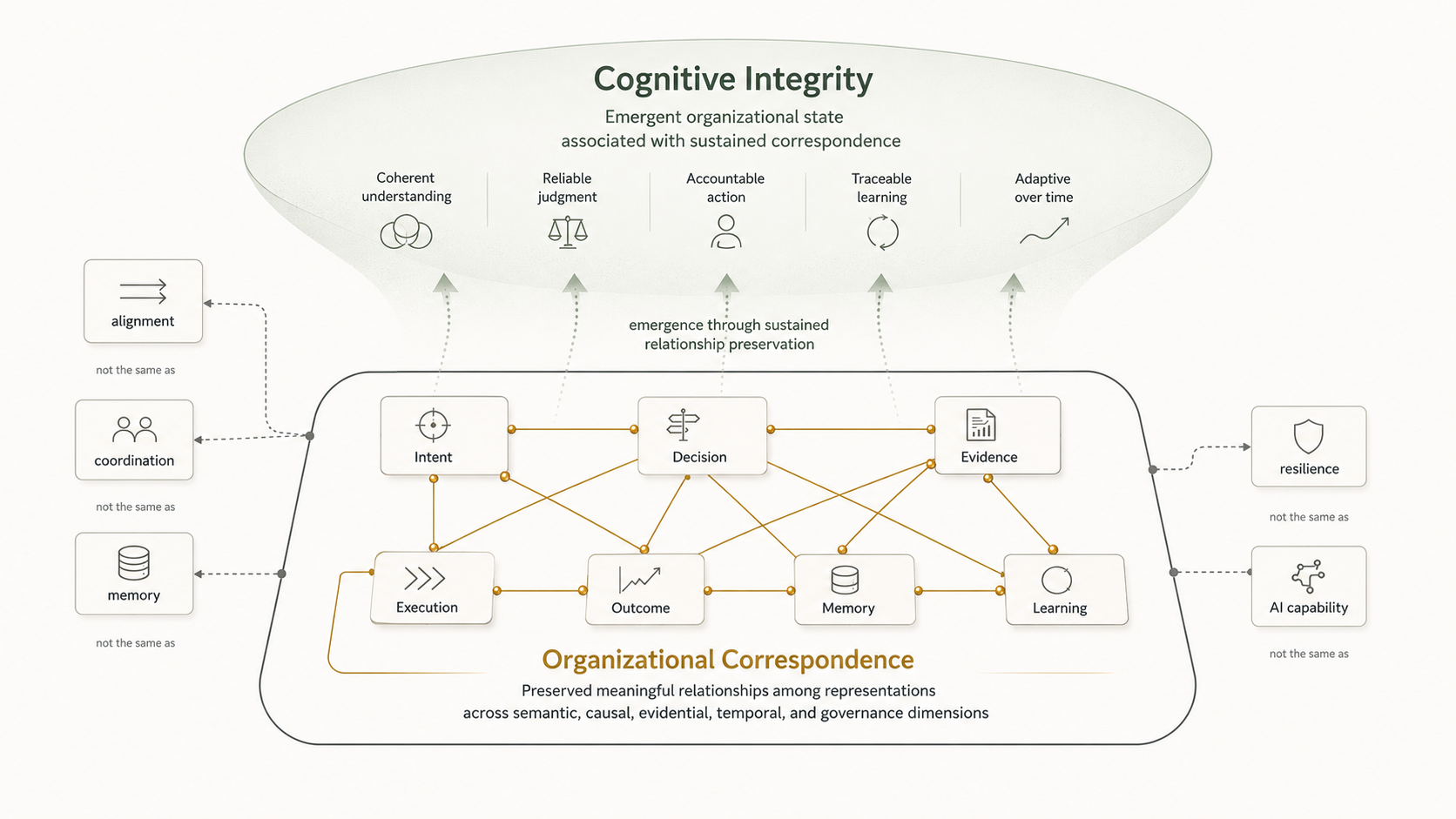
Cognitive Integrity is also distinct from related constructs. It is not alignment, because alignment may describe fit at a point in time while Cognitive Integrity concerns sustained represented cognition across change. It is not coordination quality, because an organization can coordinate work efficiently around degraded representations. It is not knowledge integration, because integrated knowledge assets may still be disconnected from intent, decisions, outcomes, and learning. It is not organizational memory, because memory may be extensive yet obsolete, fragmented, or ungoverned. It is not resilience or dynamic capability, because those describe capacities or outcomes of adaptation; Cognitive Integrity is the cognitive condition that may support adaptation without guaranteeing it.
This boundary protects the theory from overclaiming. Cognitive Integrity may support adaptive capacity, decision quality, execution quality, resilience, or strategic consistency, but it does not directly cause organizational performance. Markets, resources, regulation, competition, timing, leadership, politics, and institutional conditions remain consequential. Correspondence Theory claims only that sustained correspondence is associated with a more coherent state of represented organizational cognition.
In AI-native organizations, Cognitive Integrity becomes more fragile because AI systems can generate or transform representations at scale. A model may summarize customer signals, propose resource shifts, draft policies, or produce decision options. These artifacts may improve speed, but they can also increase divergence if their relationships to intent, evidence, authority, decision history, and learning are weak. AI participation does not eliminate the need for Cognitive Integrity; it raises the burden of preserving it.
Cognitive Integrity should therefore be understood as a dynamic state. It can be strengthened, weakened, restored, or placed under stress. To explain those dynamics, Correspondence Theory requires a mechanism. That mechanism is the Correspondence Loop.