
The Problem of Represented Organization
Modern organizations operate through representations. They convert purpose into strategy, strategy into priorities, priorities into decisions, decisions into plans, plans into work, work into evidence, evidence into outcomes, outcomes into learning, and learning into memory. At each step, the organization produces representations that different people, teams, systems, and AI agents may read, transform, revise, ignore, recombine, or act upon.
This condition is not new, but it has become more consequential. As organizations become more digital, distributed, and AI-mediated, represented cognition grows denser. More claims are generated, more summaries are produced, more models are updated, more recommendations circulate, and more decisions depend on artifacts produced outside the reader's immediate context. The organization may appear more informed while becoming less coherent.
The problem is not representation abundance. Organizations need representations to coordinate action and preserve memory. The problem is relationship preservation. A representation has organizational meaning only because it stands in relation to other representations. A priority means something because it relates to purpose, constraints, assumptions, decisions, resources, and expected outcomes. A recommendation means something because it relates to evidence, method, context, authority, and consequence. A lesson means something because it relates to the event, decision, action, and outcome from which it arose.
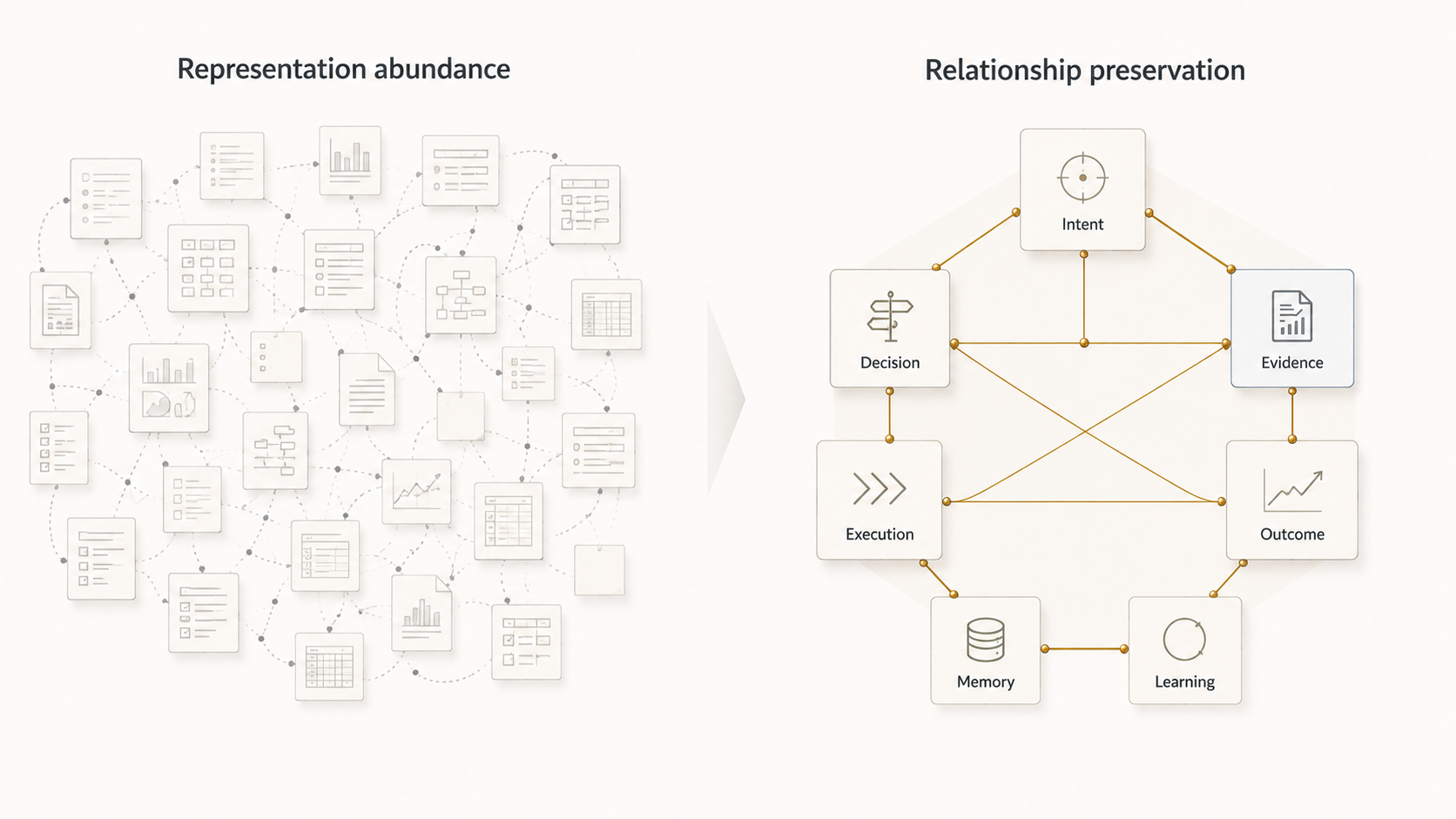
When these relationships are preserved, organizational cognition can remain intelligible across time. When they degrade, organizations can continue to produce documents, dashboards, metrics, plans, and AI outputs while losing the ability to understand what those representations mean in relation to one another. The organization still has information, but its represented cognition has fragmented.
Correspondence Theory begins from this problem. An intelligent organization is not merely an organization with more knowledge, stronger coordination, better data, more capable AI, or faster feedback. It is an organization whose representations remain meaningfully connected as intent, decision, action, evidence, memory, assessment, measurement, and learning evolve.
One recurring chain will help carry the theory. Imagine an organization that states an intent, authorizes a decision, executes work, gathers evidence, interprets an outcome, and stores a lesson. Correspondence Theory asks whether the relationships among those representations remain meaningful as each step is revised, reused, summarized, or acted upon later. The example is not a case. It is a simple pathway through which the theory's claims can be tested conceptually.
The first task is therefore ontological. Before correspondence can be defined, the theory must name the substrate in which correspondence is preserved or lost: the Representation Network. The next chapter makes that substrate explicit.