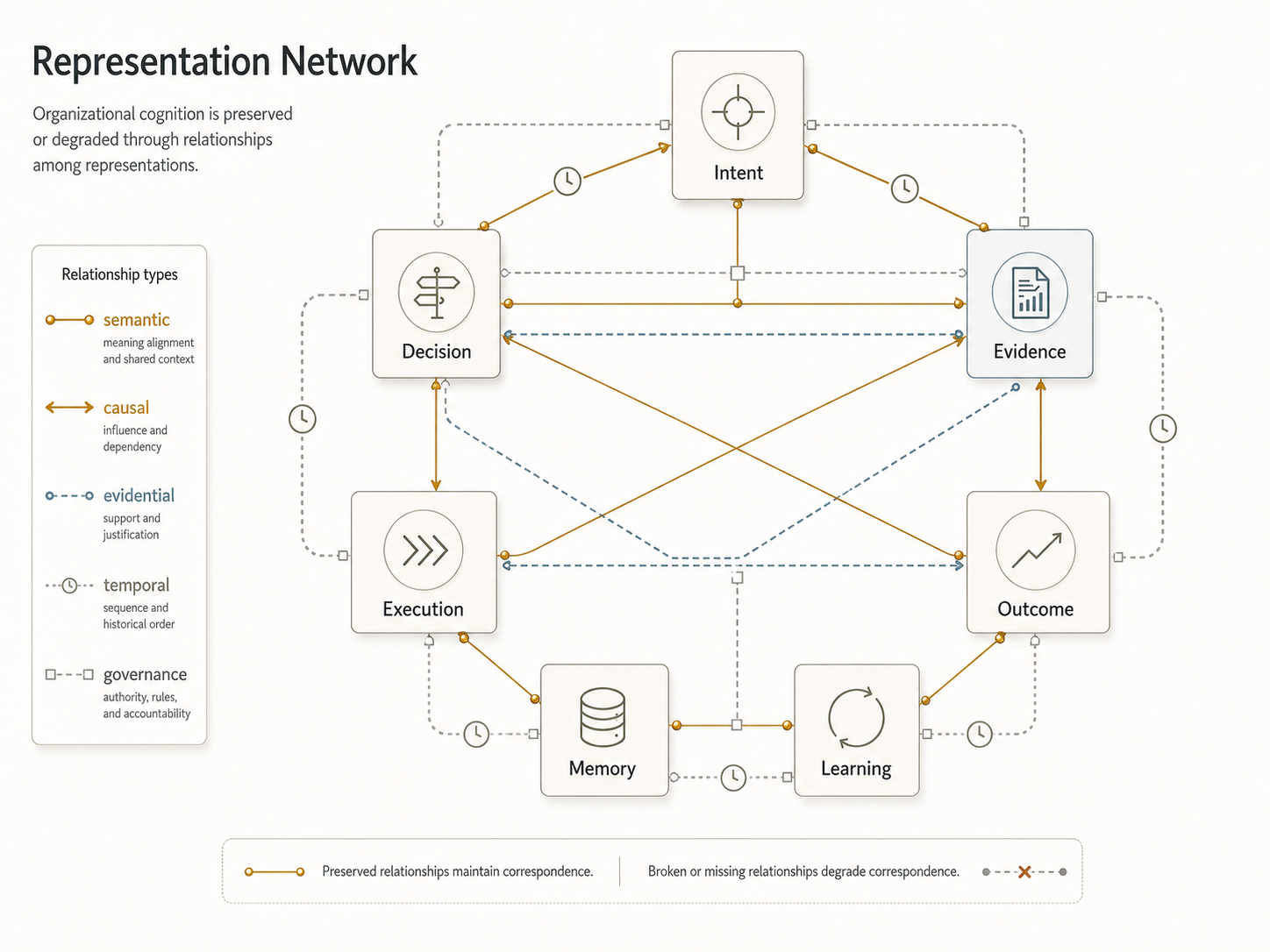
Representation Networks
A representation is a durable expression of organizational meaning, condition, intent, evidence, decision, assumption, action, outcome, or memory. Representations may be textual, visual, procedural, computational, narrative, formal, informal, human-generated, AI-generated, or system-generated. Their theoretical importance does not come from their medium. It comes from their role in represented organizational cognition.
Representations rarely stand alone. They form networks. A strategy links to objectives. Objectives link to decisions. Decisions link to evidence, actions, owners, assumptions, risks, and expected outcomes. Outcomes link back to decisions and forward to learning. Memory links prior interpretations to future action. Governance records link authority to decisions and revision. AI-generated artifacts may introduce new representations into this network, but they do not escape the need for relationship preservation.
A Representation Network is the evolving network of organizational representations and the meaningful relationships among them. The network is not a knowledge graph, repository, digital twin, process map, enterprise architecture model, or software system, although such artifacts may contain parts of it or provide traces of it. It is the scientific substrate of Correspondence Theory: the represented structure through which organizational cognition becomes persistent, distributed, revisable, and vulnerable to fragmentation.
The relationships in a Representation Network are multidimensional. Semantic relationships concern meaning. Causal relationships concern how one representation explains, produces, constrains, or follows from another. Evidential relationships concern support, challenge, warrant, uncertainty, and source. Temporal relationships concern sequence, validity interval, revision, history, and preservation over time. Governance relationships concern authority, permission, accountability, review, and legitimate revision.
These relationship types matter because coherence cannot be reduced to connectivity. Two representations may be linked without corresponding. A dashboard may link to a decision while omitting the assumption that made the decision valid. A model may link to a data source while losing the governance condition under which the data may be used. A summary may link to a report while changing its claim strength. The presence of a relationship is not the same as the preservation of meaning.
The Representation Network therefore gives Correspondence Theory its unit of attention. The book is not primarily about isolated documents, individual beliefs, information flows, stored knowledge, or AI outputs. It is about the conditions under which represented organizational cognition remains meaningfully related as the organization changes.
In the recurring chain, the intent statement, decision record, evidence base, execution record, outcome interpretation, and lesson are all representations. Their theoretical importance lies not in their format, but in whether the relationships among them remain valid. A reader should therefore look for the network, not merely for the artifact.