
The Collapse of Workflow
The modern workflow was a brilliant compromise. It allowed organizations to move work among people who could not all see the same information, make the same decisions, or act at the same time. Handoffs were not accidents; they were the architecture of coordination. AI weakens that premise. When systems can interpret, generate, route, and act continuously, the workflow stops looking like the natural shape of work. It begins to look like a memory of older constraints.
The usual answer is better workflow automation, but the more important shift is from workflow to flow: a continuous connection among intent, information, decision, execution, and learning.
For more than a century, workflow has been the dominant model for organizing work. A task begins. Someone completes it. The work is handed to the next person. Another task begins. Eventually the outcome is delivered. The model appears so natural that few organizations question it. Yet workflows were never an ideal way to organize work. They were a practical response to human limitations. Information moved slowly. People specialized. Knowledge was fragmented. Coordination required explicit communication. Responsibility had to be transferred from one individual to another. Work naturally formed queues.
Workflow emerged as the mechanism that allowed organizations to coordinate these sequential activities. It solved an important problem. For its time, it was remarkably effective. Artificial intelligence changes the conditions that made workflow necessary.
Information no longer waits for someone to retrieve it. Context no longer needs to be recreated at every step. Analysis can happen continuously. Decisions can be informed instantly. Execution no longer depends entirely on sequential human activity. When these constraints disappear, workflow begins to lose its purpose. The objective is no longer moving work from person to person. The objective becomes moving intent to outcome. This is a fundamentally different model. Organizations often believe they are modernizing by automating workflows.
In reality, many are simply accelerating structures that no longer fit the capabilities of the technology they are introducing. A faster workflow remains a workflow. Artificial intelligence does not simply make workflows faster. It questions why the workflow exists in the first place.
The UPS ORION case also helps make this distinction concrete. Route optimization did not merely make an existing paper route plan quicker to produce. It changed the relationship between planning, driver judgment, data quality, route expectations, and performance measurement. Some recommendations were counterintuitive at first, so adoption required explanation, trust, and new leading indicators. That is the deeper lesson for workflow: the path from intent to outcome may need to be redesigned, not simply accelerated. Figure 5.1 shows the structural version of that lesson by placing handoff-based workflow beside intent-to-outcome flow.
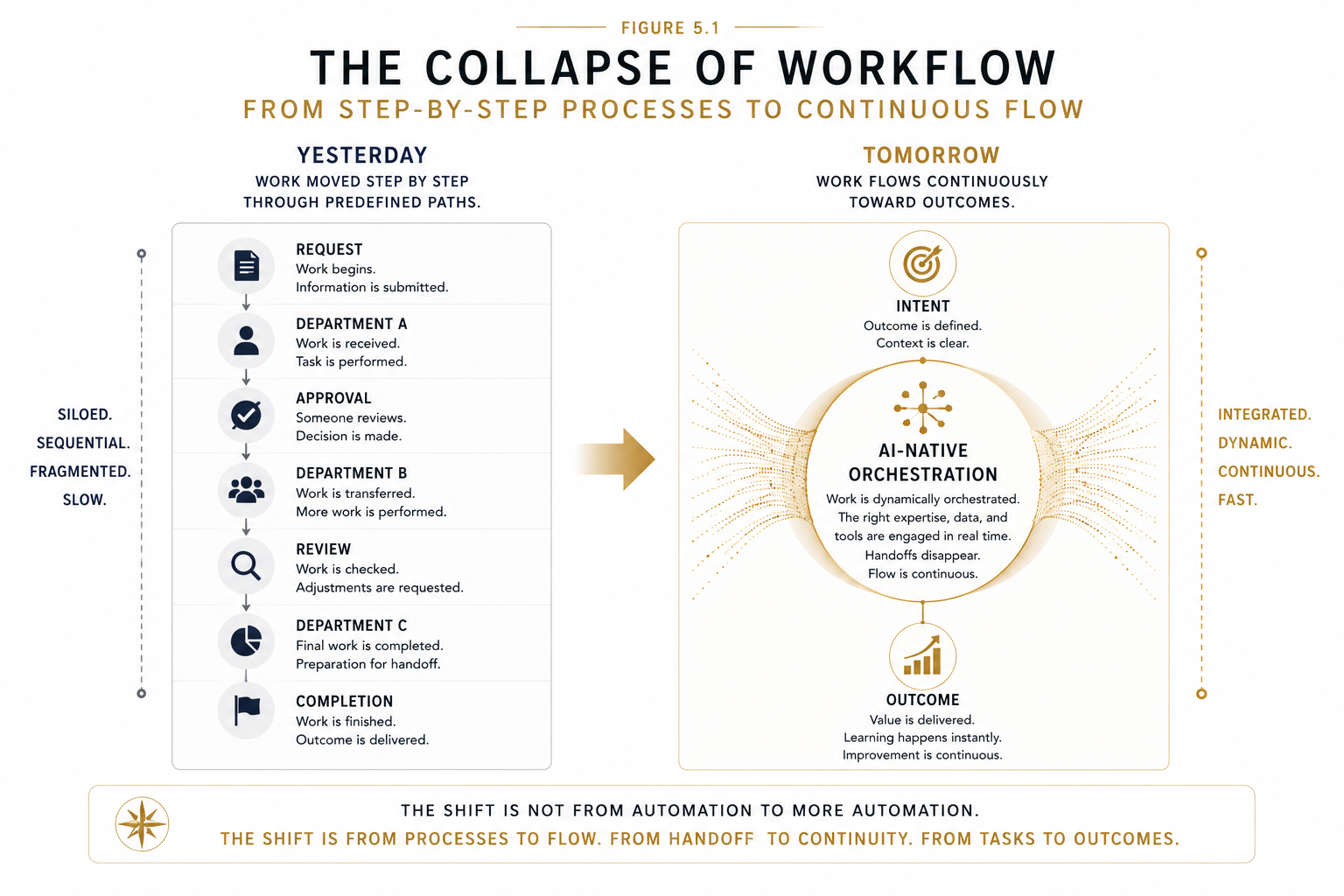
AI-native organizations coordinate around intent, enabling continuous flow toward outcomes rather than step-by-step task progression.
The visual contrast is the chapter's central distinction: workflow manages handoffs, while flow preserves continuity among intent, information, decision, execution, and learning.
Every workflow contains friction. Work waits. People wait. Information waits. Approvals wait. Each handoff introduces delay. Each transfer requires interpretation. Each queue increases uncertainty. Each approval creates another opportunity for misunderstanding. These costs have always existed. Organizations accepted them because there was no practical alternative. Artificial intelligence introduces another possibility. Instead of transferring work between isolated participants, work can remain connected to a continuously evolving understanding of the intended outcome. Execution becomes dynamic rather than predetermined. The path is no longer fixed before work begins. It adapts continuously as circumstances change.
This does not eliminate people. It eliminates unnecessary waiting between people, removes unnecessary translation, and reduces unnecessary coordination.
The organization begins operating less like a relay race and more like a continuously flowing system. The economics of coordination change with it. Historically, organizations invested enormous effort into managing handoffs. Project plans, status meetings, approval chains, escalation processes, and reporting structures all existed primarily to coordinate transitions between people, departments, and functions. As artificial intelligence absorbs more of this coordination, many of these mechanisms become progressively less valuable. The focus shifts from controlling movement to enabling flow.
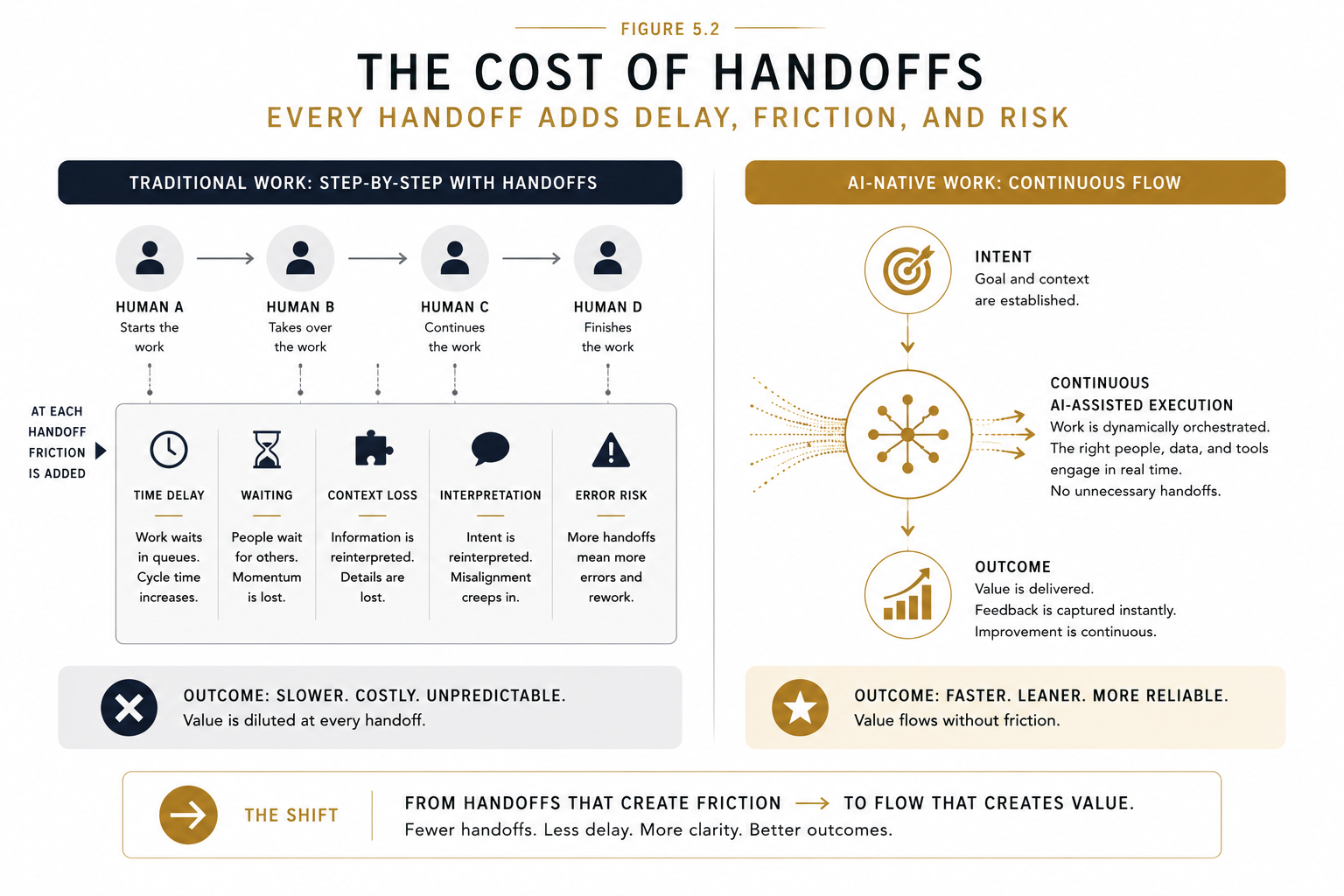
Continuous AI-assisted execution reduces friction by preserving context from intent through outcome.
The handoff figure shows why the old architecture becomes expensive even when every participant performs well. Delay, translation, and lost context are structural costs.
This is not a prediction that processes disappear. Organizations will always require governance, accountability, and compliance. What changes is how these are achieved. Instead of controlling work through sequential workflows, organizations increasingly guide work through continuously available intent, real-time information, and dynamic orchestration. The emphasis moves from process to outcome, from activity to impact, and from coordination to continuity. This represents one of the largest changes in modern management. For generations, leaders improved workflows. The next generation of leaders will increasingly redesign them.
Some workflows will remain, many will become dramatically shorter, and others will disappear entirely. The defining characteristic of AI-native organizations will not be the number of workflows they automate, but the number of workflows they no longer need. The future of work is less about workflow than flow. Work moves continuously toward outcomes. People contribute where they create the greatest value. Artificial intelligence continuously orchestrates information, coordination, and execution. The organization becomes less concerned with moving tasks. It becomes more capable of delivering results. That is the operating system shift.
The point is not the automation of workflow, but the transition from workflow to continuous organizational flow. The collapse of workflow does not mean the end of discipline. It means discipline must move from rigid sequences into the design of continuous flow.
Executive Takeaway
The future of work is not better workflows. It is continuous flow, where intent, information, decisions, and execution remain connected from beginning to end.