
The Great Compression
Organizations have long depended on distance: time separated information from decision, decision from execution, and execution from learning. That distance created a need for meetings, reports, approvals, escalation paths, and management routines. Artificial intelligence compresses that distance. The effect is not merely faster work. It changes what coordination is for. When information can be interpreted quickly and execution can begin sooner, many structures designed to bridge distance become visible as friction. Compression is often treated as speed. The stronger explanation is that AI reduces organizational distance and changes the assumptions behind coordination.
Every organization contains distance: between strategy and execution, decisions and action, information and insight, work and outcomes, outcomes and learning. For more than a century, these distances shaped the design of organizations. They determined how many management layers were required, why workflows existed, why meetings were necessary, why approvals became institutionalized, and why reporting cycles emerged. Distance was not a flaw. It was an unavoidable consequence of human limitations. Information moved slowly. People processed only so much information at once. Communication required time. Decisions travelled through organizations layer by layer before action could begin.
Learning often arrived long after the opportunity to respond had disappeared, so the organizational operating system evolved to manage those distances. Hierarchy reduced uncertainty. Management coordinated activity. Processes synchronized work. Reporting connected outcomes back to leadership. The system functioned remarkably well because the distance itself was real.
Artificial intelligence changes that reality. Information can increasingly be collected and interpreted continuously. Analysis no longer waits for specialists. Execution no longer depends exclusively on sequential human activity. Learning no longer needs to happen after quarterly reviews. As the underlying constraints change, organizational distance begins to collapse. This is the Great Compression. It is not primarily about reducing people. It is about reducing the organizational distance between intent and outcome. Every improvement in artificial intelligence shortens one or more of these distances. Strategy reaches execution faster. Decisions can trigger action with far less delay.
Information becomes insight continuously, work produces measurable outcomes in real time, and learning becomes part of execution instead of a separate organizational process. The organization begins to behave differently, not because people disappear, but because distance does.
Amazon's public description of its robotics fulfillment network offers a visible operations example of this kind of compression. The company reports deploying more than one million robots across its operations network and describes newer fulfillment centers that combine robotics, computer vision, cloud infrastructure, and AI models to support package movement and operator workflows. This does not prove that Amazon represents the future operating system for every organization. It does show how physical flow, data flow, and decision flow begin to compress when technology and infrastructure are designed together.
Figure 4.1 asks the reader to look beyond speed in one place and examine how many distances inside the organization begin to shrink at the same time.
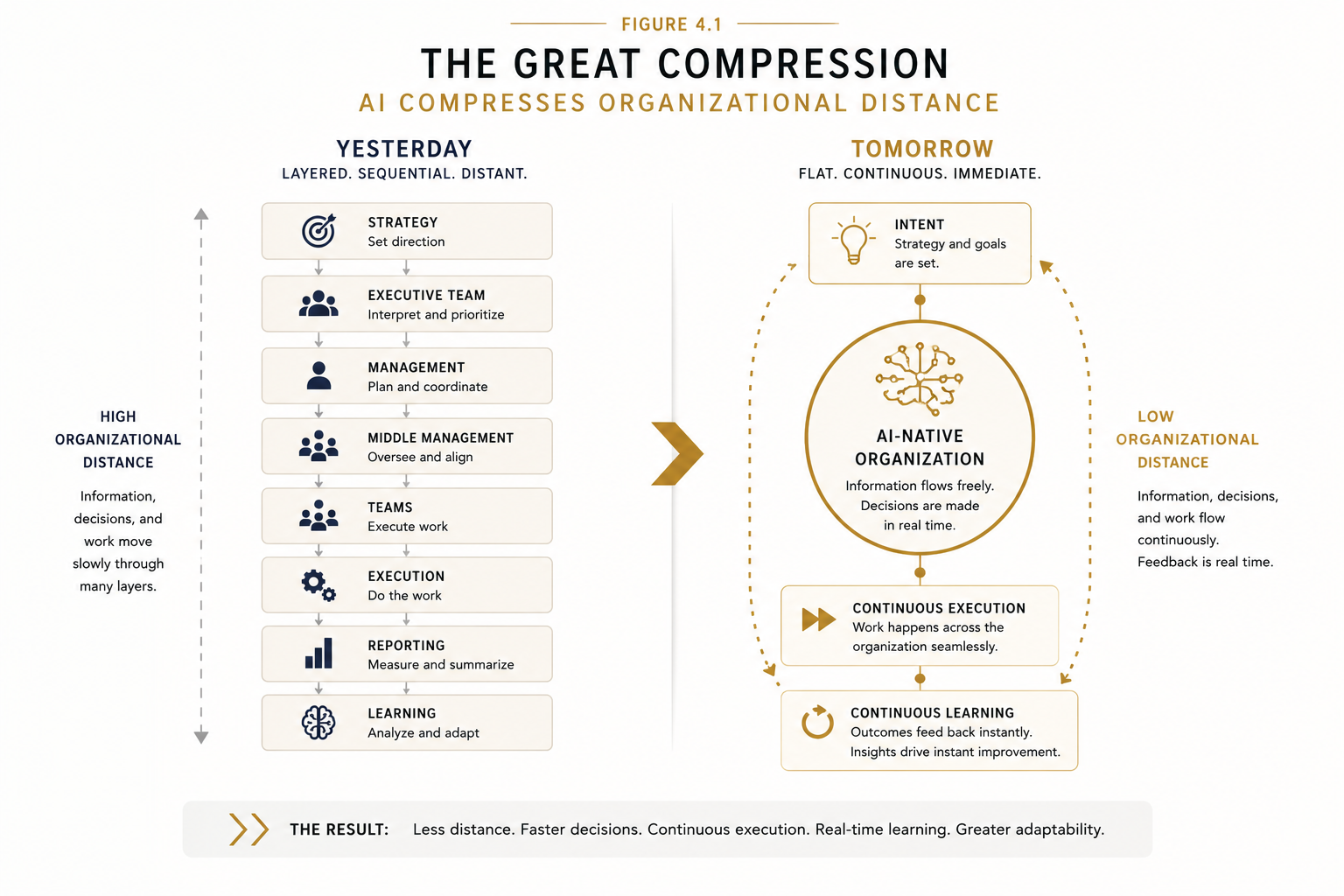
Layers become shorter, feedback becomes continuous, and the path from intent to execution becomes dramatically more direct.
The compression shown here is not only faster throughput. It changes the distance between intent and action, which changes what coordination must accomplish.
Once distance begins to shrink, the management problem changes. Historically, organizations required many intermediate layers because information degraded as it travelled. Each layer interpreted strategy, translated priorities, coordinated work, resolved conflicts, and reported progress. These activities were essential. Today, many of them become progressively less necessary. Artificial intelligence enables information to flow without waiting for manual interpretation. Decisions become increasingly informed by continuously updated information. Execution becomes connected directly to organizational intent. Feedback returns almost immediately. The distance separating these activities continues to shrink. This does not eliminate leadership. It changes its role.
Leaders spend less time transmitting information and more time defining intent. They spend less time coordinating execution and requesting reports, and more time shaping direction and interpreting emerging patterns. Leadership shifts from managing organizational distance to guiding organizational purpose.
The same principle applies throughout the organization. Teams become increasingly autonomous, functions become increasingly connected, and boundaries become increasingly permeable. The organization begins operating less like a hierarchy and more like a continuously adapting system. Compression also changes the rhythm of organizational learning. Traditional organizations learned periodically through monthly reports, quarterly business reviews, and annual strategy updates. Each cycle reflected the limitations of information moving through human systems. Artificial intelligence enables continuous observation, continuous feedback, and continuous adaptation. Learning gradually becomes embedded within execution itself.
Organizations stop merely reacting to change and begin adapting while change is occurring. The operating system no longer depends on periodic synchronization; synchronization becomes continuous.
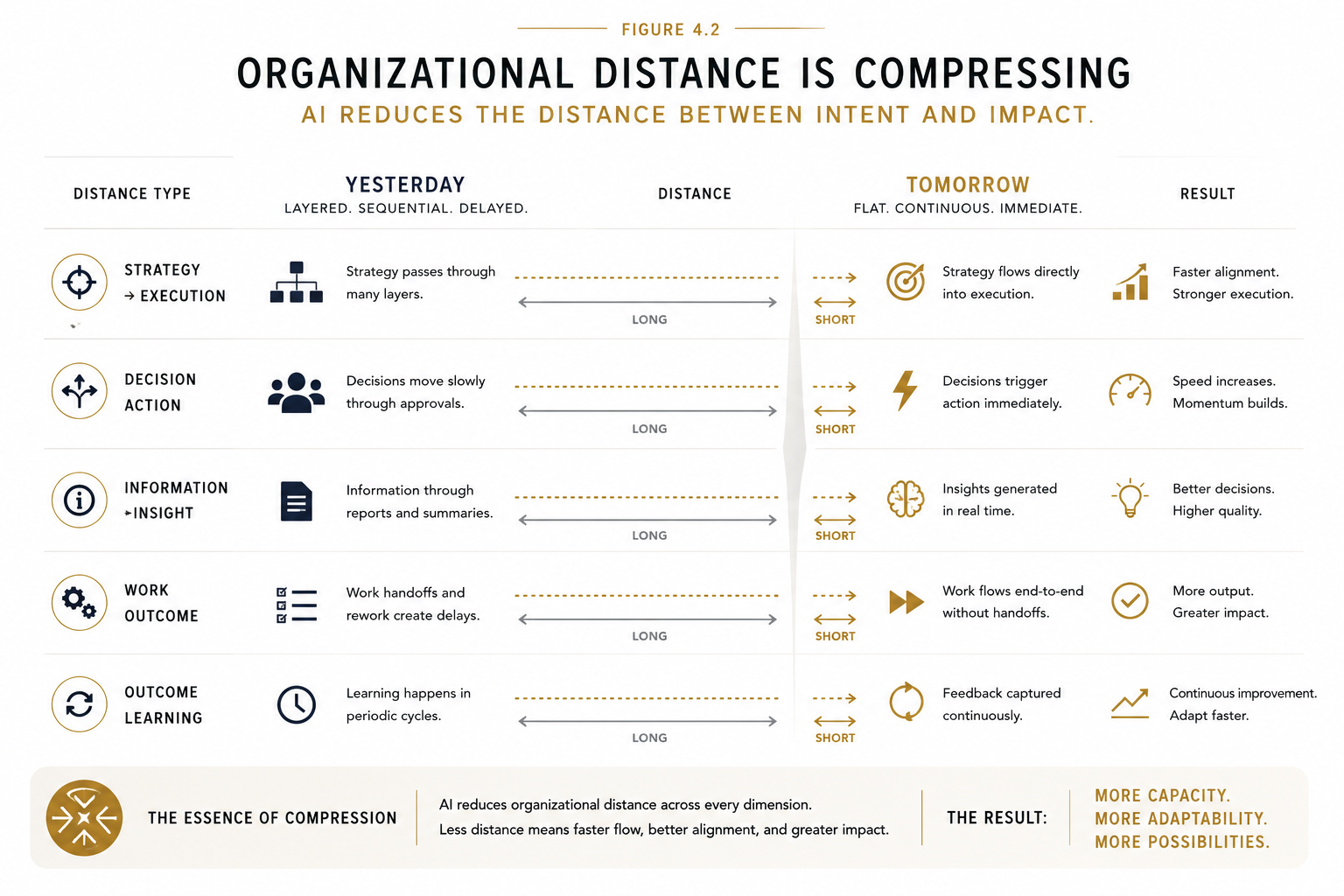
The result is not simply faster execution, but a fundamentally different organizational architecture.
The distance figure makes the hidden architecture visible. When distance shrinks, organizations cannot rely on slow translation layers to preserve coherence.
This is why many discussions about artificial intelligence focus on the wrong question. They ask: How many jobs will disappear? The more important question is: How much organizational distance will disappear? The answer affects every organization. Some management layers become unnecessary because information flows directly. Some meetings disappear because decisions occur continuously. Some workflows vanish because work no longer needs sequential coordination. Some reports become obsolete because organizational visibility exists in real time. None of these changes happen because hierarchy is inherently wrong.
They happen because hierarchy evolved to solve problems that artificial intelligence increasingly solves differently. Every technological revolution compresses something. The steam engine compressed physical effort. Computers compressed information processing. The internet compressed communication. Artificial intelligence compresses organizational distance.
The implications extend far beyond efficiency. When organizational distance decreases, organizations become more adaptive, more responsive, more coherent, and more capable of acting on intent without unnecessary delay. This is not about building smaller organizations. Many future organizations will employ more people than today's largest enterprises. The difference is that they will require dramatically less organizational distance to coordinate their work. That distinction changes everything. The operating system shift is not measured by headcount; it is measured by the distance between an idea and its execution, between a decision and its outcome, and between learning and adaptation.
The organizations that succeed in the AI era will not simply move faster. They will have far less distance to travel. Compression is therefore not only an operational improvement. It is a test of whether the organization can function when distance no longer performs the hidden work it once did.
Executive Takeaway
Artificial intelligence does not simply reduce work. It reduces organizational distance. And when distance disappears, the operating system must change with it.