
The Human Advantage
The common fear is that AI makes people less important. The more precise fear is that organizations may misunderstand which human capabilities are becoming more important. When systems assume more routine execution, the human advantage does not disappear. It moves. It concentrates in the capabilities that determine whether execution has meaning, whether action is wise, and whether the organization remains worthy of trust. The point is not that automation reduces human importance. The deeper pattern is that human value migrates toward intent, judgment, relationships, creativity, ethics, and learning.
Whenever a new technological revolution begins, the same question emerges: What happens to people? During the Industrial Revolution, machines transformed physical labor. During the Information Age, computers transformed knowledge work.
Now, artificial intelligence is transforming execution itself. Each transformation has generated concern that human value would diminish. History tells a different story. Technology rarely eliminates human contribution. It changes where that contribution creates the greatest value. The AI era is no exception. Artificial intelligence can increasingly analyze information, generate content, coordinate activities, and execute complex tasks at extraordinary speed. What it cannot do is determine why those tasks matter. That distinction becomes clearer when productivity evidence is treated carefully.
Microsoft Research's workplace studies suggest that generative AI can help people become more productive, but that the effect varies by role, function, organization, adoption, and utilization. In other words, human context still matters. The same tool does not create the same value everywhere.
The organization must decide where machine capability should substitute, where it should augment, and where human judgment must remain central. Machines can assist work, but they cannot define purpose, establish meaning, choose between competing values, or genuinely build trust. As execution becomes increasingly abundant, human value migrates upward. The movement is not away from work, but toward the work that only humans can perform. Figure 10.1 exists to show that migration across eras, from physical work to knowledge work and now toward purpose, judgment, relationships, and learning.
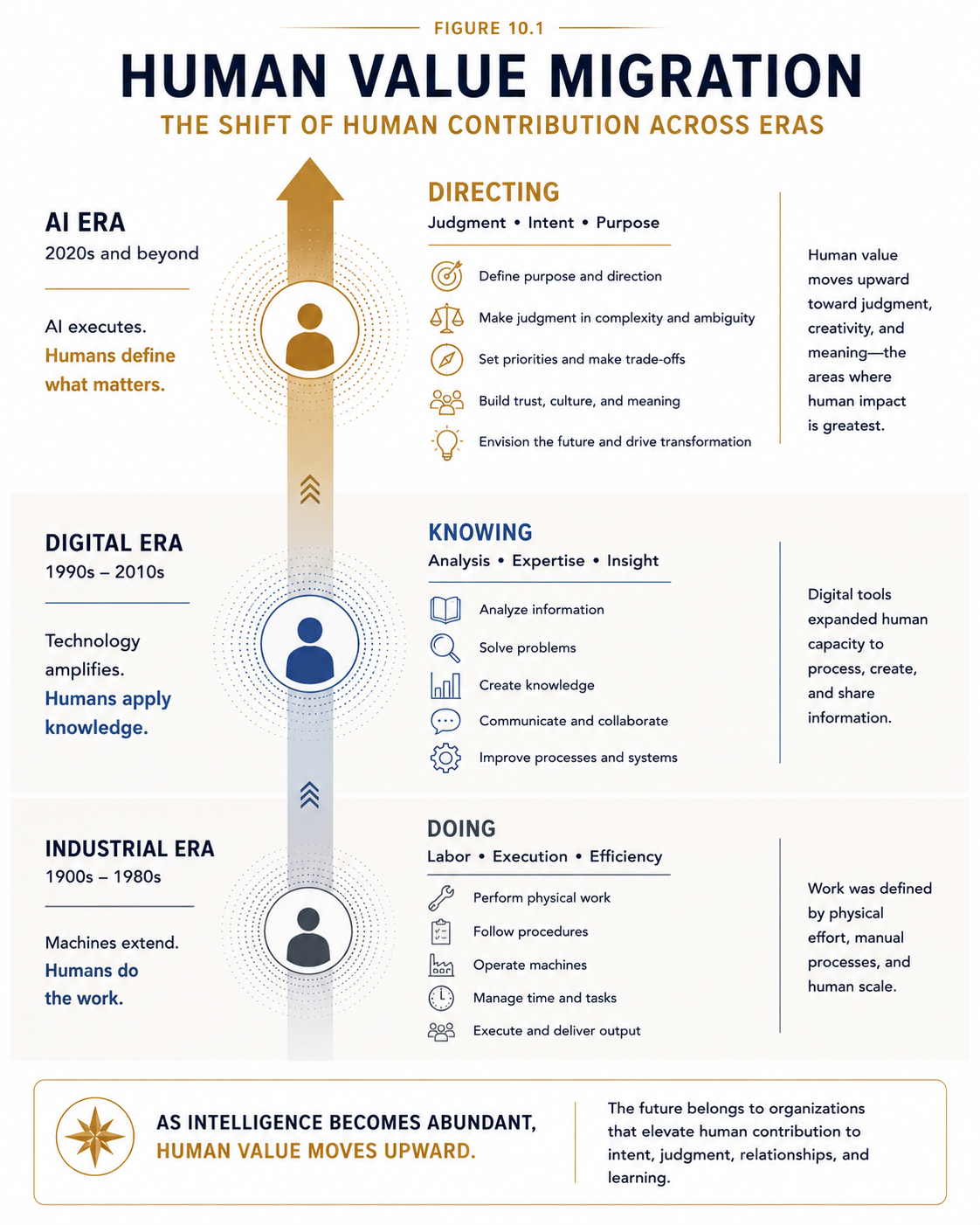
As artificial intelligence makes execution abundant, human value increasingly concentrates around intent, judgment, relationships, and continuous learning.
The migration figure clarifies the movement of value rather than the disappearance of value. It does not claim that earlier forms of human contribution vanish; it shows why the scarce executive question shifts toward where people create distinct value as routine execution becomes less scarce.
This migration has happened before. The Industrial Era rewarded physical capability. Organizations valued efficiency, discipline, consistency, and the ability to perform work at scale. Machines amplified physical effort. People performed the work. The Information Age shifted value toward knowledge. Computers automated calculation and information processing. People increasingly created value through expertise, analysis, communication, and problem-solving. Knowledge became the defining competitive asset. Artificial intelligence changes the landscape once again. Knowledge itself becomes increasingly abundant. Information is available instantly. Analysis can be generated in seconds. Execution can occur continuously. The scarce resource is no longer information.
It is human direction. The highest-value contribution increasingly comes from capabilities that cannot simply be automated. Four capabilities become particularly important. The first is intent. Organizations require purpose, direction, priorities, and trade-offs.
Artificial intelligence can determine many possible paths. People determine which destination matters. Intent defines the future the organization seeks to create. Without clear intent, intelligent systems optimize activity without understanding purpose; execution becomes faster, but meaning does not. The second capability is judgment. Many organizational decisions have no objectively correct answer. They involve uncertainty, ethical considerations, long-term consequences, and conflicting stakeholder interests. Human judgment integrates experience, wisdom, values, and contextual understanding in ways that extend beyond optimization alone. As intelligent systems become more capable, good judgment becomes increasingly valuable rather than less.
The third capability is relationships. Organizations exist because people create value together. Trust cannot simply be automated. Culture cannot be generated by algorithms. Leadership depends upon influence, empathy, negotiation, communication, and shared meaning. Artificial intelligence may facilitate relationships, but it cannot replace genuine human connection. The stronger the technological capability, the greater the importance of relationships that sustain collaboration and collective purpose. The fourth capability is continuous learning. Organizations must constantly adapt. Markets evolve. Technology evolves. Customer expectations evolve. Learning is therefore no longer an occasional management activity. It becomes a defining organizational capability. Human beings remain responsible for questioning assumptions, discovering new possibilities, challenging existing mental models, and deciding how organizations should evolve. Learning does not merely improve the organization. It enables the organization to remain relevant.
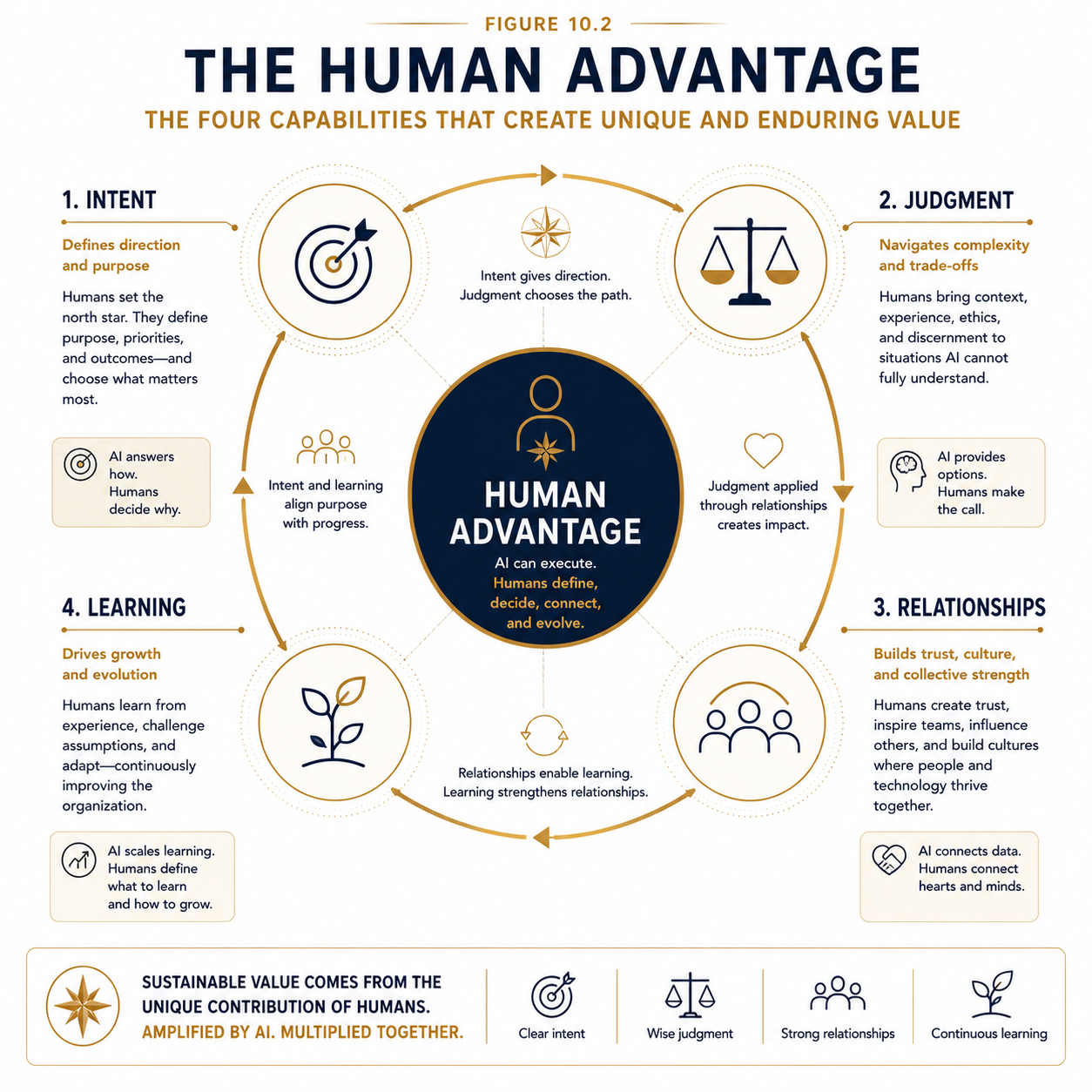
Artificial intelligence amplifies execution, while people amplify meaning, direction, trust, and organizational evolution.
The advantage figure shows why the human role becomes more consequential: intent, judgment, relationships, and learning reinforce one another as intelligent systems expand execution. It does not claim that AI removes human responsibility; it shows why leaders must deliberately develop the capabilities that give accelerated execution meaning.
These capabilities do not exist independently. Intent guides judgment. Judgment shapes relationships. Relationships enable learning. Learning continuously refines intent. Together they create a reinforcing cycle that becomes the foundation of every successful AI-native organization. Artificial intelligence strengthens this cycle by accelerating analysis, surfacing information, coordinating execution, and expanding organizational capability. Human beings strengthen something different: they decide what success means, determine acceptable trade-offs, create cultures that people want to join, establish ethical boundaries, and inspire others to pursue shared goals. This distinction changes how organizations should think about talent.
Historically, organizations often rewarded efficiency: the ability to complete tasks, manage processes, coordinate activities, and optimize operations. These capabilities remain valuable. They are no longer sufficient.
Tomorrow's organizations will increasingly develop people who can think systemically, exercise wise judgment, communicate across disciplines, build trusted relationships, and continuously learn alongside intelligent systems. This also changes leadership development. Future leaders will spend less time mastering operational procedures. They will spend more time strengthening curiosity, ethical reasoning, strategic thinking, communication, creativity, and organizational learning. The objective is not to compete with artificial intelligence. It is to complement it. The most successful organizations will therefore not separate people and AI. They will design systems where each contributes what it does best. Artificial intelligence provides speed; people provide significance. Artificial intelligence scales capability, while people define purpose. Artificial intelligence expands possibility, while people decide which possibilities deserve pursuit. This is the human advantage: not that people perform more work than machines, but that they define the meaning of the work itself. The future belongs neither to humans alone nor to intelligent systems alone. It belongs to organizations that combine both into a coherent whole. Technology amplifies human potential, and human purpose directs technological capability. Neither reaches its full potential without the other. That is the defining organizational principle of the AI era.
The human advantage is therefore not nostalgia for work AI can now perform. It is a renewed responsibility to develop the human capabilities that intelligent systems make more consequential.
Executive Takeaway
Artificial intelligence elevates what only people can uniquely contribute: intent, judgment, relationships, and continuous learning. The competitive advantage of AI-native organizations will increasingly depend on how effectively they develop and integrate these human capabilities.