
The Validator Problem
Every profession has a hidden apprenticeship. People learn by doing imperfect work, receiving feedback, recognizing patterns, and slowly developing judgment. Much of that work is tedious. Much of it is also formative. If AI removes the work without replacing the learning path, organizations create a quiet vulnerability. They may gain speed today while weakening the expertise needed to validate tomorrow's output. The visible benefit is less routine work. The strategic risk is that expertise development becomes a design problem rather than a by-product of everyday execution.
Artificial intelligence promises extraordinary gains in productivity because it can analyze, recommend, generate, coordinate, and execute. The better these capabilities become, the less work people need to perform themselves.
At first, this appears entirely positive. The visible benefits are less repetitive work, faster decisions, greater efficiency, and higher quality. Yet beneath these benefits lies a quieter transformation, one that organizations rarely recognize until it has already begun. Experience is no longer created in the same way. For generations, expertise developed naturally. People learned by doing: by solving difficult problems, making mistakes, encountering unusual situations, and repeating tasks until patterns became intuitive. Execution created experience. Experience created judgment, and judgment created expertise.
Expertise eventually produced the people who could teach others, make difficult decisions, and validate the quality of organizational work. This process sustained itself. Artificial intelligence changes the process. Increasingly, intelligent systems perform the execution. People review outcomes, approve recommendations, monitor results, and intervene only when necessary.
The work changes from doing to validating. At first glance, this appears to preserve human oversight. But it introduces an unexpected problem. Validators become experts because they once performed the work themselves. If fewer people perform the work, where will future validators come from? That is the validator problem. This is already visible in a quieter way in current AI adoption research. Organizations report using generative AI across functions, but review practices, risk roles, and governance maturity vary. Some outputs are checked carefully; others move through the organization with limited scrutiny.
That variation is not simply a compliance detail. It is a capability signal. An organization can only rely on AI-mediated work if enough people still possess the judgment to evaluate it.
Figure 11.1 shows the break in the development path that prose alone can easily hide.
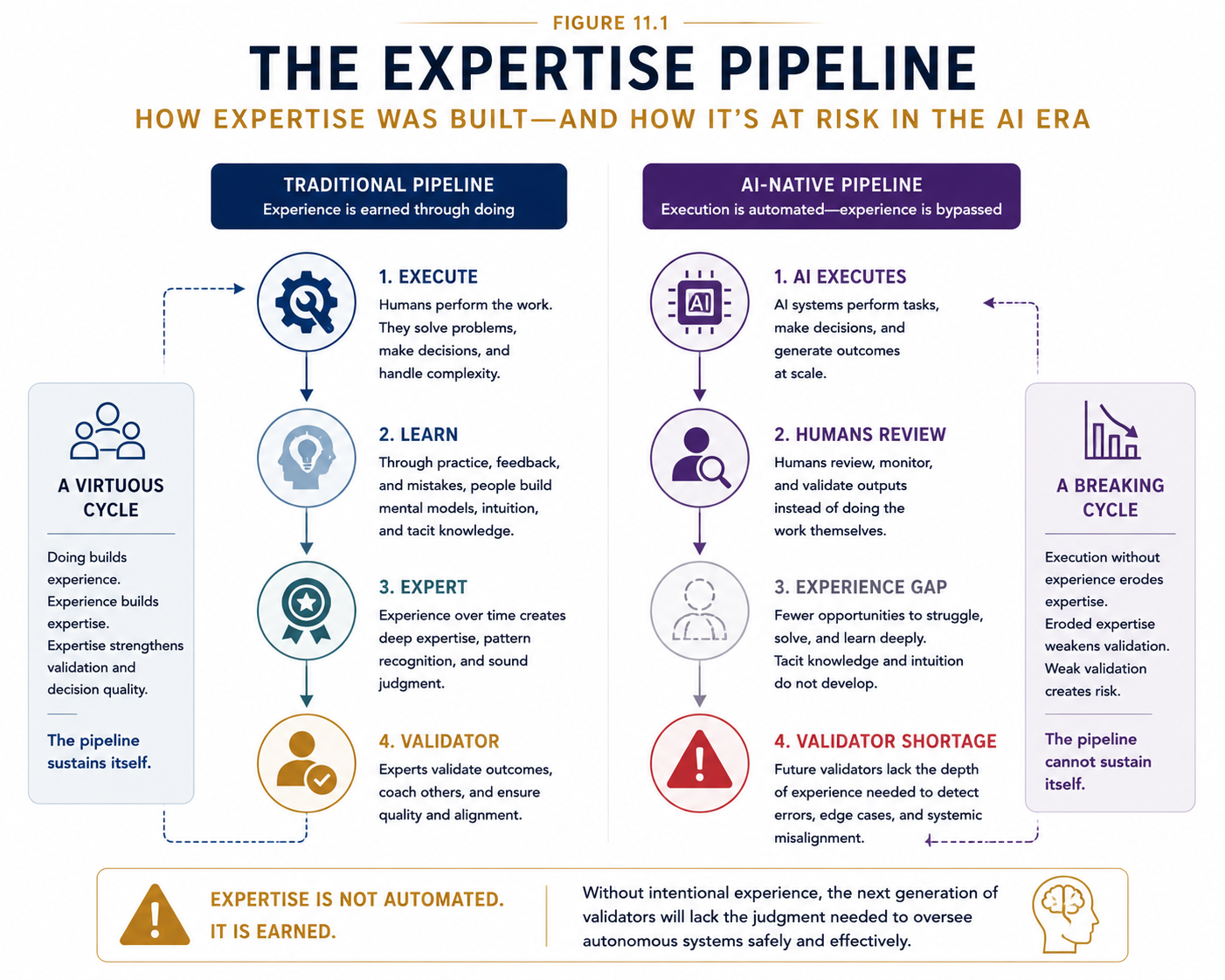
AI-native organizations risk interrupting this pipeline as intelligent systems perform an increasing share of operational work, creating a future shortage of experienced validators.
The expertise-pipeline figure makes the developmental risk concrete: when the learning path is weakened, future capacity to validate intelligent systems weakens with it.
This is not primarily a workforce problem. It is an organizational capability problem. Organizations rely on deep expertise that extends beyond documented knowledge. Experienced professionals recognize subtle warning signs. They identify unusual situations. They notice patterns others overlook. They understand context that has never been formally documented. This is tacit knowledge. It develops slowly. It cannot simply be downloaded from a database or generated by a language model. Tacit knowledge emerges through experience. If experience becomes scarce, tacit knowledge gradually disappears. Artificial intelligence does not eliminate expertise. It changes how expertise must be developed.
This challenge becomes even more significant as organizations become increasingly AI-native. The role of people shifts from execution toward supervision: reviewing AI-generated outputs, validating recommendations, and intervening when systems encounter uncertainty. They also remain responsible for outcomes. Ironically, this new role often demands greater expertise than the work people previously performed. Validation is cognitively demanding. Reviewers must understand not only what the AI recommends, but why. They must detect subtle errors, recognize hidden assumptions, evaluate situations the AI has never encountered, and exercise judgment under uncertainty. This creates another emerging challenge: cognitive fatigue.
AI-native professionals may perform fewer manual tasks than previous generations, yet they often sustain higher levels of continuous mental effort as they monitor, compare, verify, interpret, and remain ready to intervene across multiple activities at once. The workload shifts. Physical effort decreases. Cognitive responsibility increases. Organizations must recognize that this is not a temporary adjustment.
It is a new form of work, one that requires different capabilities, different support systems, and different approaches to leadership.
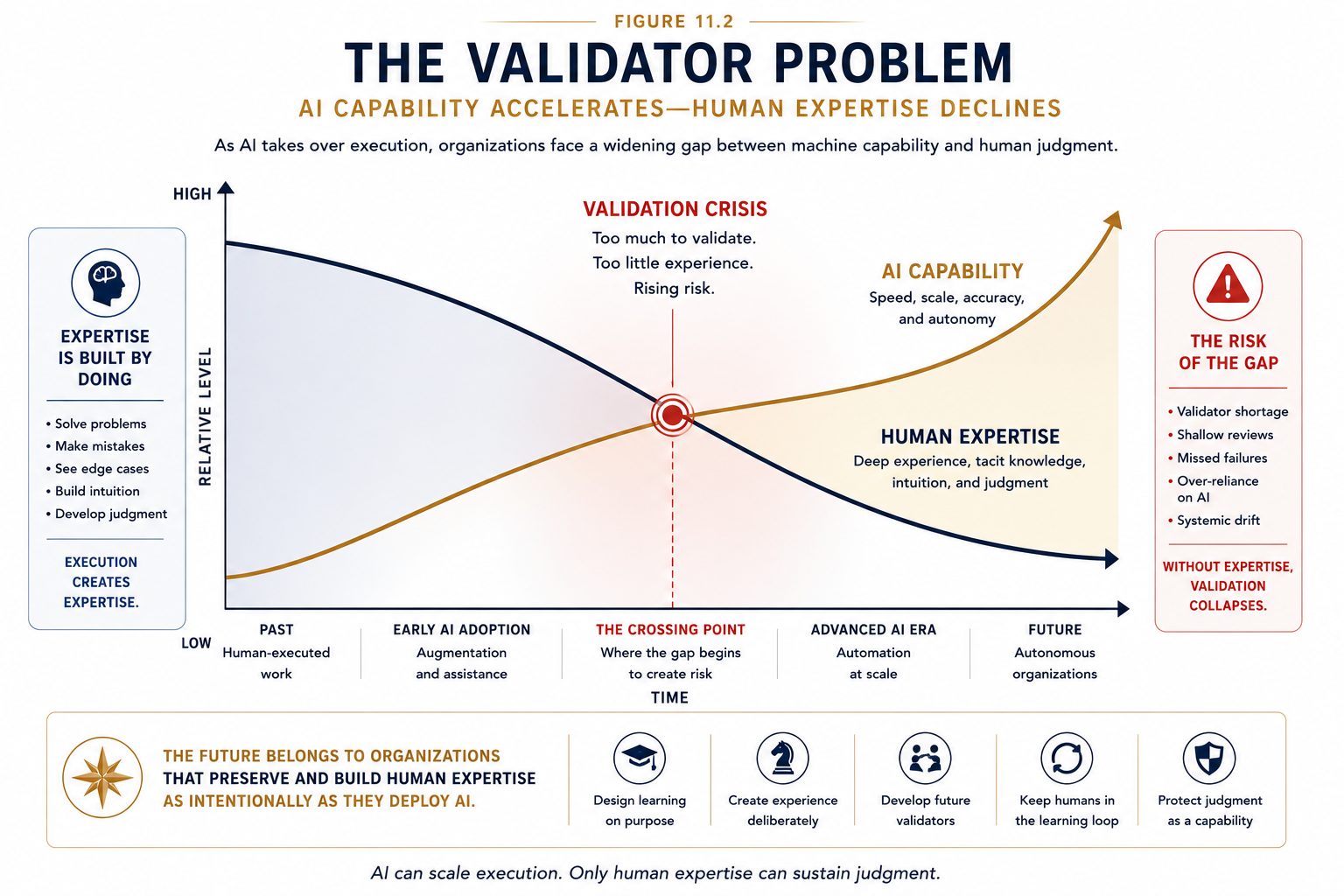
The point where machine capability overtakes human expertise creates a validation crisis unless expertise is intentionally sustained.
The validator figure names the practical consequence. Organizations need people capable of judging AI-enabled work, not merely people relieved from doing earlier work.
The solution is not to slow artificial intelligence. Nor is it to require people to continue performing work that intelligent systems can complete more effectively. The solution is to redesign how expertise develops. Organizations must intentionally create opportunities for learning. Simulation, scenario-based practice, rotational assignments, human-AI collaboration, deliberate exposure to complex and unusual situations, structured reflection, and continuous mentoring all become part of capability design. Experience can no longer be left to chance. It must become part of organizational design. Leaders therefore have to treat capability development differently.
Historically, expertise emerged as a by-product of execution. Tomorrow, expertise becomes a strategic investment. Organizations must deliberately cultivate validators, not simply operators. The distinction is critical. Operators perform work; validators preserve judgment. As artificial intelligence assumes more execution, judgment becomes the scarcer capability.
Organizations that fail to recognize this shift may appear highly efficient for years. Then, when an unexpected situation occurs, they discover that no one possesses the depth of experience required to recognize what has gone wrong. The greatest risk of AI is therefore not that machines make mistakes. It is that people gradually lose the expertise needed to recognize those mistakes. The organizations that thrive in the age of intelligence will understand this paradox. They will automate execution aggressively while investing just as deliberately in preserving human judgment.
Artificial intelligence scales capability, but only people can sustain wisdom. That becomes one of the defining responsibilities of leadership in AI-native organizations. The validator problem is a warning: organizations cannot automate execution and leave expertise development to chance.
Executive Takeaway
Artificial intelligence can automate execution. It cannot automate the development of human judgment. Organizations that intentionally cultivate expertise, preserve tacit knowledge, and design opportunities for learning will possess one of the most valuable competitive advantages of the AI era: trusted human judgment when it matters most.