
The New Competitive Advantage
For a brief period, access to AI can feel like strategy. The organization with the newest model, the best copilots, or the most visible pilots appears to have moved ahead. That advantage is real, but temporary. Transformative technologies rarely remain scarce. Over time, access spreads, costs fall, and capabilities become infrastructure. When that happens, the advantage moves from the technology itself to the organization that can turn common capability into uncommon coherence. Better models and tools may create early advantage, but that advantage is unlikely to remain decisive.
The durable advantage shifts toward the operating model that learns, adapts, governs, and preserves coherence faster than competitors. For the past several years, organizations have competed to adopt artificial intelligence. They have invested in language models, built copilots, automated workflows, experimented with autonomous agents, announced AI strategies, and measured productivity gains. For a time, access to artificial intelligence created competitive advantage. That advantage will not last. History suggests a different pattern. Every transformative technology begins as a differentiator. Eventually it becomes infrastructure. Electricity followed this path. The internet followed this path. Cloud computing followed this path. Artificial intelligence will follow it as well. Models improve. Capabilities spread. Costs decline. Knowledge becomes widely available. Current adoption evidence already hints at this transition.
McKinsey reports that AI use has become widespread across organizations, while enterprise-level financial impact from generative AI remains limited for most respondents. Microsoft describes a similar tension: AI is producing real productivity gains, but organizations must rethink knowledge work itself to keep pace. Together these signals suggest that access is becoming less decisive than the ability to organize around access. Eventually, every organization will have access to remarkably capable intelligent systems. When that happens, competitive advantage will shift once again. The decisive difference will not be who possesses artificial intelligence, but who organizes around it most effectively. Technology becomes available to everyone. Organizational capability does not. That becomes the new competitive advantage.
Figure 13.1 places the AI era inside the longer pattern of advantage shifting whenever scarcity changes, so the reader can see why access to models is unlikely to remain the durable source of advantage.
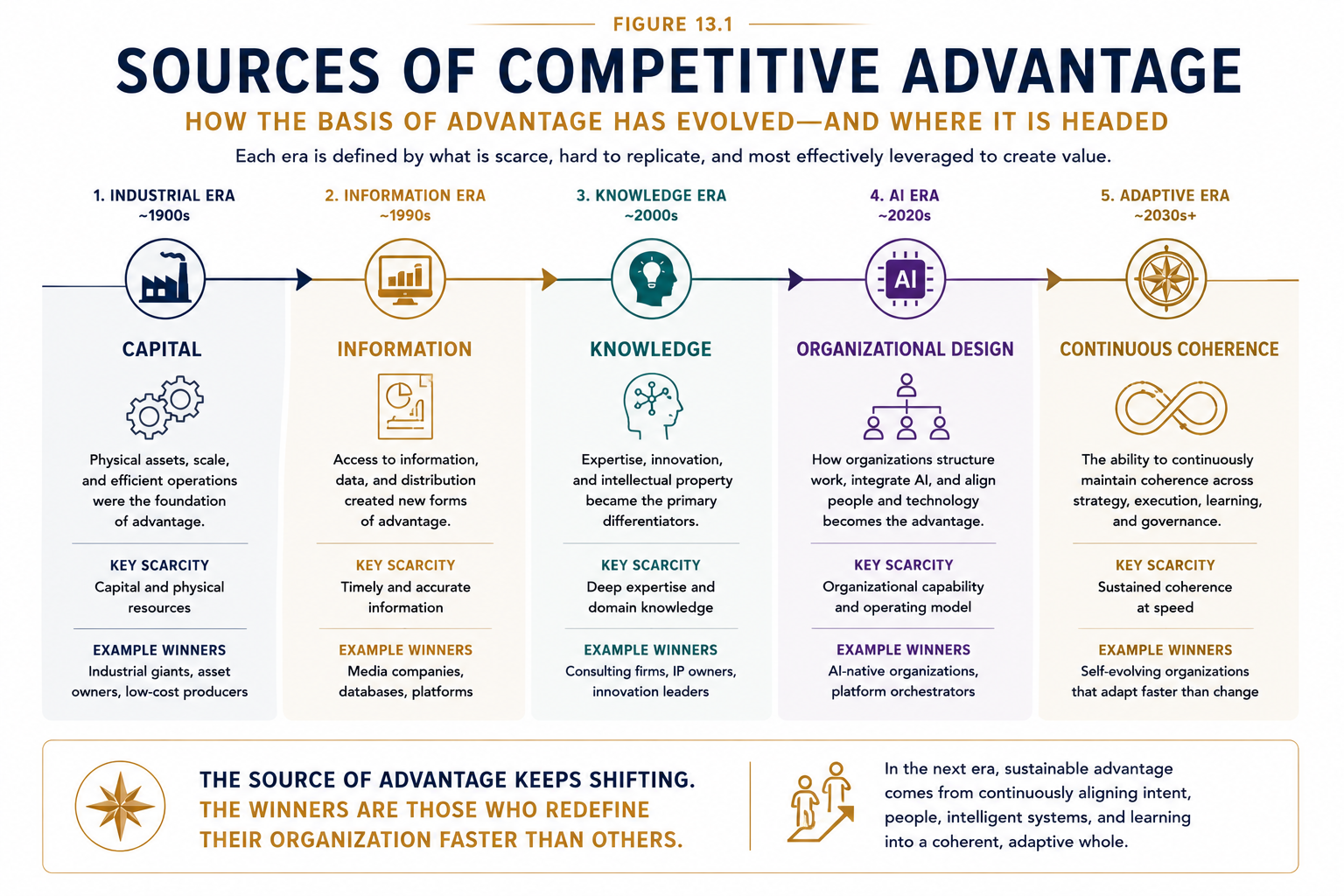
In the AI era, sustainable advantage increasingly comes not from technology itself, but from organizational design and the ability to maintain coherence while continuously adapting.
The figure does not claim that technology stops mattering. It shows that when technology diffuses, the scarce capability shifts toward organizational learning, coherence, and the capacity to organize intelligence effectively.
Every era has been defined by a different scarce resource. The Industrial Era rewarded capital: factories, physical assets, scale, and ownership of production. Organizations that controlled these resources dominated their industries. The Information Era shifted advantage toward information: data, communication, and distribution. Access to information became increasingly valuable. The Knowledge Era rewarded expertise: innovation, intellectual property, and specialized knowledge. Organizations competed by knowing more than their competitors. Artificial intelligence changes this pattern once again. Knowledge itself becomes increasingly abundant. Information becomes instantly accessible. Analysis becomes inexpensive. Execution becomes continuous. The scarce resource changes.
It is no longer intelligence alone. It is the ability to organize intelligence effectively. This represents a profound shift in executive thinking. Technology no longer determines advantage by itself. Organizational architecture does.
The organizations that outperform will not necessarily possess the most capable models. They will possess the operating models that integrate people, intelligent systems, governance, and learning more effectively than others. This creates five important shifts in competitive advantage. The first is a shift from technology to organization. Technology increasingly becomes available to everyone. Organizational capability remains difficult to replicate. The second is a shift from efficiency to adaptability. Efficiency improves existing systems. Adaptability enables organizations to evolve as environments change. The third is a shift from information to learning. Information becomes abundant.
Learning becomes the scarce capability. Organizations that learn faster improve faster. The fourth is a shift from execution to coherence. Execution increasingly becomes automated.
The challenge becomes ensuring that strategy, decisions, execution, governance, and learning continue moving together as one integrated system. Organizations that preserve this coherence while continuously adapting become extraordinarily resilient. The fifth shift is from scale to evolution. Historically, the largest organizations often dominated because they could scale more effectively. Tomorrow, organizations will increasingly succeed because they evolve more effectively. The fastest learner becomes the strongest competitor. The most adaptive organization becomes the market leader.
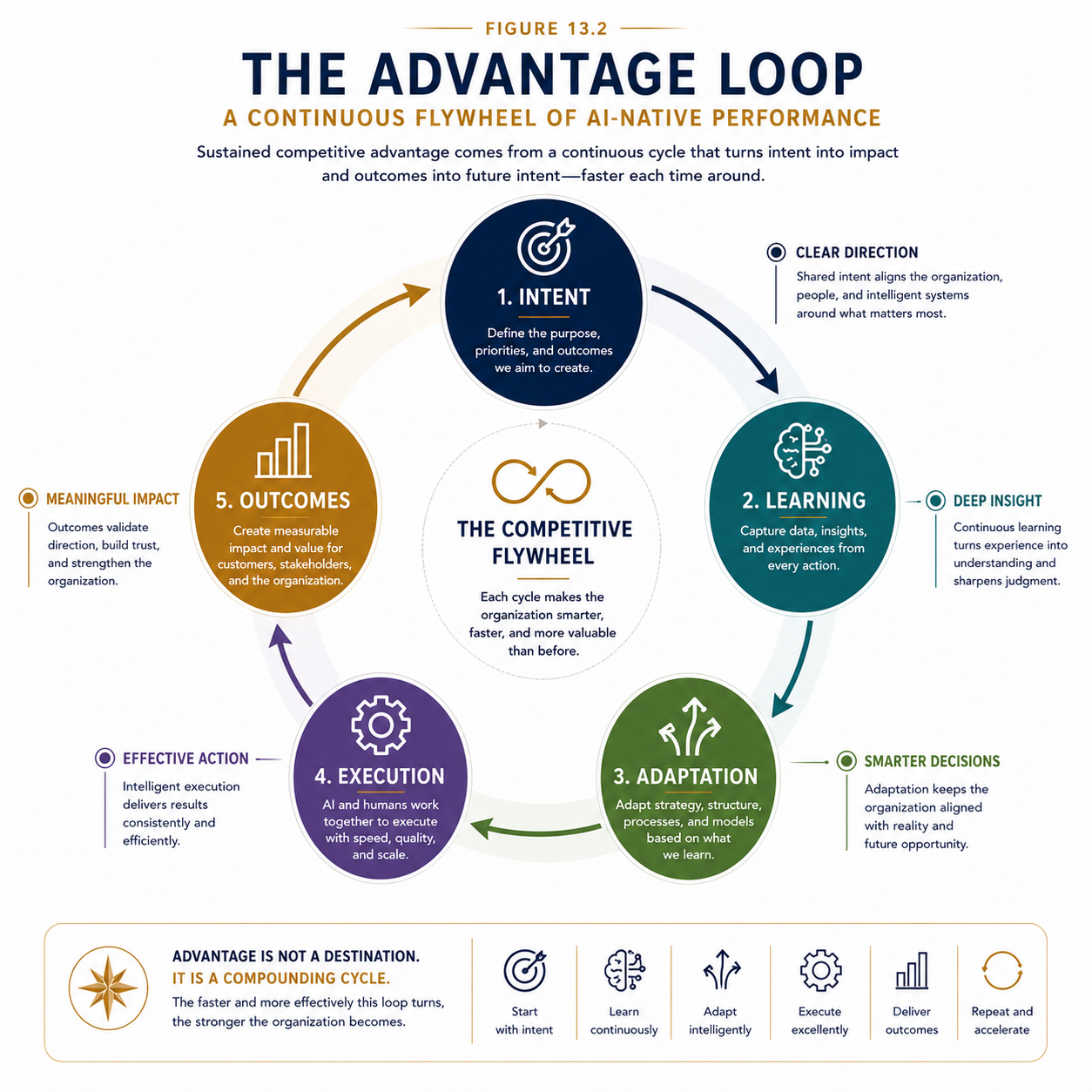
It emerges through a continuous cycle in which intent guides execution, execution generates learning, learning drives adaptation, and adaptation continuously strengthens future outcomes.
The advantage loop is cumulative. It does not present adaptation as a one-time program; it explains why the same technology can produce different outcomes in organizations with different learning and alignment capacity.
Strategy begins to change as well. Traditionally, organizations created strategy periodically, executed it, reviewed it, and then updated it. Artificial intelligence compresses this cycle. Intent becomes continuous. Execution becomes continuous. Learning becomes continuous. Adaptation becomes continuous. Competitive advantage compounds through repetition. Organizations improve because every cycle strengthens the next. This creates an organizational flywheel. Clear intent guides action. Execution generates outcomes. Outcomes generate insight. Insight drives learning. Learning shapes adaptation. Adaptation strengthens future intent. Each complete cycle increases organizational capability, not through isolated projects, but through continuous evolution.
This also explains why some organizations will improve rapidly while others struggle despite using the same technology. Technology is rarely the limiting factor; leadership, organizational design, learning capability, governance, culture, and purpose often are. Artificial intelligence amplifies all of them. If these capabilities are weak, AI accelerates confusion. If they are strong, AI accelerates excellence. Technology therefore becomes a multiplier rather than the source of advantage itself. This insight fundamentally changes how organizations should invest. The greatest return no longer comes solely from acquiring better technology.
It comes from strengthening the organization's ability to continuously learn, adapt, align, and evolve. The strongest organizations of the coming decade will therefore not be those that automate the most work. They will be those that redesign themselves most effectively around intelligent systems while preserving clarity of purpose and organizational coherence. Competitive advantage is no longer something organizations possess. It becomes something they continuously create.
That may be the defining strategic insight of the AI era. The new competitive advantage is not possession. It is the disciplined capacity to evolve faster while staying aligned.
Executive Takeaway
Artificial intelligence will become widely available. Sustainable competitive advantage will belong to organizations that continuously align intent, people, intelligent systems, governance, execution, and learning into an adaptive operating model capable of evolving faster than its environment.