Rebuilding Around AI
Most AI programs begin in the wrong place. They begin with tools, vendors, use cases, pilots, and productivity targets. These decisions matter, but they do not answer the larger design question. If the operating system is changing, leaders must ask how the organization itself should be rebuilt. Which structures still serve a purpose? Which workflows exist only because older constraints required them? Which forms of governance must be designed before execution accelerates? Software selection and use cases are necessary but insufficient. The redesign must begin with organizational architecture: intent, governance, work, people, systems, and learning.
Most AI transformation programs begin with technology. They evaluate models, purchase software, deploy copilots, automate workflows, and measure productivity.
These initiatives often deliver meaningful improvements. Yet many organizations eventually discover that something fundamental has not changed: the organization itself. Artificial intelligence has been introduced; the operating model has not. This explains why so many AI initiatives produce impressive demonstrations but modest organizational transformation. Technology improves the existing system. The system itself remains largely unchanged. Successful AI-native organizations begin somewhere else. They redesign the organization first. Technology follows. This is the difference between AI adoption and organizational transformation. One improves execution. The other redefines how the organization creates value.
Rebuilding around AI therefore begins not with software selection, but with organizational design. Instead of asking only, "Where can we use AI?" leaders have to ask, "How should the organization operate now that intelligence has become abundant?" Answering that question requires a different set of design principles. Survey evidence is beginning to point in the same direction. McKinsey reports that AI use is spreading across business functions, yet most respondents still do not see material enterprise-level EBIT impact from generative AI. The same research points to workflow redesign and stronger scaling practices as important attributes of value capture.
The lesson is cautious but important: adding AI is not the same as rewiring the organization around it.
Principle One: Design Around Intent
Every transformation begins with clarity. Organizations have traditionally organized work around functions, departments, applications, and processes.
AI-native organizations begin with intent. What outcome should be created? What value should the organization deliver? What purpose should guide every decision? Intent becomes the organizing principle. Structures, technology, and execution align around that shared direction. Without clear intent, intelligent systems simply optimize disconnected activities. With clear intent, they amplify meaningful outcomes.
Principle Two: Redesign Work, Not Workflows
Many organizations attempt to automate existing workflows. A better question is whether those workflows should exist at all. Workflows emerged because people required structured coordination. Artificial intelligence removes many of those constraints.
Instead of asking how to automate every step, leaders ask how value should flow continuously from intention to outcome. Some processes disappear entirely. Others become dramatically simpler. The objective is not faster workflows; it is better organizational flow.
Principle Three: Compress Organizational Distance
Every approval, handoff, reporting layer, and unnecessary meeting introduces organizational distance. Distance slows learning, delays decisions, and weakens alignment. Artificial intelligence enables organizations to dramatically reduce this distance. Information reaches decision-makers sooner. Execution begins faster. Feedback returns immediately. Organizations become more responsive because the distance between intent and action continues to shrink. Figure 12.1 shows why these principles must operate as a cycle rather than as isolated initiatives.
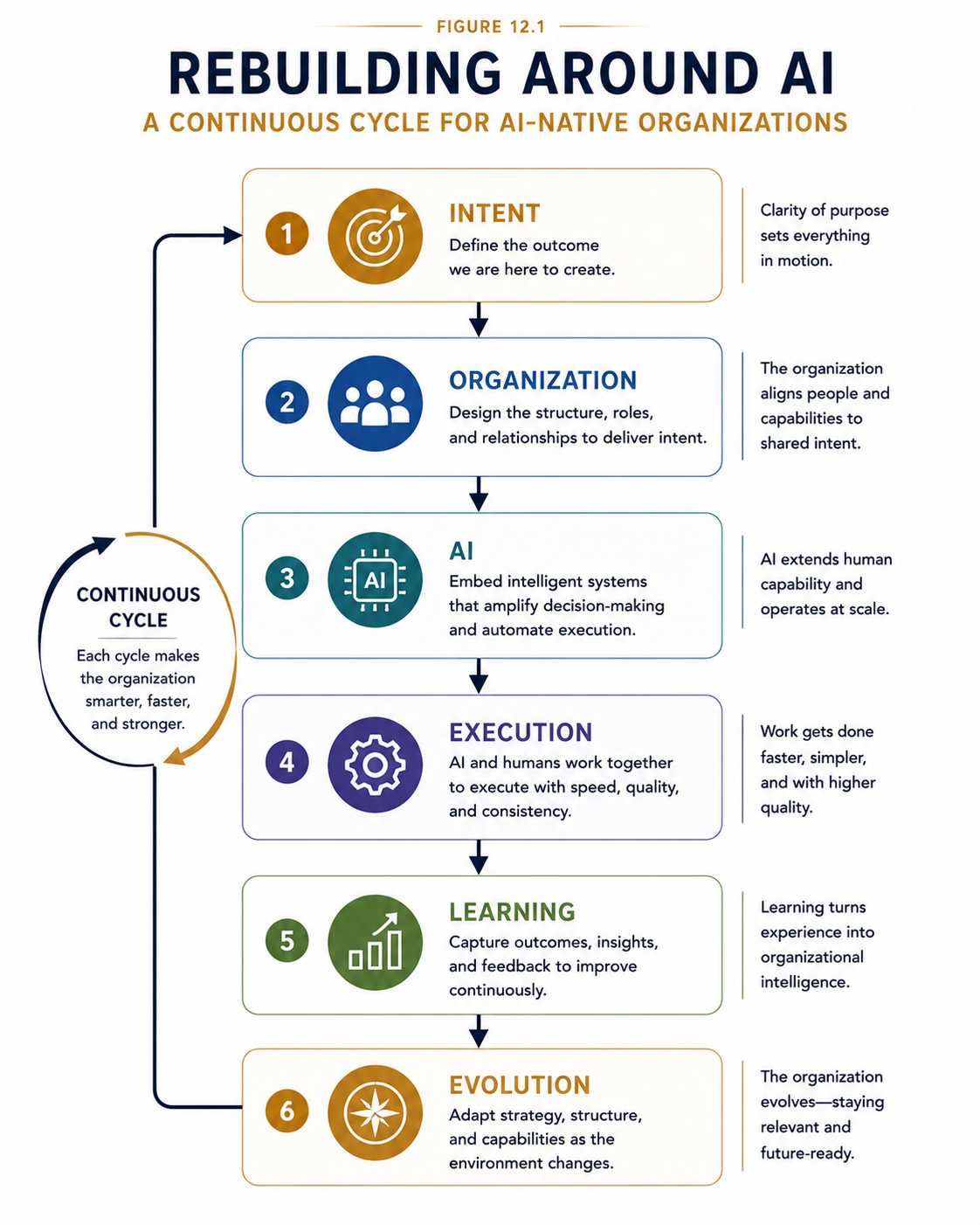
Intent shapes organizational design, intelligent systems amplify execution, learning generates new insight, and continuous evolution strengthens future organizational capability.
This framework is a redesign map. It does not claim that technology work disappears; it shows why technology creates value only when intent, organizational design, execution, learning, and evolution reinforce one another.
Principle Four: Design for Human Advantage
Artificial intelligence should not replace people. It should elevate them. Organizations increasingly redesign work so that people focus on uniquely human contributions: intent, judgment, relationships, creativity, ethics, and continuous learning. Technology performs what scales well. People perform what gives work meaning. The objective is not human efficiency; it is human impact.
Principle Five: Build Adaptive Governance
Governance cannot remain dependent upon periodic reviews. Organizations increasingly require continuous visibility, transparent execution, adaptive guardrails, and rapid learning. Control shifts from supervising activities to preserving alignment with organizational intent, so governance becomes embedded within the operating system itself rather than added afterward.
Principle Six: Design for Continuous Evolution
Perhaps the greatest mistake organizations make is assuming transformation has an end. It does not. Artificial intelligence evolves continuously. Markets evolve continuously. Customer expectations evolve continuously. Organizations must therefore become capable of redesigning themselves continuously. Transformation becomes a permanent organizational capability rather than a temporary initiative.
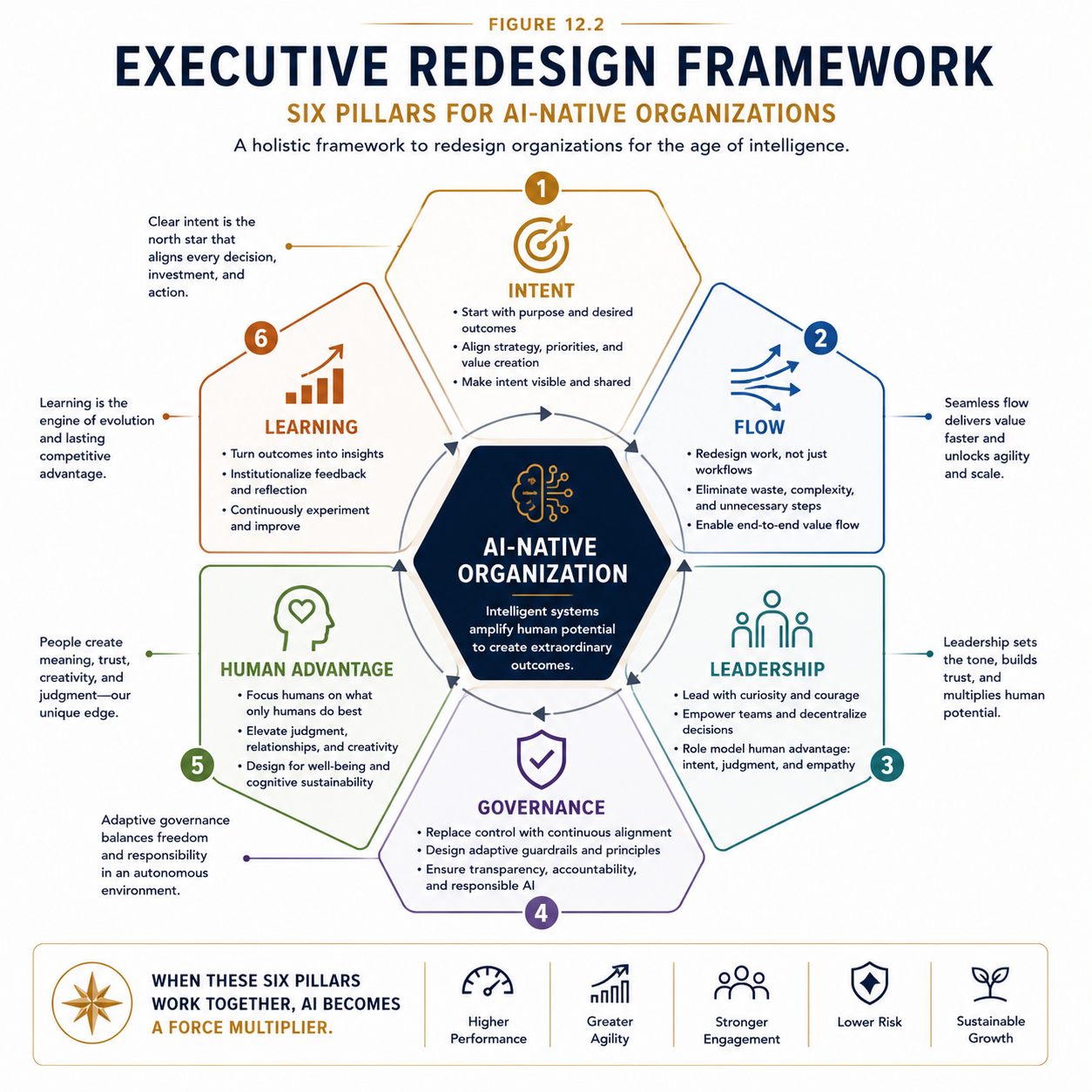
Together these create an adaptive operating system capable of continuous evolution.
The executive framework converts the design principles into a leadership sequence. It helps leaders decide where redesign begins and how the pieces reinforce one another.
These six principles reinforce one another. Intent provides direction. Flow removes unnecessary complexity. Leadership creates shared purpose. Governance preserves alignment. Human advantage strengthens uniquely human capabilities. Learning continuously improves the entire system. None of these principles succeed independently. Together they create an organization capable of adapting faster than its environment changes. This also changes the role of executives. Transformation is no longer primarily about selecting technologies. It is about designing systems. Leaders become architects rather than administrators. They shape environments where people and intelligent systems continuously improve one another. Technology becomes an amplifier.
Organizational design becomes the multiplier. The organizations that succeed will therefore not be those with the largest AI budgets or those deploying the greatest number of models. They will be those that redesign themselves most effectively around intelligence. The distinction is consequential. Technology can often be purchased, but organizational capability must be built. It develops through leadership, culture, governance, learning, purpose, and thoughtful design. Artificial intelligence accelerates this process. It does not replace it. The operating system shift therefore is not complete when AI has been deployed. It begins when organizations redesign themselves around what AI makes possible. Organizations that merely deploy AI will improve. Organizations that rebuild around AI will redefine their industries. Rebuilding around AI is not a technology roadmap; it is a leadership commitment to redesign the conditions under which technology becomes value.
Executive Takeaway
AI transformation is not a technology program. It is an organizational redesign program. Leaders who begin with software improve yesterday's organization. Leaders who begin with organizational architecture build tomorrow's organization.