The Productivity Trap
A productivity gain is seductive because it is visible. The report arrives faster. The service interaction takes less time. The code appears in minutes. Executives can measure the improvement, announce progress, and justify investment. But the deeper question is more uncomfortable: what if the organization becomes better at doing work that should eventually be redesigned away? AI can make yesterday's operating model faster. That does not mean it has made the organization ready for tomorrow.
More output and shorter cycle times can look like transformation, but productivity improves the existing operating system while transformation questions why that system exists. Every major technological revolution begins with efficiency. Machines produced more than human labor. Computers processed information faster than paper.
The internet accelerated communication. Artificial intelligence is doing the same. Tasks that once required hours now take minutes. Reports are generated instantly. Code is written faster. Customer interactions become increasingly automated. Across every industry, organizations are experiencing measurable improvements in productivity. On the surface, this looks like transformation. In practice, it rarely is. Klarna's 2024 announcement about its AI customer-service assistant illustrates the attraction of this moment.
The company reported that, in its first month, the assistant handled two-thirds of customer-service chats, completed work it described as equivalent to 700 full-time agents, reduced repeat inquiries, and shortened average resolution time. Those are meaningful functional productivity claims, and they should not be dismissed.
But even if every reported metric is accepted exactly as stated, the example still proves only a narrower point: AI can dramatically improve a defined service operation. It does not by itself prove that the whole enterprise has redesigned its operating system, because productivity improves execution; it does not change the operating system. Most organizations approach AI with a familiar question: How can we work faster? How can we automate more tasks? Reduce effort? Increase output? These are logical questions. They are also limiting.
They assume that the underlying operating system is fundamentally correct, and that the objective is simply to improve performance within it. That assumption no longer holds. Artificial intelligence does not simply improve organizations. It amplifies them.
Well-designed organizations become dramatically more effective. Poorly designed organizations become dramatically more complex. The technology rarely creates new organizational behavior. It accelerates the behavior that already exists. This is where the productivity trap begins. Organizations optimize individual tasks. They automate workflows. They improve routing. They reduce cycle times. Each improvement is measurable. Each improvement appears successful. But the operating system remains unchanged. A marketing team produces twice as many campaigns. A software team delivers more features. Finance generates reports in seconds instead of days. Customer service resolves more requests. The work becomes faster.
The organization does not become fundamentally different. The system moves. It does not transform. This is not a failure of artificial intelligence. It is a consequence of perspective. Productivity is visible, and executives can measure it. Dashboards improve. Cycle times shrink. Costs decline. Return on investment appears positive. Transformation is different. Transformation changes how the organization itself operates. It questions assumptions. It redesigns structures. It removes activities that no longer need to exist. Those changes are more difficult to measure. They are also far more valuable. Over time, this distinction becomes critical. The more organizations optimize existing work, the more they reinforce the operating system that created that work in the first place. They become increasingly efficient at operating within a system that is gradually becoming obsolete.
This creates organizational inertia. Every successful optimization strengthens yesterday's assumptions.
The organization becomes better at doing the same work, in the same way, under the same operating model, even as the environment around it fundamentally changes. Artificial intelligence accelerates this process. Instead of exposing outdated structures immediately, it often allows organizations to postpone redesign. The operating system survives a little longer. The underlying problem grows a little larger. This creates another consequence that is often overlooked. Higher productivity rarely reduces complexity. Without redesign, it usually increases it. More reports generate more decisions. More insights generate more meetings. More outputs require more coordination.
More automation often creates more exceptions. Organizations become increasingly productive while simultaneously becoming increasingly difficult to manage. The gains produced by artificial intelligence are gradually absorbed by the operating system itself.
From the outside, this appears to be progress. From the inside, it often feels like acceleration without clarity. Teams work faster. Priorities shift more frequently. Outputs multiply. Yet outcomes improve only incrementally. The gap between activity and impact becomes increasingly visible. This is the moment where a different question must be asked. What if the problem is not how work is performed? What if the work itself reflects assumptions that no longer apply? What if the workflows being optimized exist only because organizations were designed around human coordination?
What if many of those workflows no longer need to exist at all? When the dominant constraint changes, every structure built around that constraint eventually becomes a candidate for redesign. Some disappear, some evolve, and some become entirely unnecessary. Improvement alone cannot answer those questions. Only redesign can. This is why productivity is both valuable and dangerous. It demonstrates that the technology works. It also creates the illusion that the operating system does. That illusion delays transformation. The organization becomes increasingly efficient at preserving structures that should eventually disappear. This is the productivity trap. It does not prevent progress. It postpones reinvention. The future will not belong to the organizations that automate the most tasks.
It will belong to the organizations willing to question why those tasks existed in the first place. Productivity improves the existing operating system. Transformation replaces it. This is the question Figure 2.1 is meant to hold in view. The trap is not productivity itself; it is mistaking local acceleration for structural change.
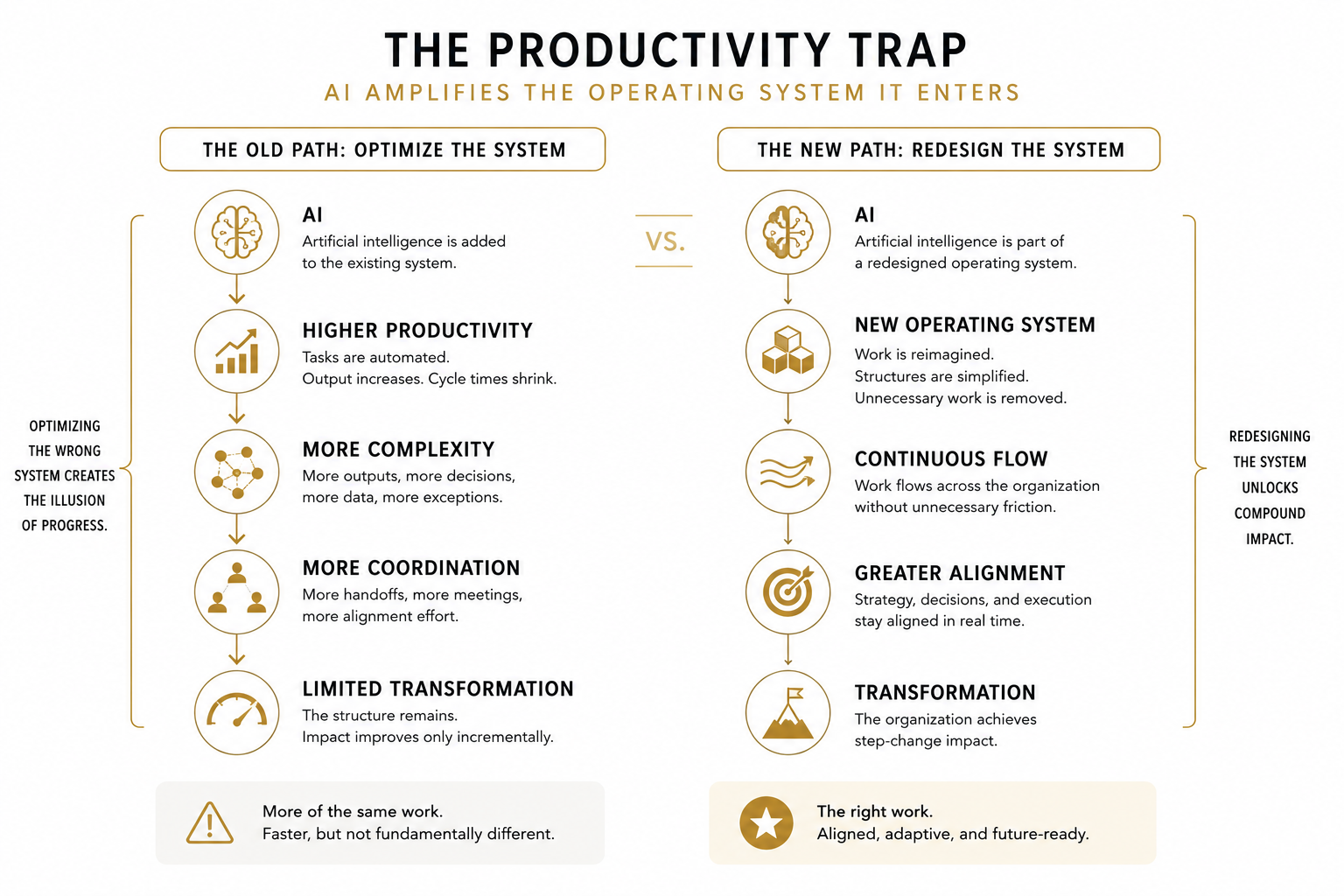
Optimizing the wrong operating system increases efficiency, but not transformation.
The important movement is circular: AI improves tasks, visible productivity confirms the old model, and the organization becomes more committed to the structure that needs redesign. The figure does not argue against productivity; it warns executives not to confuse local acceleration with operating-system change.
Most organizations will choose improvement because it is measurable, predictable, and comfortable. Transformation is different. It requires questioning assumptions that once made perfect sense, redesigning structures that have existed for decades, replacing coordination with flow, replacing process with capability, and replacing optimization with reinvention. The question is no longer how to get more done. It is whether the organization is doing the right work in the right operating system. Organizations rarely fail because they improve too little. They fail because they improve the wrong system. The operating system shift begins the moment leaders recognize the difference.
The trap is not productivity itself. The trap is allowing productivity to become a substitute for redesign.