The System Failure
The most revealing AI failure often begins after the demonstration succeeds. The model summarizes the document. The assistant drafts the plan. The workflow produces the output faster than anyone expected. Then the organization has to decide what the output means, who owns it, whether it should be trusted, and how it becomes action. At that moment, the technology is no longer the limiting factor. The operating system around the technology is.
AI exposes assumptions that were once invisible: that work should move through handoffs, that control should sit in approvals, that execution should be paced by human coordination, and that enterprise software should record what has already happened.
Adoption, training, and better tooling explain only part of the disappointment. The deeper issue is that the dominant constraint has moved from human execution toward organizational understanding, direction, and governance. Every generation of organizations becomes optimized for the constraints of its time. The organizations that thrive are not those that perfect yesterday's operating model. They are the ones that recognize when the fundamental constraint has changed. Artificial intelligence is changing one of the deepest constraints in organizational history. Most organizations adopting AI today will be disappointed.
The problem is not that the technology fails to work; it is that the organization around it does. AI is entering systems that were never designed for it. Workflows assume human coordination. Software assumes structured interaction.
Organizations assume execution is the primary constraint. Those assumptions shaped the modern operating model. Today, they increasingly limit it. This is why the most revealing AI question inside an organization is often not, "Did the tool work?" but "What happened after it worked?" A model can summarize a long document, generate analysis, or draft a plan. The harder test begins when that output has to become an organizational decision, a funded priority, a changed process, or a governed action.
Research on generative AI in real workplaces suggests that productivity gains are real but uneven; they depend on how the work is adopted, used, and recalibrated inside specific organizational contexts. That qualification matters because it tells us the constraint is not only technical capability. It is the operating system that surrounds capability. Every organization has an operating system. It is rarely documented, yet it determines how decisions are made, how work flows, how responsibility is assigned, and how people coordinate. Like the operating system of a computer, it is largely invisible while everything functions as expected.
Most organizations have never consciously redesigned it. Instead, it evolved over decades as a response to a world where people, not systems, were the primary execution engine. For decades, organizations were built around a single constraint: human capability.
People could process only so much information, make only so many decisions, and coordinate only so much work. Organizations operated at human speed, so the system adapted: hierarchy distributed decisions, workflows coordinated activity, approvals reduced risk, checkpoints created control, and dashboards made progress visible. Layer by layer, an organizational operating system emerged. It was not accidental. It was an elegant response to human limitation. For a remarkably long time, it worked, until the constraint began to move. Artificial intelligence does not operate at human speed.
It can process continuously, generate outputs almost instantly, coordinate activity across systems, and increasingly participate in execution itself without waiting for human handoffs. Tasks no longer need to queue. Decisions no longer need to wait.
Work no longer needs to move step by step through predefined paths. When that happens, the system does not simply become faster; it becomes misaligned. The structure, processes, and roles remain, but they are increasingly organized around a constraint that has moved.
Figure 1.1 gives this problem its simplest form. It does not say that human capability has become irrelevant. It shows that the point around which the organization was designed has moved. Once that happens, the old system can keep operating and still become wrong.
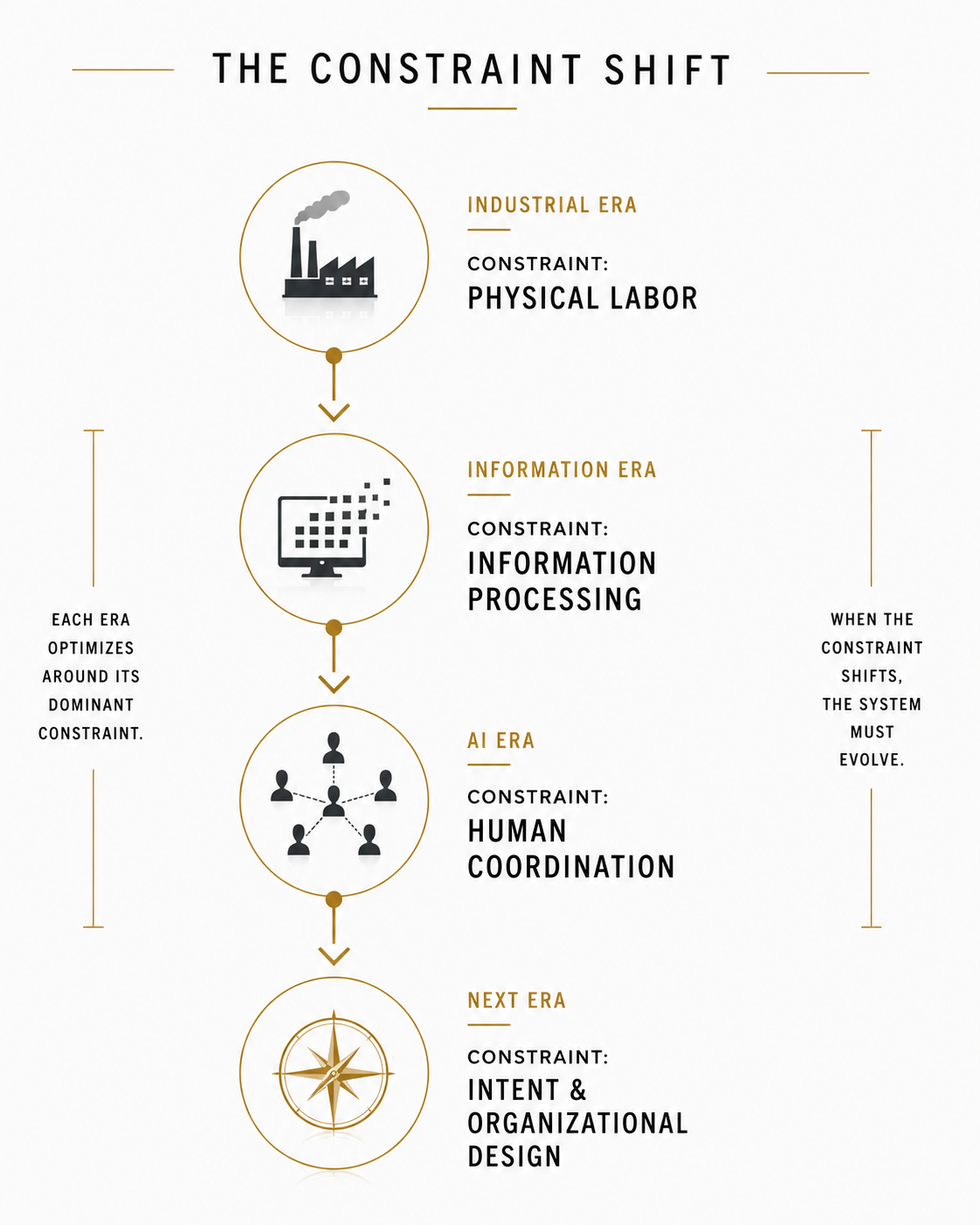
When the constraint changes, the operating system built around it must evolve.
Read this figure as a diagnostic rather than a forecast. It shows why improving the old model can still leave the organization misaligned with the constraint that now matters.
This is why AI often feels powerful in isolation but surprisingly limited in practice. A team generates reports in seconds, yet decisions still take weeks. A customer support function resolves more requests, yet the customer experience changes very little. A product team ships more features, yet strategic direction remains unclear. The work accelerates while the organization itself remains largely unchanged. Most organizations respond by embedding AI into the existing model. They automate individual steps, improve workflows, and accelerate execution. At first, this looks like progress. Output increases. Cycle times shrink. Productivity improves.
These gains are real, but the deeper structure remains untouched. The organization continues to behave as though people are still the primary execution constraint, even as intelligent systems increasingly absorb work that once depended entirely on humans. This creates a hidden mismatch. The old operating system asks: How do we help people execute faster? The emerging operating system asks a fundamentally different question: What should execution become when systems can perform it continuously? These are not the same question. One improves the existing model. The other challenges its foundations. A system built around the wrong constraint does not evolve; it gradually falls out of alignment with reality.
Over time, that misalignment becomes impossible to ignore. Some parts of the organization improve dramatically while others barely change.
Some processes become almost effortless while others grow increasingly complex. Some teams accelerate while others become bottlenecks. The organization begins to feel inconsistent, not because AI is inconsistent, but because the operating system surrounding it is. The constraint did not disappear. It moved. For more than a century, organizations treated execution as the dominant bottleneck. Today, execution is rapidly becoming abundant. The emerging bottleneck is no longer doing the work. It is understanding, directing, and governing systems capable of doing the work. This is the real shift.
Artificial intelligence is not exposing only a technology gap. It is exposing an operating system gap. Most organizations will try to close that gap by improving the old system. They will optimize workflows that no longer need to exist, measure productivity instead of questioning structure, and make the wrong operating system faster. But speed does not fix misalignment. It amplifies it. If the operating system is built for the wrong constraint, improvement becomes a form of delay. The question is no longer how to use AI inside the organization. The question is how the organization itself must change once artificial intelligence becomes part of its operating system.
That is where the operating system shift begins: not with a new tool, another pilot project, or a productivity gain, but with a simple realization. The operating system that shaped the modern organization was built for a different world.
Every organization must eventually decide whether to continue improving that operating system or redesign it for the one that is now emerging. The first move in the operating system shift is therefore diagnostic. Leaders must stop asking only whether AI can improve a task and begin asking whether the system around the task was designed for the world now emerging.