
Building the Organizational Operating System
Leaders should not begin by buying an Organizational Operating System. They should begin by designing the operating relationships that make such a system possible.
The starting point is intent. What is the organization trying to preserve, accomplish, and become? Intent orients relevance. Without intent, knowledge becomes accumulation, attention becomes noise, and AI becomes a generator of plausible priorities.
The second step is governed knowledge. Leaders should ask what the organization must know in order to operate, how knowledge becomes authoritative, how it expires, how it is challenged, how it is projected, and how AI may use it. This is the work of the Organizational Knowledge Kernel.
The third step is authority. Leaders should distinguish capability, permission, recommendation, judgment, decision, authorization, execution, and accountability. They should decide which actions can be delegated, which require human judgment, which require collective authority, and which require constitutional review.
The fourth step is executive operation. Leaders should design the moments in which organizational state becomes executive attention and executive attention becomes authorized action. The Executive Operating Experience is not only a user experience problem. It is a governance, memory, evidence, and learning problem.
The fifth step is learning. Execution should return evidence. Evidence should revise knowledge. Learning should update memory, representation, routines, and sometimes intent. Adaptation should be visible enough to preserve correspondence and disciplined enough to avoid drift.
The sequence is deliberately modest. It does not require leaders to rebuild the organization all at once. It asks them to start where coherence matters most: the decisions, commitments, delegations, projections, and learning loops where ambiguity is most expensive.
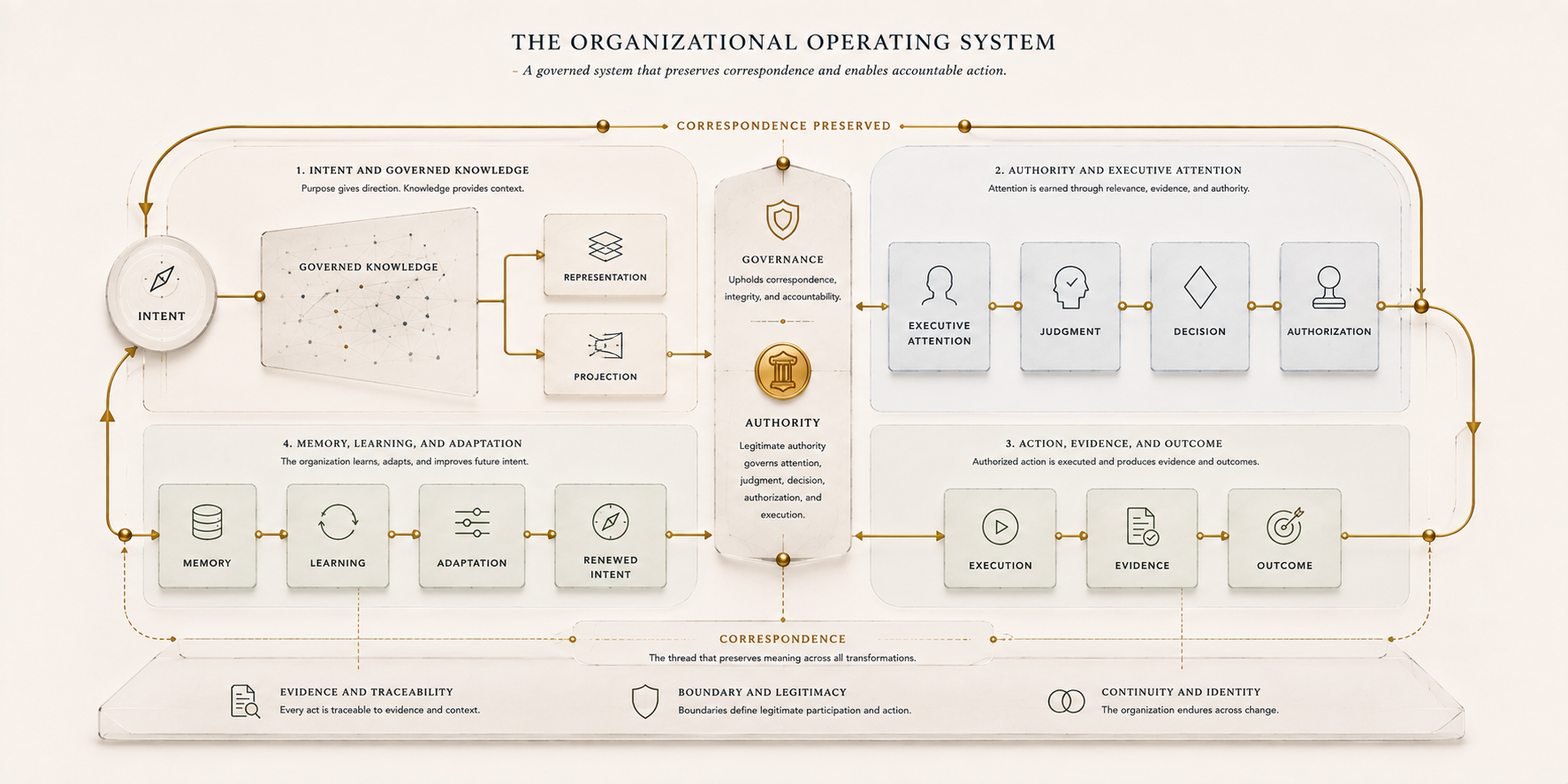
It is the book's synthesis: the organization operating as a governed, learning system.
This is not a checklist for a transformation program. It is an architecture of responsibility. Different organizations will build different technologies, governance forums, knowledge structures, executive rituals, and AI capabilities. What they cannot avoid is the operating question: how will intent, knowledge, authority, action, evidence, memory, and learning remain connected as intelligence becomes distributed?
The organizations that answer this question well will not merely move faster. They will understand themselves better while moving. They will know what they are authorizing. They will see what changed. They will learn from what happened. They will adapt without losing their identity.
That is the work of the Organizational Operating System.