
Failure, Drift, and Repair
A real operating system must be able to fail visibly. If failure cannot be detected, interpreted, contained, and repaired, the organization does not have an operating system. It has a set of hopeful arrangements.
AI-native organizations face distinctive failure modes. Projection error occurs when a situated view no longer corresponds to governed source knowledge. Stale memory occurs when old knowledge is retrieved as if it were current. Authority diffusion occurs when action proceeds through technical permission without legitimate decision rights. False assurance occurs when fluent AI synthesis hides uncertainty or dissent. Execution drift occurs when authorized intent changes shape as it moves through work. Learning failure occurs when outcomes return but do not revise knowledge.
These failures are familiar in executive life even when the names are new. A leader discovers that two teams acted on different versions of the same priority. A system escalates an issue without showing that the underlying evidence is stale. A confident summary omits the dissent that should have changed the decision. A delegated action succeeds technically while exceeding the authority that made it legitimate.
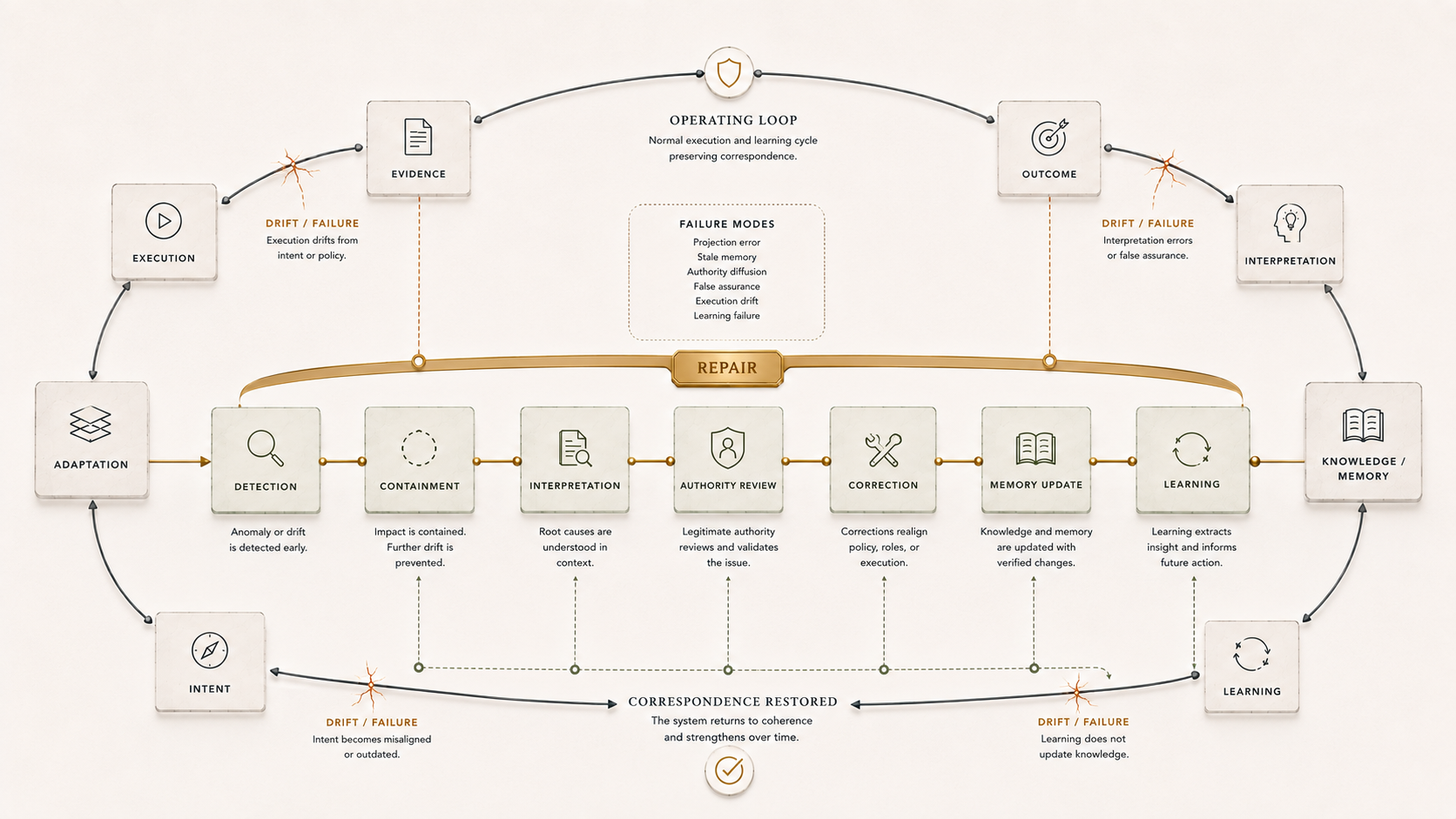
The figure reframes failure as an operating signal, not merely a defect.
Failure is not the opposite of an Organizational Operating System. Unmanaged failure is. A coherent operating system assumes that representations will age, evidence will conflict, AI outputs will require challenge, authority will need clarification, and execution will produce surprises. It therefore designs repair into operation.
Repair requires more than error correction. It requires preserving the relationship between what failed and what the organization should now learn. If an AI-generated projection misled a decision, the issue is not only the projection. The organization must ask whether the source knowledge was stale, whether confidence was overstated, whether authority was unclear, whether dissent was hidden, whether the executive episode failed to inspect evidence, and whether execution produced signals that were ignored.
The point of repair is not blame avoidance. It is continuity. Repair allows the organization to change without pretending nothing happened and without overcorrecting into fear. It is how the operating system preserves correspondence under stress.
Once failure and repair are visible, the final question becomes practical: how should leaders begin building the Organizational Operating System without mistaking the work for another technology program?