
The AI-Native Operating Problem
An AI-native organization is not an organization run by AI. It is an organization in which AI participates materially in interpretation, coordination, recommendation, execution support, monitoring, or learning. The word native marks an operating condition, not a maturity badge. AI has become part of how the organization understands itself and continues itself.
This changes the operating problem. In earlier digital organizations, software often recorded, routed, calculated, or displayed. In AI-native organizations, systems can summarize conflicting material, propose interpretations, prioritize issues, compare options, generate plans, draft commitments, trigger workflows, and preserve traces. These capabilities are powerful, but they also blur boundaries that organizations must keep clear.
Observation is not inference. Inference is not recommendation. Recommendation is not judgment. Judgment is not decision. Decision is not authorization. Authorization is not execution. Execution is not evidence. Evidence is not learning. AI can participate in many of these transitions, but it cannot be allowed to collapse them.
The central AI-native operating problem is that intelligence becomes distributed while authority must remain legitimate. AI may help the organization see, compare, explain, and act, but it does not become the source of organizational responsibility. The organization must preserve who or what is authorized, on what basis, within what scope, under what evidence, with what contestability, and with what memory effect.
Imagine an AI system that reviews market signals and recommends accelerating a product launch. The recommendation may be useful. It may even be right. Still, the organization has to know whether the evidence is current, whether the recommendation conflicts with existing commitments, who can accept the risk, what tradeoffs are being made, and what will be remembered if the launch succeeds or fails. The intelligence of the recommendation does not remove the need for governed action.
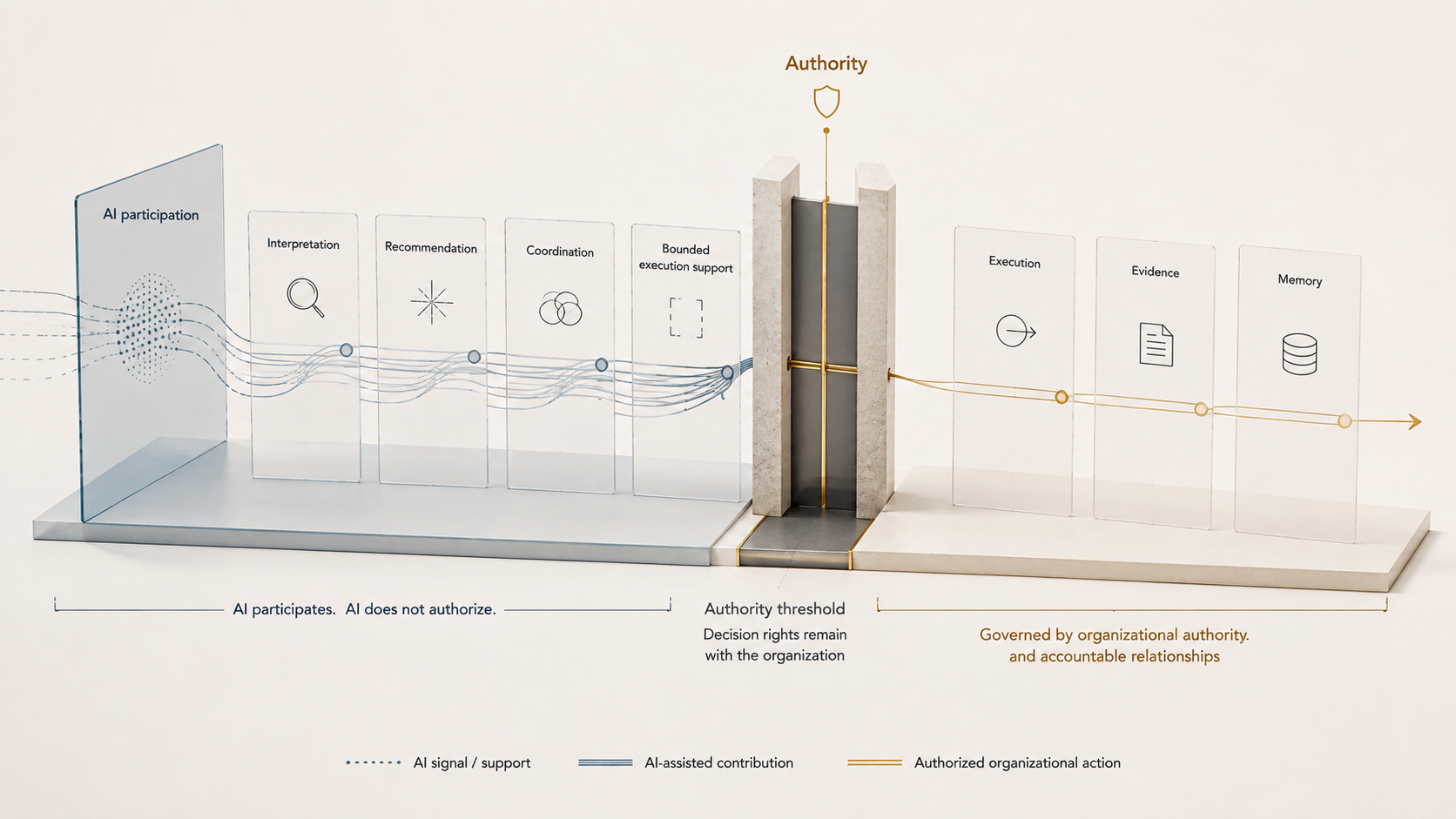
The visual point is not to keep AI outside the organization. It is to keep participation and authority distinct.
The implication is not fear of AI autonomy. The implication is design. Organizations need an operating layer capable of absorbing AI participation without losing the distinctions that make action legitimate. They need knowledge that remains grounded as AI transforms it. They need authority that remains visible as work accelerates. They need executive experiences that preserve evidence and uncertainty rather than hiding them behind fluent synthesis. They need memory that captures rationale and outcomes rather than merely accumulating transcripts.
AI-native operation begins with a knowledge problem. Before an organization can act coherently, it must know coherently.