The Operating System Is Not the Stack
The phrase operating system invites a technical misunderstanding. Executives may hear it and think of platforms, integrations, data layers, applications, or enterprise software. Those are parts of the environment in which an organization operates. They are not the Organizational Operating System.
A technology stack can store records, move data, connect applications, automate workflows, and expose interfaces. It can support the operating system, but it cannot by itself define organizational intent, determine legitimacy, preserve accountability, distinguish recommendation from decision, or decide what should become organizational memory. The stack can enforce a permission. It cannot make that permission authoritative unless the organization has constituted the authority behind it.
That is the difference between integration and operation. An integrated stack can move a customer escalation from support to product to engineering. An operating system can preserve why the escalation matters, what commitment it affects, who can change the commitment, what evidence is sufficient, and how the outcome should revise future work.
In practical terms, the Organizational Operating System keeps intent, knowledge, authority, decision, execution, evidence, memory, and learning connected. It is supported by technology, but it is not reducible to technology. It is enacted by people, AI agents, software systems, routines, governance forums, representations, and records, but it is not any one of them. It is the pattern of legitimate operation across them.
The Organizational Runtime is the same idea seen in motion. It is the organization actually operating: people making judgments, AI agents preparing or executing bounded tasks, systems preserving records, routines carrying work forward, governance mechanisms qualifying action, and evidence returning from what happened. The runtime is where the operating system is tested. If the operating layer is weak, the runtime exposes it through stale context, unclear authority, untraceable decisions, and learning that never reaches the next cycle.
This distinction matters because many AI strategies begin in the stack. They ask which model to use, which agent framework to adopt, which workflow to automate, which dashboard to improve, or which repository to connect. The questions are necessary, but they are secondary. If the organization has not defined how knowledge becomes authoritative, how decisions become executable, how execution returns as evidence, and how evidence becomes learning, a better stack merely accelerates ambiguity.
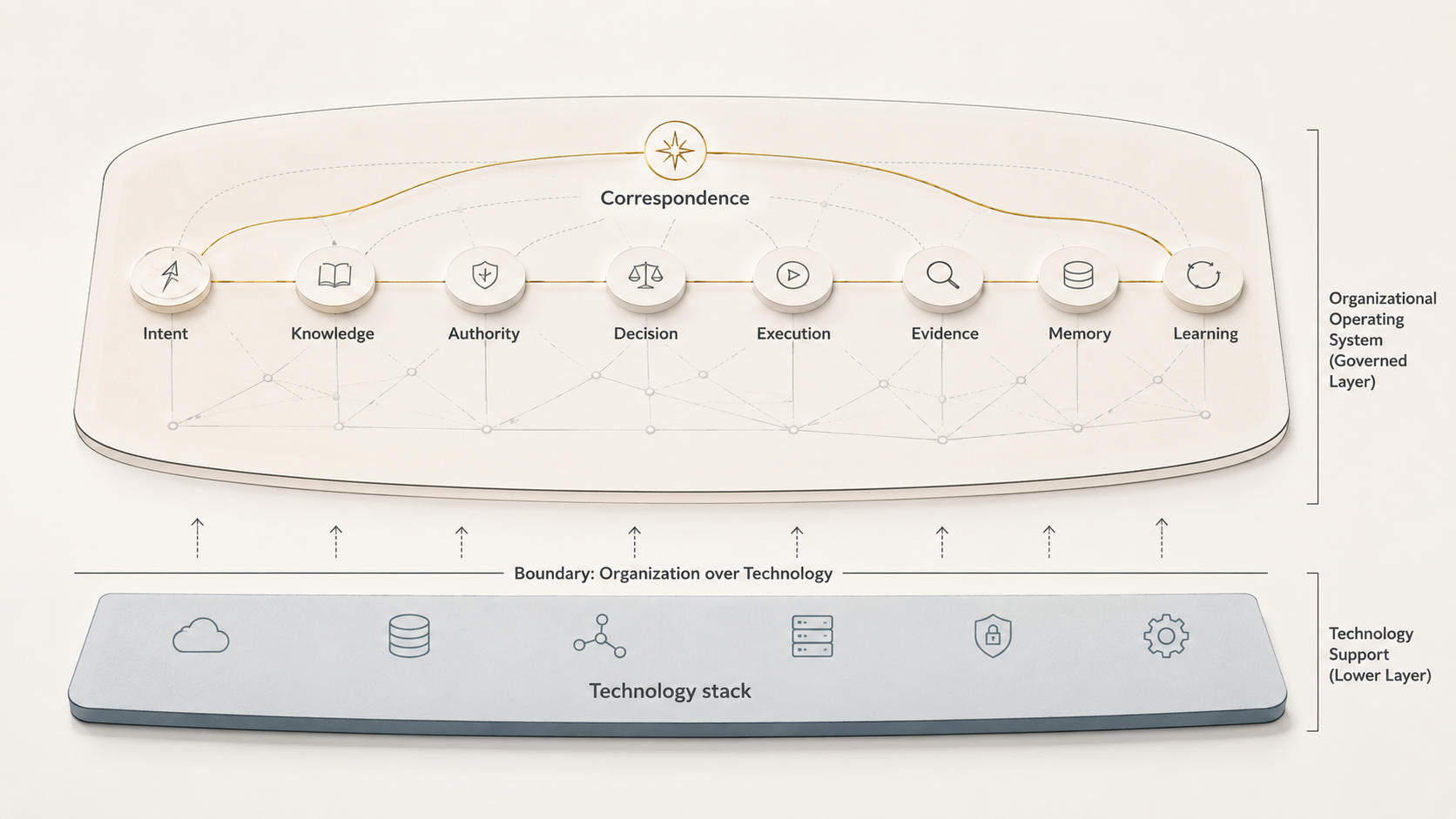
The stack contains tools, platforms, data stores, applications, AI services, and workflow systems. The operating layer contains intent, governed knowledge, authority, decision, execution, evidence, memory, learning, and correspondence.
The Organizational Operating System therefore changes the executive question. The question is not "What technology will run the organization?" The question is "What governed relationships allow the organization to operate coherently through technology, people, AI, and time?"
This is also why the operating system cannot be purchased as a product category. It must be designed as an organizational capability. It may be expressed through software, but it is constituted through governance, authority, representation, and learning. It is the difference between installing more capability and redesigning the conditions under which capability becomes coherent action.
That difference becomes urgent in AI-native organizations, because AI does not merely add another tool. It participates in the production and transformation of organizational meaning.